Wall Street sinks as Trump threatens fresh tariffs on China
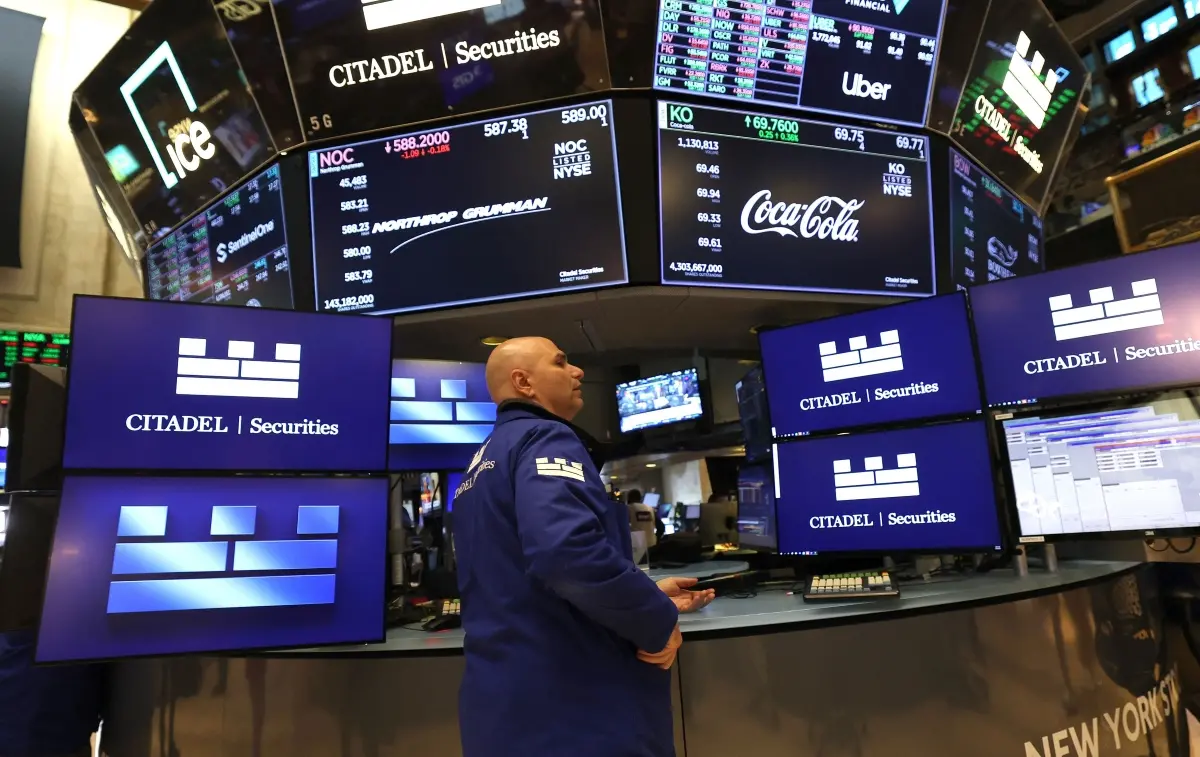
New York: US stock markets fell on Friday after Donald Trump threatened a “massive increase of tariffs” on Chinese imports, unsettling investors and ending weeks of relative calm on Wall Street.
The S&P 500 slipped 1.2%, heading for its worst loss since 1 August, while the Dow Jones Industrial Average dropped 372 points, or 0.8%. The Nasdaq composite slid 1.7% as technology shares led the decline.
Markets were steady earlier in the session until Trump posted on his social media platform Truth Social, criticising China’s export restrictions on rare earth materials essential to electronics and aerospace manufacturing. He said there was “no reason” to meet Chinese President Xi Jinping during his planned visit to South Korea.
The renewed trade tension triggered broad declines across the market, with nearly three-quarters of S&P 500 stocks falling. Levi Strauss was among the worst performers, plunging 12.3% despite posting stronger-than-expected quarterly profits. Analysts attributed the fall to investor caution following a 42% surge in the stock this year.
The broader market, which has risen about 35% since April, is now facing questions over stretched valuations, particularly in the artificial intelligence sector. Analysts warned that stock prices have outpaced profit growth, leaving the market vulnerable to corrections.
Oil prices also declined sharply as a ceasefire between Israel and Hamas raised hopes of reduced tensions in the Middle East. US benchmark crude fell 3.6% to $59.27 a barrel, while Brent crude dropped 3.3% to $63.08.
In the bond market, the yield on the 10-year US Treasury fell to 4.06% from 4.14% the previous day, reflecting investor moves towards safer assets.
Meanwhile, a University of Michigan report showed US consumer sentiment remained subdued, with inflation concerns and job insecurity still weighing on households. The survey’s one-year inflation expectation eased slightly to 4.6% from 4.7%, offering modest reassurance to the Federal Reserve as it weighs further rate cuts.
Global markets mirrored the unease, with Hong Kong’s Hang Seng index down 1.7% and Japan’s Nikkei 225 slipping 1%. South Korea’s Kospi, however, rebounded 1.7% after reopening following a public holiday.
The sell-off marked a sharp reversal in investor sentiment, underscoring Wall Street’s sensitivity to geopolitical and trade risks even amid expectations of monetary easing by the Fed.
Trump’s Truth Social post said he was considering “a massive increase of tariffs” on Chinese imports, citing anger over Beijing’s export restrictions on rare earth elements. These materials are crucial for producing consumer electronics, electric vehicles, and defence technology.
His statement also suggested he may skip a meeting with Chinese President Xi Jinping during an upcoming visit to South Korea, fuelling uncertainty about US-China relations.
The announcement triggered broad declines, with around 75% of S&P 500 stocks trading lower. Levi Strauss tumbled 12.3% despite positive earnings, as analysts cited profit-taking after a strong year-to-date performance.
Oil prices also fell sharply following the announcement of a ceasefire between Israel and Hamas, which investors saw as reducing the risk of supply disruptions. Brent crude slipped to $63.08 per barrel, while US benchmark crude dropped to $59.27.
The yield on the 10-year Treasury note declined to 4.06% as investors sought safer assets amid market turbulence.
A University of Michigan consumer sentiment report showed that inflation and job market concerns persist, with only a slight decline in short-term inflation expectations to 4.6%.
Global markets were mostly lower, with Hong Kong’s Hang Seng down 1.7% and Japan’s Nikkei 225 down 1%. South Korea’s Kospi rose 1.7% after trading resumed following a national holiday.
Economists noted that the renewed trade threats could complicate the Federal Reserve’s policy path as it attempts to support growth while controlling inflation.
(With AP inputs)