Who really pays the 0.4% MDR fee? What the new UPI rules mean for buyers and retailers
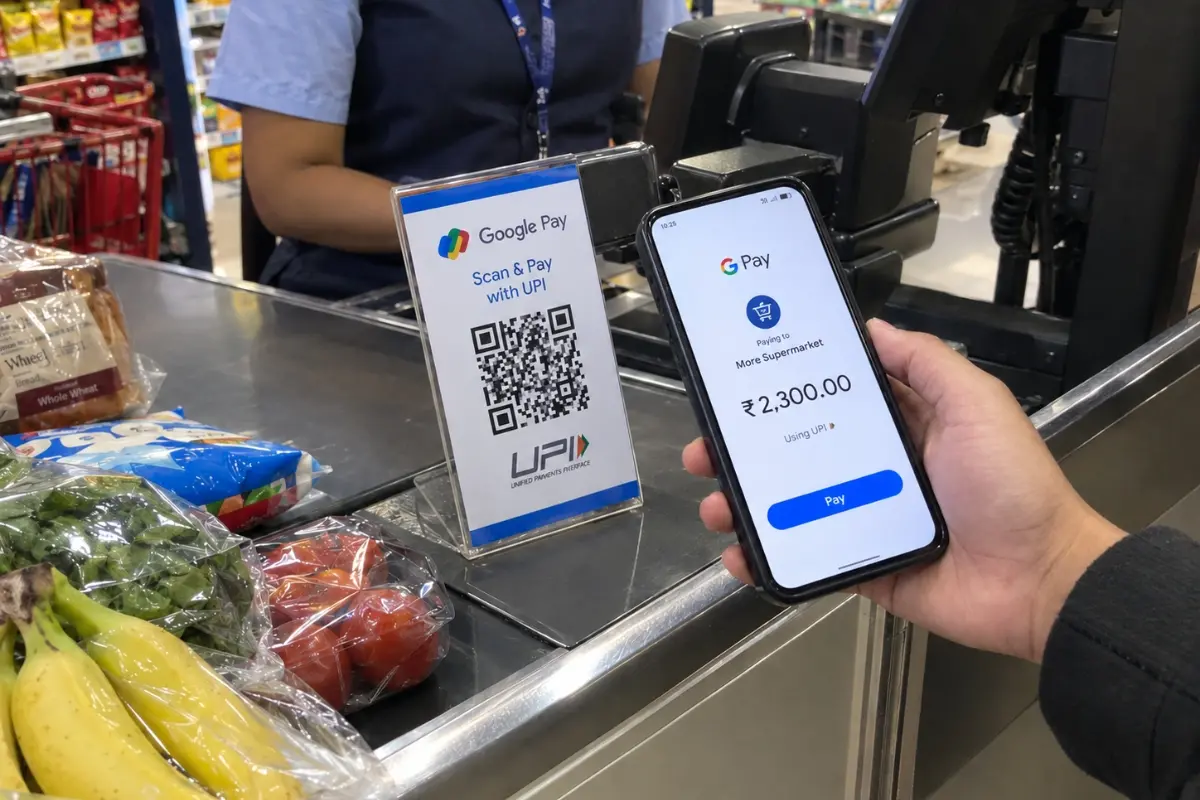
New Delhi: The National Payments Corporation of India (NPCI) and the Ministry of Finance have established a protective framework for micro-entrepreneurs following the announcement of new Merchant Discount Rate (MDR) rules. Small vendors and street sellers receiving up to ₹1 lakh per month through UPI QR codes under the Person-to-Person-Merchant (P2PM) classification will continue to enjoy mandatory zero MDR on all transactions. This specialised classification bridges informal street vendor setups with formal merchant acquiring accounts, ensuring that micro-businesses in unorganised retail remain completely protected from payment processing costs.
The Mid-Tier and Large Retail Impact
While micro-businesses remain shielded, larger commercial entities face a structured fee system starting 15 October 2026. A 0.4 per cent MDR applies to standard Person-to-Merchant (P2M) transactions exceeding ₹2,000, with total charges capped at ₹300 for high-value payments of ₹75,000 and above. A ₹5,000 transaction incurs a ₹20 MDR, whereas a ₹50,000 purchase attracts a ₹200 fee. Consequently, mid-tier electronics retailers, dining chains, and direct-to-consumer (D2C) brands operating above the ₹2,000 threshold must now absorb processing costs within their commercial operations.
ALSO READ: UPI fee revised: NPCI introduces 0.4% MDR on select merchant transactions over Rs 2000
Strict Ministry of Finance Guardrails
Merchant debate over whether to pass payment fees onto buyers has been directly constrained by regulatory mandates. The Ministry of Finance explicitly instructed banks to enforce strict compliance, preventing merchants from recovering MDR charges from consumers via checkout surcharges or added bill items. Furthermore, NPCI guidelines expressly prohibit UPI application providers from levying platform fees or hidden operational costs on retail users. As a result, commercial merchants must absorb processing fees within their gross margins rather than transferring costs directly to shoppers.
Concessions and Sectoral Variations
To mitigate cost pressures across high-volume and thin-margin industries, the regulatory framework introduces tailored fee structures. Essential service sectors, including railways, telecommunications, fuel stations, insurance providers, and agricultural input distributors, pay a flat MDR of just ₹5 per transaction above ₹2,000. Additionally, capital market transactions involving stockbrokers, mutual funds, and securities dealers attract a reduced MDR of 0.02 per cent capped at ₹300, encouraging formal retail participation while limiting institutional expense.
Broader Ecosystem Sustainability
Official government data analysis published by PIB indicates that only four per cent of total merchant transactions will be impacted by the new MDR framework, as the vast majority of payments remain below the ₹2,000 threshold or fall under the zero-MDR P2PM umbrella. According to estimates by Bernstein, the fee structure is projected to generate a sustainable revenue pool for payment ecosystem partners, reducing reliance on state subsidies while funding cybersecurity upgrades, transaction processing infrastructure, and digital expansion in Tier 3 to Tier 6 regional centres.