Weekend healthcare void: A young couple’s day-long quest for an emergency ultrasound in Kozhikode
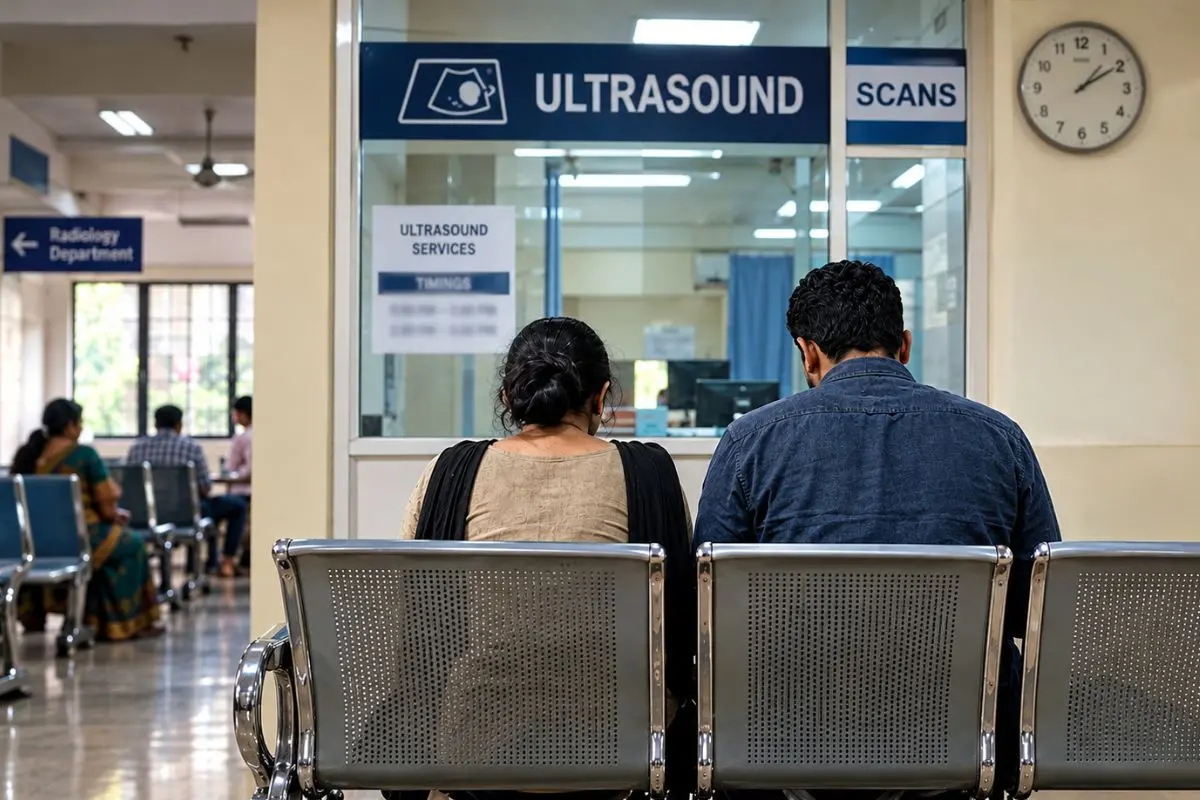
Kozhikode: When a pregnant woman began experiencing spot bleeding early on a Sunday morning, she and her husband expected a straightforward medical evaluation. Instead, they were plunged into an exhausting, eight-hour odyssey through public and private healthcare facilities in Kozhikode—exposing a systemic void in Sunday diagnostic services across the district.
The couple’s ordeal highlights a growing crisis for patients in Kerala who face severe diagnostic dead-ends outside regular weekday hours, where even critical services like Ultrasonography (USG) are rendered virtually inaccessible without costly hospital admissions or bureaucratic runarounds.
A desperate search begins
The trouble began on the morning of September 20th. Noticing alarming symptoms, the couple rushed to the casualty ward at the Kottaparamba Government Hospital. With no duty gynaecologist present, the consulting casualty doctor conferred remotely with a specialist, who advised that an immediate USG scan was essential to check the status of the pregnancy.
However, Kottaparamba lacked the necessary Sunday facilities. Staff advised the couple that stand-alone private diagnostic laboratories across the city were closed for scans and referred them directly to the Government Medical College Hospital (MCH).
Determined to find a quicker solution, the couple opted to check leading private hospitals first, hoping for swift intervention. What they encountered instead was a wall of financial and administrative hurdles.
Private hospitals and the "admission trap"
At a major private hospital in the city, the couple was informed that a simple, outpatient USG scan could not be conducted on a Sunday. To access the scanner, the patient had to be formally admitted through the emergency ward, assigned a hospital bed, administered IV fluids via a cannula, and billed for a full casualty workup.
"There was no need for all that," the woman recalled. "It was just a matter of getting a scan to know what was wrong. They brought a separate bed and insisted on inserting a cannula. The whole process was going to consume unnecessary time and money when all we needed was a clear diagnosis."
Unwilling to submit to an expensive admission for a basic diagnostic check, they left and phoned another leading private hospital, only to be met with identical terms. The hospital confirmed that Sunday scans were strictly tied to casualty admissions, carrying heavy bed and administrative fees.
"They said we had to get admitted as a casualty patient just to get checked," she explained. "The bed charges alone were over a thousand rupees, on top of all the other billing. It felt like a system designed purely to generate revenue rather than offer prompt care."
Lost in the public sector maze
Left with no other alternative, the couple journeyed to the Kozhikode Government Medical College Hospital, where they were pushed through a frustrating cycle of misdirection.
Radiology Department: Staff informed them that the department was closed for the day and undergoing routine cleaning, with no duty radiologists on site.
Super Specialty Block: Officials redirected them to the new Casualty unit, stating scans were not conducted in Super Specialty on Sundays.
Main Casualty: By 1:00 PM, casualty staff examined their referral note and sent them to the Institute of Maternal and Child Health (IMCH) block.
IMCH Block: Security and administrative staff instructed them to join the Outpatient (OP) queue to see a doctor before approaching the scan room.
When the exhausted couple went directly to the IMCH scanning section to verify availability, duty staff told them that no USG scanning was conducted in IMCH on Sundays and insisted that emergency scans were handled only back at the Main Casualty.
"When we told them that Casualty had sent us down to IMCH in the first place, they spoke to us very rudely," the woman said. "They told us, 'There is no scanning here today, you can go check for yourselves if you want.' It was utterly disheartening."
Desperate for answers, the couple scoured standalone medical labs in the Medical College vicinity—including several prominent ones. While basic blood testing and X-ray services were running, every single facility confirmed that USG scanning was suspended for the weekend.
Resolution — a long-drawn task
By 2:00 PM, with panic and physical fatigue setting in, the couple approached another private hospital in the city. Staff clarified that while routine Sunday scanning was unavailable, an emergency radiologist was on call for urgent cases.
They were informed that if they registered as an emergency case and paid the required fees, the doctor would fit them in between critical trauma patients.
"We decided to wait there because we had already spent half the day running around," she said. "We ate our lunch at the hospital and waited for over an hour in the casualty unit until the doctor arrived to attend to an accident case."
The long-awaited scan was finally completed around 3:30 PM. The couple returned home at 5:00 PM—nine hours after their search began, but still without confirmed results!
And why? When the couple returned to Kottaparamba Hospital with the scan reports as instructed, the doctor reportedly shrugged them off and told them to return the next morning, as no gynecologist was on duty even during evening hours.
Alas, the couple could get the results confirmed only the next day, September 21. The situation was that grim!
When Mathrubhumi reached out to the government hospitals for a response regarding the ordeal faced by the couple, the attempts were met with silence, with officials refusing to comment or provide an explanation.
Notably, the cold response comes amid a brewing controversy over an audio message from Kerala’s Director of Health Services (DHS), instructing government hospital superintendents not to share information with the media about the ongoing shortage of medicines.
A call for systemic reform
This couple's experience sheds light on a glaring hole in the region's healthcare infrastructure. While emergency trauma care is widely publicised, basic emergency diagnostics—such as ultrasound imaging for high-risk obstetric cases—remain severely restricted on weekends.
Public sector hospitals often lack streamlined weekend referral pathways, leaving patients trapped in institutional ping-pong between departments. Simultaneously, private healthcare facilities exploit this gap by bundling essential diagnostic tests into costly emergency ward admissions.
For patients in Kozhikode, falling ill or experiencing pregnancy complications on a Sunday remains a perilous and costly ordeal—one that healthcare authorities must urgently address.