Operation man-eater! Kerala’s longest tiger hunt ends after 53 days; ₹6 lakh spent
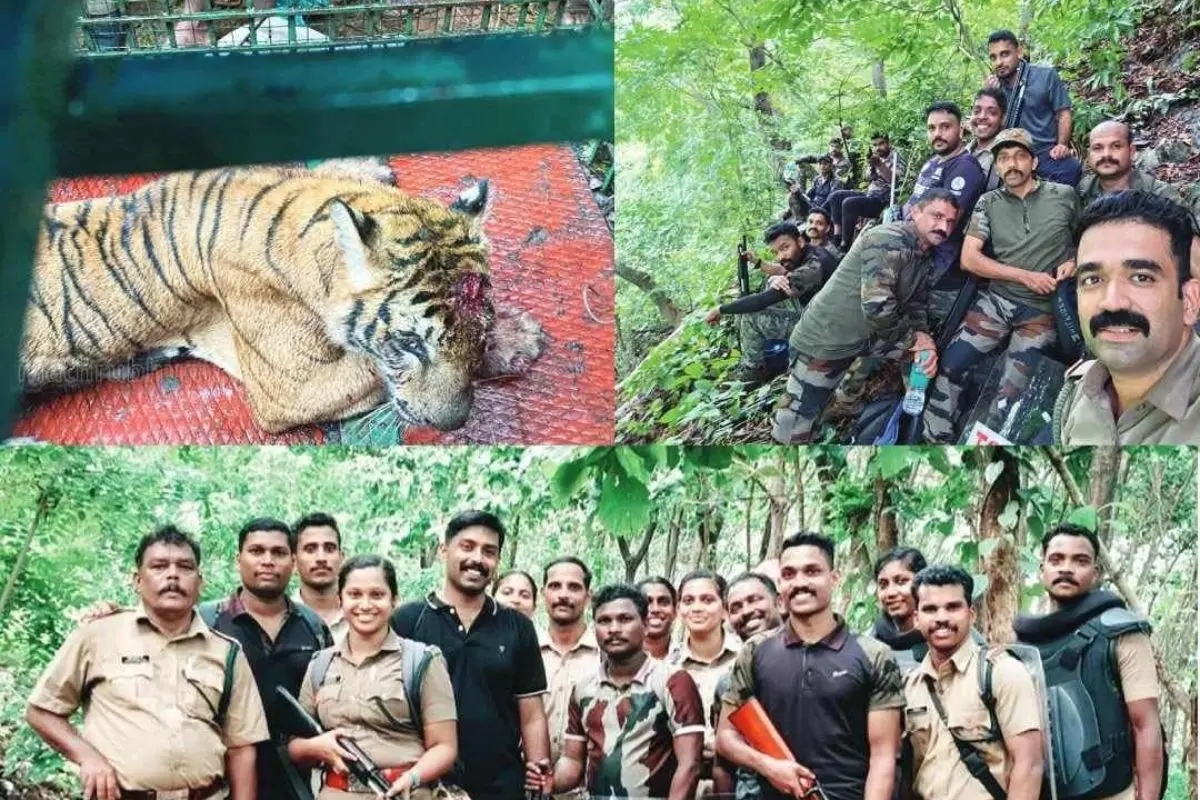
Kalikavu (Malappuram): The tiger hunt at Adakkakundu in Kalikavu, has become the longest-running wildlife operation in Kerala’s history, spanning 53 days. It finally concluded with the capture of the tiger that had mauled plantation worker Gafoor Ali on 15 May, triggering the mission. This surpasses the 44-day tiger operation previously held in Wayanad.
The rescue team, comprising 17 experienced Rapid Response Team (RRT) members from Wayanad and officials from Nilambur North and South forest divisions, remained on the ground throughout the operation, without a single day’s break. The team encountered the tiger twice during the search.
On one occasion, without a tranquilliser team present, Forest personnel had to climb trees to escape when the tiger appeared unexpectedly. In another instance, they had to fire rubber bullets to drive it away. Around 70 officials from Malappuram and Wayanad participated in the operation daily. For 15 days, the team camped at Crescent Higher Secondary School in Adakkakundu before relocating to a nearby house when the school reopened.
The Forest staff ensured the entire team of 70 was fed together each day. Even after the tiger was captured, the Wayanad RRT members chose not to return home.
Locals fear more tigers in the region
Residents in Kalikavu and Karuvarakundu highlands believe more tigers roam the area. The captured animal, found near Sulthana Estate, was old and weak. Locals suspect another stronger tiger still lurks in the region, citing incidents where it preyed on livestock.
The captured tiger had earlier been spotted in the Puttala tribal hamlet next to Sulthana Estate, where it reportedly lingered for over half an hour before retreating into the plantation. A year ago, residents of Kundoda had reportedly seen a tiger with two cubs. Locals now believe the tiger caught in Kerala Estate C Division may be one from that group.
Comb operations to continue
Nilambur South Divisional Forest Officer (DFO) G Dhanik Lal said the combing operations would not be halted immediately, as removing one tiger often leads to another occupying the area. “Only after thorough monitoring will the mission officially conclude,” he said, adding that there’s relief in having addressed people’s fears and expressed gratitude to the local community for their cooperation.
Equipment brought in from three districts
Forest officials used equipment from Malappuram, Wayanad and Palakkad districts in the mission. The operation deployed 100 trail cameras and 16 live-streaming cameras. More cameras were installed when the tiger crossed from Adakkakundu in Kalikavu panchayat into the agricultural zones of Karuvarakundu.
Initial setups were from RRT camps in Nilambur North, South and Wayanad. After pugmarks were found in distant areas, additional equipment was brought from Parambikulam in Palakkad. Five traps were laid, capturing a leopard in one and the tiger in another—both from Kerala Estate and Sulthana Estate in Karuvarakundu.
Although three trained kumki elephants (used for wildlife operations) were brought in—Kunju, Konni Surendran and Sooryan—they were not used due to the difficult terrain. The elephants, known for their expertise in handling wild animals, had to be returned as the hilly landscape proved too treacherous.
Public protests over release fears
After the tiger was caught, tensions escalated when residents demanded it be shot dead. Authorities explained that legal restrictions prevented this and assured that the tiger would be relocated to a zoo. Forest Range Officer P Rajeev gave a written assurance to Karuvarakundu Grama Panchayat vice president Madhathil Abdul Latheef, which helped ease the situation.
Still, the protest led to a brief standoff. Only after police reinforcements arrived and dispersed the crowd was the tiger safely loaded into a vehicle and taken to the Amarambalam RRT camp. Although Forest officials had prepared to provide first aid at the capture site, they had to abandon the plan due to the unrest.
At Amarambalam, the tiger was given food and primary medical care before being transported to the Puthur Wildlife Sanctuary. This newly established facility is now the designated holding centre for captured wild animals in the state, equipped with veterinary care for injured wildlife.
Locals block tiger’s transfer for six hours
Residents blocked the transfer of the captured tiger for over six hours, demanding it be euthanised for killing plantation worker Gafoor Ali and several domestic animals. Despite efforts by Forest officials and police to pacify them, protesters remained adamant.
Amid shouting and chanting, officers struggled to address the crowd. Additional police battalions from Perinthalmanna and Nilambur subdivisions were brought in to manage the situation. A scuffle broke out when the police tried to disperse the protesters.
Authorities reminded residents that they had previously promised to relocate a leopard caught a month earlier to a zoo, but instead released it back into the wild—fueling distrust. A written assurance from Forest Range Officer P Rajeev promising the tiger would be sent to a zoo finally calmed the protesters. Though over a hundred people gathered at the site, they did not obstruct the loading of the tiger and trap onto the lorry. Under heavy security, the animal was transported to Amarambalam for treatment.
Operation cost hits ₹6 lakh
The 53-day mission in Kalikavu cost the Forest Department approximately ₹6 lakh, according to DFO G Dhanik Lal. A major portion of this went toward treating the mahout (elephant handler) who was injured by a kumki elephant named Kunju, which had been brought from Muthanga in Wayanad. The mahout, J Abhayakrishnan (Chandu) from Kottarakkara in Kollam, suffered serious injuries, and his treatment alone cost ₹80,000.
When surveillance equipment from Wayanad and Parambikulam proved insufficient, six new live-stream cameras were purchased specifically for the mission. Feeding the 70-member team each day also incurred a major expense.
Animals used as live bait in traps cost ₹6,000. Of the four goats and one piglet tied up, two goats were killed by the tiger, one by the leopard, and another goat and the piglet died in the rain. The remaining two goats and a piglet owned by the Forest Department will be auctioned to recover costs. A piglet provided by Karuvarakundu Grama Panchayat will be returned.
Repairs to faulty traps also added to the total expense.