‘I may have lost, but I will keep fighting’: Survivor in Kerala nun rape case
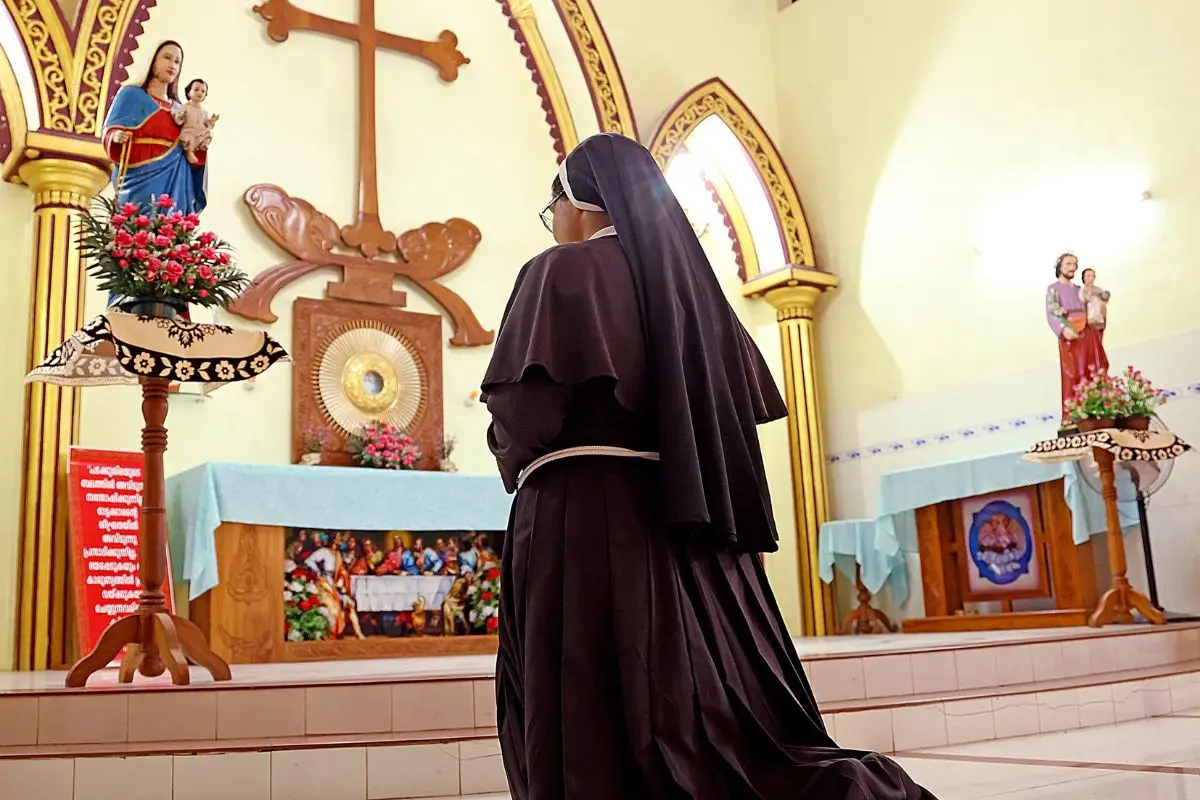
A nun who levelled sexual assault allegations against former Jalandhar bishop Franco Mulakkal speaks to Mathrubhumi about her life as a survivor, four years after the Additional District and Sessions Court in Kottayam acquitted the bishop of charges of rape.
What was the nun rape case?
Mulakkal had been accused of raping the nun multiple times during his visit to a convent in Kottayam between 2014 and 2016, when he was the Bishop of the Jalandhar diocese of the Roman Catholic Church.
He was acquitted on January 14, 2022, as the prosecution failed to produce evidence against him.
The trial period and the acquittal deeply affected the survivor and those with her, taking a severe psychological toll. The convent in Kuravilangad, where the survivor has been residing is set on a 5.5-acre compound and now houses just three souls. For security, five police officers are stationed there at all times. Security was increased after threats were received in the early stages. Even so, once night falls, the nuns do not step outside their rooms and communicate only by phone.
After the verdict went against them, all allowances from their congregation — the Missionaries of Jesus (MJ) based in Jalandhar — were stopped. Support from their families remains their greatest source of strength. They were offered substantial assistance by a Europe-based charitable foundation, including relocation for all of them, but the survivor and her companions declined and chose to remain there.
In the meantime, Franco has lost his position as bishop.
Since the verdict, the survivor had stayed away from the media. Now, she says she no longer intends to remain silent and will continue the fight to the very end.
The appeal is currently before the High Court. Hence, details of the case are avoided.
Two months ago, the survivor met the chief minister seeking the appointment of a special public prosecutor, and she is now awaiting action.
Excerpts from an interview with Mathrubhumi correspondent Joseph Mathew.
- When did you decide to become a nun?
The desire began as early as fourth standard. Watching nuns arrange flowers in church for First Communion and other occasions stirred something in me. At home, I would wrap a towel around my head like a nun’s veil and walk about in a petticoat. Soon, people began calling me “the little nun.
In ninth standard, my mother was diagnosed with cancer. I witnessed her treatment and hair loss, and evening prayers became a daily ritual at home. My elder sister and I, close in age, prayed fervently for her. We came from a reasonably well-off family with paddy fields and coconut trees, and often accompanied our mother as she boiled and pounded rice.
There were five children—four girls and a boy—and evening prayers often lasted 45 minutes. As my mother’s condition worsened, I feared losing her. One day she was discharged from the hospital, not because she had recovered, but because nothing more could be done. After her death, I felt abandoned by God; despite all my prayers, there had been no answer.
My father’s nephew, a priest in Punjab, invited me to stay with him. Home had become unbearable. That year, I failed tenth standard. My father, an Army man, insisted I pass, so during a two-month break I learned tailoring and shorthand. I cleared the exam the following year.
I then went to Punjab, where I studied typing, shorthand, and Hindi. I also assisted at a nursery run by the Franciscan Clarist Congregation Sisters, who taught me basic English. Gradually, the desire to become a nun returned.
My cousin visited every Thursday from the seminary. When I told him I wanted to join a convent, he urged caution. But when I remained resolute, he suggested a congregation founded by Bishop Symphorian Keeprath. In 1994, I joined the second batch of the Missionaries of Jesus (MJ).
- When did you take religious vows?
I was clothed in the habit in 1999. That same year, on Easter morning, my cousin, who had been my strongest support, died in an accident there. After the early morning Mass, he fell asleep at the wheel; the car hit a tree. Once again, I felt there was no God. I began to doubt my vocation.
Everyone from home came for the funeral. My cousin Shijo was among them. When he told me he wanted to become a priest, I wondered how I could tell him that I was thinking of leaving the convent. I changed my mind. Later, when I returned home, my younger sister told me she too had decided to become a nun and joined MJ.
My perpetual vows were taken on May 4, 2004, at the Kuravilangad convent. The very next month, I was elected as the general superior.
- When did you return home?
In 2012, my sister’s husband underwent a liver transplant. My sister was the donor, but my brother-in-law passed away. I requested a transfer to Kuravilangad and came here in June 2013, primarily to provide my sister with emotional support.
- Wasn’t it only after you returned to Kuravilangad that Franco was appointed Bishop of Jalandhar?
Yes, I arrived in Kuravilangad in June 2013. In August that year, Franco took charge in Jalandhar.
- Did you know him earlier?
I had seen him at various diocesan functions as one of the priests of the Jalandhar diocese. Nothing more.
- From the outset, the Opposition has alleged that your accusations against Bishop Franco were motivated by financial gain. How do you respond?
My father was a soldier who took voluntary retirement after 27 years of service. Those who make such allegations know nothing about how he raised us. A political leader even made derogatory remarks about my brother building a house and my sister constructing a shopping complex. That land was bought for my mother by my uncle in 1974—before I was even born.
Some people claimed I raised false allegations because I stopped receiving money. That is untrue.
- Did you ever consider leaving the congregation after these events?
Yes, I thought about it. I tried to leave without telling anyone. How can someone who is not a virgin claim to be a nun? My juniors were with me — how could I tell them? I loved my congregation deeply and could not go home. My sister’s husband had passed away, and my younger sister was still at home. If I had gone home, my younger sister would have left the congregation too. The prospect of three women living in the house was unthinkable. I also feared being labelled a runaway nun.
I thought of leaving the state and teaching somewhere anonymously. But my sister refused to let me leave the congregation. So I decided to inform authorities from within the system.
I first told the parish priest at Kuravilangad, then met the bishops. One Bishop told me the nuncio would visit Varappuzha in October, whence I could meet him directly. But by the time the news of the nuncio's arrival reached me, it was too late.
I wrote to Rome and to the nuncio in Delhi. There was no response. Once the authorities became aware, harassment from the Jalandhar diocese began. False complaints were filed. The Punjab police called us to intimidate us. Only then did I realise that the calls were meant to intimidate, not file complaints.
Eventually, when my brother’s safety was threatened, I was forced to give the police a letter I had earlier written to church authorities about the abuse. I never wanted to go to the police. That complaint to the Kottayam SP became the beginning of everything.
- Why are you speaking about all this now?
It is because of the court verdict against the actress. Some people circulated that, although I had been abused 13 times, I did not respond, and only filed a complaint when no money was given. Even in her case, the verdict went against her initially—despite her reporting it immediately.
- How did you cope with the trial stage?
It was extremely difficult. There were 13 days of cross-examination. Since the case is still before the court, I cannot go into further details. On trial days, I barely slept at night and would attend court in the mornings after taking medication for migraine.
- The case says you were assaulted 13 times. Naturally, doesn’t the question arise as to why you did not speak out at the very beginning?
Even if it had happened thirty thousand times, it is impossible to speak out. That is how the system works. For a nun, the most important thing is her vow of chastity. How can one publicly say that it has been taken away—especially when the abuse comes from someone in authority? How could I tell the junior nuns under me? As I said earlier, I spoke out later only because I was left with no choice.
In May 2017, I had submitted a letter seeking to leave the congregation. When this became known, about 16 others were ready to leave with me. Because of that, I withdrew the letter myself. Leaving a congregation is not at all easy for nuns; it is not like priests leaving a seminary. Either one is already advanced in age or one’s parents may have passed away—where does one go then?
- The opposition pointed out that you travelled with Franco the day after the first rape and even appeared to participate happily in a function. What was the context?
My sister had a son after nine years of marriage. My cousin Sebastian, who is a priest, said it would be good if a bishop could be present for the child’s First Holy Communion. Franco usually visited home during May, and it was Sebastian who fixed the appointment. The incident happened here on the eve of the First Communion. I simply could not avoid attending the function the next day. They had strongly wished for a priest—especially a bishop—to be present. How could I tell them what had happened? I had to suppress all my pain and attend.
- Didn’t the nuns at the Kuravilangad house later split into two groups—those with you and those against you?
Yes. Five were with me. On one September 8, someone brought in food that had been ordered. We did not know that it had been ordered from here. The superior came and said, “Today is our congregation day; this food is for us.” I was shattered. Aren’t we also part of the same congregation? There were around 12 of them there at the time. We ate only the leftovers from lunch.
In 2022, after the verdict was delivered, we were asked to go on leave, saying that the case had been lost anyway. We knew that once we left this place, we would never be able to return. These acts of neglect are what made us stronger, and we should thank them for that.
On May 16, 2023, everyone except us left.
- How long have your allowances been stopped?
By November, it will have been three years. A person’s monthly allowance was 5,000 rupees. All allowances were stopped because I refused to go on leave as instructed.
- How do you live now?
If it weren’t for the support of my household, I would have collapsed. Some people help me. We raise 28 chickens and 32 ducks and sell their eggs. A few people pooled enough money and bought a cow, which produces three litres of milk, which is also sold. We also have a sewing machine for tailoring and embroidery. I attend Sunday Mass at the nearby Latin church.
- How long have you been waiting for the government to appoint a special prosecutor for your appeal in the High Court?
I first approached the Kottayam District Police Chief. Later, on November 12, 2025, I met the Chief Minister in person. I have proposed the name of advocate B. G. Harindranath. I am waiting with hope.
When the actor’s case came up, everyone was saying things like “we are with her”. But in reality, that support often does not translate into results. I believed that at least the actor, who was ready to speak out from the very beginning, would get justice. When even that did not happen, I decided to speak out as well.
I may have lost. But I will keep fighting. I have lived only 17 years at home; the rest of my life has been in convents. I am 50 now. Where am I to go? Even if I have to die, it will be here.