‘Viksit Kerala essential’: PM Modi flags off 4 trains, launches SVANidhi scheme in TVM event
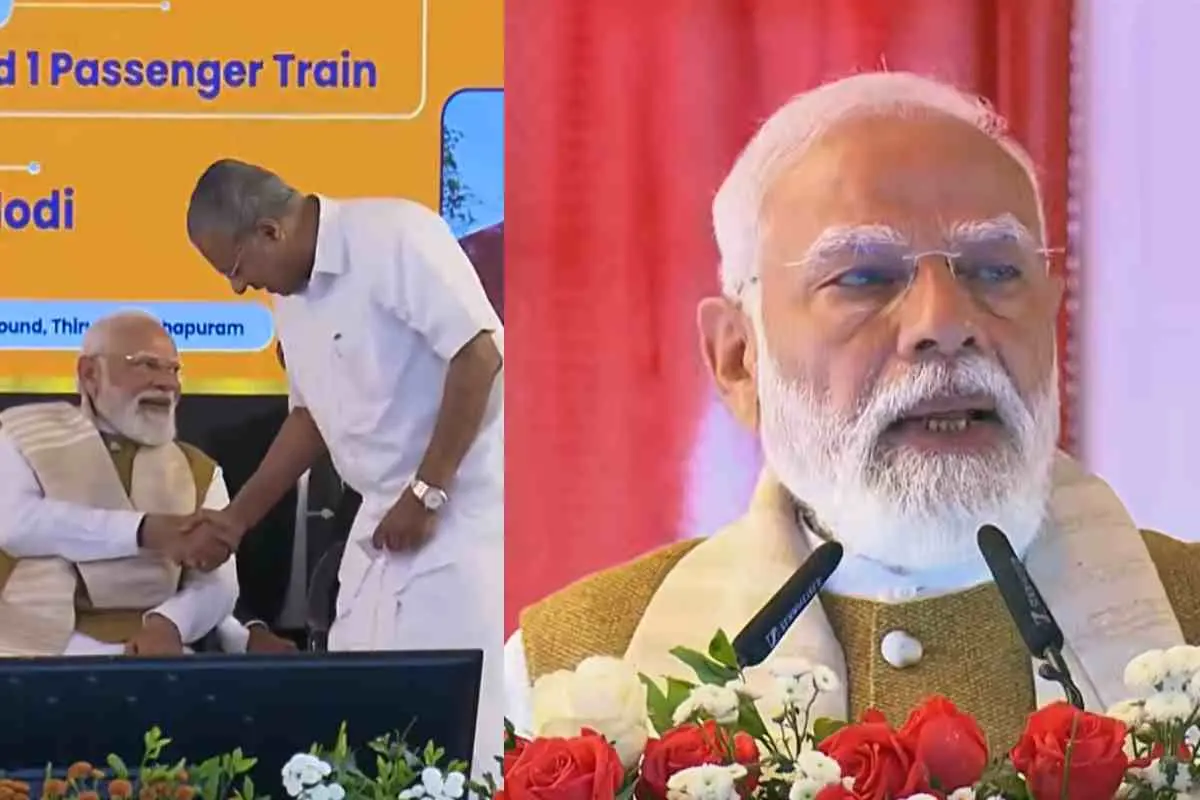
Thiruvananthapuram: Prime Minister Narendra Modi on Friday launched a series of infrastructure, welfare and connectivity projects in Kerala, flagging off new train services and underlining what he described as a “new momentum” in the state’s development driven by the Centre’s initiatives. A key focus of the programme was financial inclusion, with the Prime Minister announcing the rollout of PM SVANidhi credit cards for street vendors — a facility he said was once limited to the wealthy.
Addressing a public gathering in Thiruvananthapuram after inaugurating projects and flagging off trains, Modi said a “new realisation” had emerged among people regarding the Union government’s efforts for Kerala’s growth.
Rail connectivity strengthened, Thiruvananthapuram positioned as national hub
Modi flagged off three Amrit Bharat Express trains — Nagercoil–Mangaluru, Thiruvananthapuram–Tambaram and Thiruvananthapuram–Charlapalli — along with a Thrissur–Guruvayur passenger service, saying the moves would strengthen regional connectivity across Kerala, Tamil Nadu, Karnataka, Telangana and Andhra Pradesh.
He said the new services would enhance ease of travel, support tourism and make journeys easier for pilgrims. “The new passenger train between Guruvayur and Thrissur will make journeys easier for pilgrims,” Modi said.
The Prime Minister said the projects would help transform Thiruvananthapuram into a major hub, adding that rail connectivity in Kerala had been “further strengthened” as part of broader development efforts.
Credit cards for street vendors mark shift in financial inclusion
A central announcement at the event was the launch of the PM SVANidhi Credit Card, a UPI-linked, interest-free revolving credit facility for street vendors. Modi said 10,000 beneficiaries in Kerala, including more than 600 in Thiruvananthapuram, received credit cards during the programme.
“Previously, only wealthy people had credit cards, but now street vendors also have SVANidhi credit cards,” the Prime Minister said.
Highlighting the scheme’s impact, Modi said street vendors had earlier struggled to borrow even small sums at high interest rates. “The condition of those who sell goods on the streets and in the lanes was very bad earlier. They had to take even a few hundred rupees at very high interest rates to buy goods,” he said.
He added that lakhs of vendors nationwide had benefited, noting, “Millions of street vendors have received a bank loan for the first time in their lives.”
Urban welfare, housing and tax relief highlighted
Modi said cities played a crucial role in the mission to build a developed India, stating that over the past 11 years, the Union government had made significant investments in urban infrastructure.
“Our cities have played a crucial role in this development. For the past 11 years, our government has made significant investments in urban infrastructure,” he said.
Under the Pradhan Mantri Awas Yojana, he said more than four crore houses had been built across the country, including over one crore for the urban poor. In Kerala alone, nearly 1.25 lakh urban poor families had received permanent homes.
The Prime Minister also highlighted free healthcare up to Rs 5 lakh under Ayushman Bharat, support under the Matru Vandana Yojana for women, and income tax exemption up to Rs 12 lakh, which he said had benefited Kerala’s middle and salaried classes.
Banking access expanded for marginalised groups
Modi said a major effort had been made over the past decade to connect crores of citizens to the banking system.
“Now the poor, SC, ST, OBC communities, women, and fishermen are able to access bank loans easily, with the Union Government itself acting as their guarantor when they lack collateral,” he said.
He added that the PM SVANidhi scheme had transformed the lives of street vendors by providing institutional credit and new livelihood opportunities.
Focus on science, innovation and healthcare
The Prime Minister laid the foundation stone for a CSIR–NIIST Innovation, Technology and Entrepreneurship Hub and a state-of-the-art Radiosurgery Centre at the Sree Chitra Tirunal Institute for Medical Sciences and Technology. He also inaugurated the new Poojappura Head Post Office.
“The NDA government is also investing heavily in Connectivity, Science & Innovation, and Healthcare. The inauguration of the CSIR Innovation Hub in Kerala and the launch of a Radio Surgery Centre in a medical college will help make Kerala a hub for Science, Innovation, and Healthcare,” Modi said.
Calling for accelerated growth, he said, “A developed Kerala (Viksit Kerala) is essential for realising the dream of a developed India (Viksit India),” and assured continued central support.
Chief Minister Pinarayi Vijayan and Governor Rajendra Vishwanath Arlekar were present at the event, where Modi was felicitated.
Vijayan listed the initiatives launched: CSIR-NIIST Innovation Hub, Poojappura Head Post Office, PM SVANidhi scheme for one lakh beneficiaries, and new train services. He expressed gratitude for central approval: “I take this opportunity to express our sincere gratitude to the Prime Minister for having cleared these projects. I hope this concern and goodwill gesture will continue to be shown to Keralam in the times to come too.”
Arrival and packed programme in state capital
The Prime Minister landed at Thiruvananthapuram airport at around 10.25 am and was received by Governor Rajendra Vishwanath Arlekar, Chief Minister Pinarayi Vijayan and other dignitaries. From the airport, he travelled towards Thiruvananthapuram Central station amid tight security arrangements, with BJP workers and supporters lining the roads ahead of a planned roadshow.
This marks the Prime Minister’s first visit to Kerala after the BJP’s surprise victory in the Thiruvananthapuram Corporation elections, ending the Left Democratic Front’s 45-year control of the civic body.
Development push: urban roadmap, trains and welfare
A central focus of the visit is the expected unveiling of the Capital City Development Blueprint. The proposed roadmap is likely to cover new central projects, the next phase of the Smart City p
Political stakes ahead of Kerala polls
Modi’s high-profile visit combining major development announcements with clear political messaging, as Kerala heads towards Assembly elections in April–May. Party strategists see the capital city blueprint as an effort to project Thiruvananthapuram as a model of BJP-led urban governance in a state where the party has traditionally struggled to expand beyond limited pockets.
Despite its civic breakthrough, the BJP currently has no representation in the 140-member Kerala Assembly, and internal assessments have pointed to a dip in overall vote share. Against this backdrop, the party has framed its push as “Mission 2026”, with Thiruvananthapuram emerging as both a test case and an opportunity.
Friday’s visit is being closely watched as an attempt to convert civic control and development messaging into broader political momentum in Kerala.