No death penalty for TP murder convicts; 6 get double lifer without waiver for 20 years
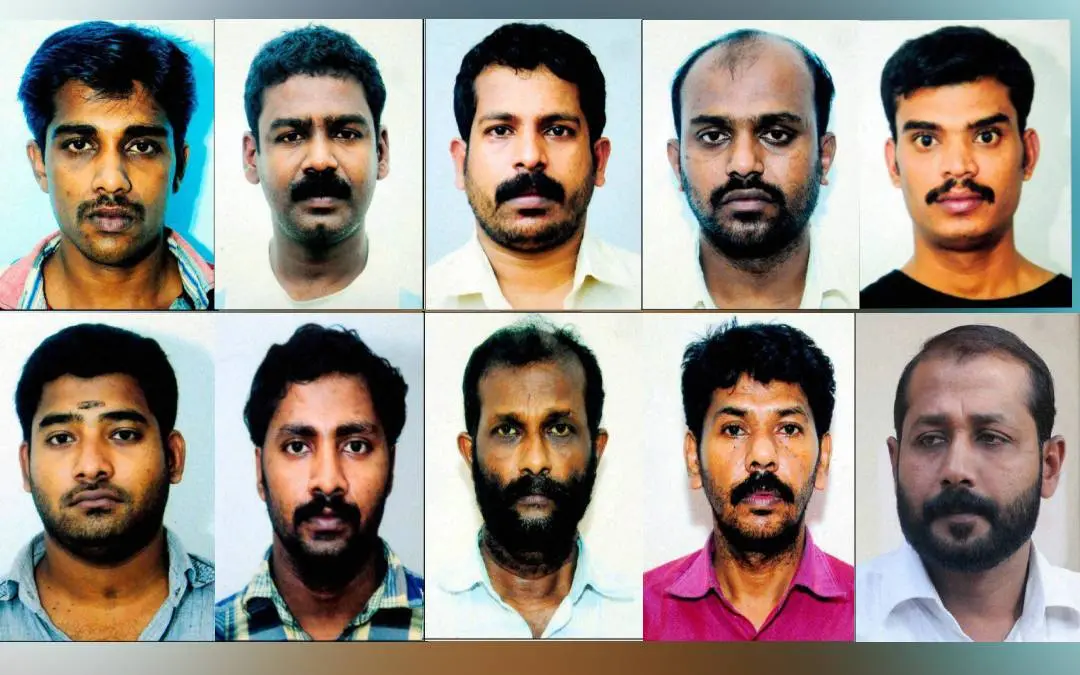
Kochi: The Kerala High Court division bench on Tuesday issued the verdict on the plea to enhance the punishments for the convicts in the TP Chandrasekharan murder case. The bench did not announce death sentences to the convicts in the TP Chandrasekharan murder case. However, all the convicts, except two, were sentenced to life terms without any remission until they served 20 years in prison. The court has also enhanced the sentences of six of them to double life imprisonment.
The six getting double life imprisonment are the first five and the seventh convicts. K K Krishnan and Geothi Babu, whose acquittal was reversed by the High Court, also sentenced to life imprisonment. However, the court did not impose the no-waiver condition on the duo considering their age, and on 18th accused P V Rafeek.
"So far as A18 (Rafeek) is concerned, we do not see the need to enhance his sentence from that imposed by the trial court. He was not charged with conspiracy nor was he attributed with any political affiliation or motive in connection with his role in the murder," the bench said.
The High Court also increased the fine slapped on the accused. Each of them has to pay a fine of Rs 1 lakh. The court also ordered a compensation of Rs 7.5 lakh to the slain RMP leader’s wife, K K Rema, and Rs 5 lakhs to his son Abhinand. The trial court had given them a compensation of Rs 3 lakh and Rs 2 lakh respectively.
A division bench, comprising Justices A K Jayasankaran Nambiar and Kauser Edappagath, issued the verdict after hearing the petition filed by the slain RMP leader’s wife and Vadakara MLA, K K Rema, demanding maximum punishment for the nine accused, including the first eight accused– MC Anoop, Kirmani Manoj, Kodi Suni, TK Rajeesh, Mohammed Shafi, Annan Sijith, K Shinoj and KC Ramachandran- besides the 11th accused- Trouser Manoj in the case.
The bench observed that it's time to take a serious view on political murders as they undermine democratic principles. "Crimes that have the effect of inducing fear in the people to the point where they are prevented from freely exercising their constitutionally guaranteed freedoms of speech and expression ought to be dealt with firmly, for they cannot be tolerated in a society that is governed by the rule of law," the bench said, making a serious observation on political murders.
During the arguments on the sentence that lasted for three hours, the high court observed, "It's about time that we take a grim view about political murders."
Public prosecutor P Kumarankutty sought the death sentence for the accused in the heinous crime. He argued that the health conditions of the accused should not be taken as an excuse for the death penalty. He pointed out that the motive for killing TP had not yet been found. Drawing the court’s attention to the accused’s criminal activities inside the prison, the prosecution alleged that the jail report on the accused is incomplete with no remarks on such activities.
Meanwhile, the counsel for the convicts argued that TP Chandrasekharan’s murder was not the first political murder. The prosecution has not presented anything new before the court, the defence counsel said, adding that the convicted should not be sentenced to capital punishment.
Before pronouncing the verdict, the court had examined the reports of the Kannur, Thrissur, and Thavanur Jail Superintendents on the work done by the accused inside the prisons besides the report on their mental health. The defence counsel had alleged that copies of the same were not provided to them.
The bench said that any crime that is committed with a view to silence dissent, which is an integral facet of the right to privacy under Article 21 of our Constitution, has to be seen as a crime against the people at large in a society that has chosen to be governed by democratic principles.
However, the high court said that while the crime committed by the convicts was "abhorrent and despicable", it cannot be categorised as rarest of rare to impose the death sentence on them.
It also said that a sentence of a simple life imprisonment would also not be proportionate to the gravity of the offence committed and "would not meet the need to respond swiftly and sternly to crimes that virtually amount to an attack on democracy itself". "That apart, the barbaric nature of the crime, where an unarmed man was hacked to death on a highway by six armed assailants who had no known enmity against him but were mere assassins and co-conspirators, needs to be condemned in a befitting manner.
"Not doing so in such a brutal case, by showing undue leniency to the accused, will adversely affect public confidence in the efficacy of our legal system," the high court added.
The court on Monday enquired in detail with the convicts about the sentence when the first accused M C Anoop pleaded that he has a dependent wife and two children and the second accused Kirmani Manoj said his octogenarian mother is alone at home. Another accused Kodi Suni pleaded that he was in no way related to the case, while K Krishnan and Geothy Babu informed the court about their poor health conditions and ailments.
The High Court had upheld the trial court judgment convicting all the accused with respect to the charges proved against them. T P Chandrasekharan was hacked to death by a gang on May 4, 2012, in Vadakara while he was returning home on his bike.
With PTI inputs