‘Chooralmala disaster triggered by a small rock fissure in Vellarimala,’ says expert
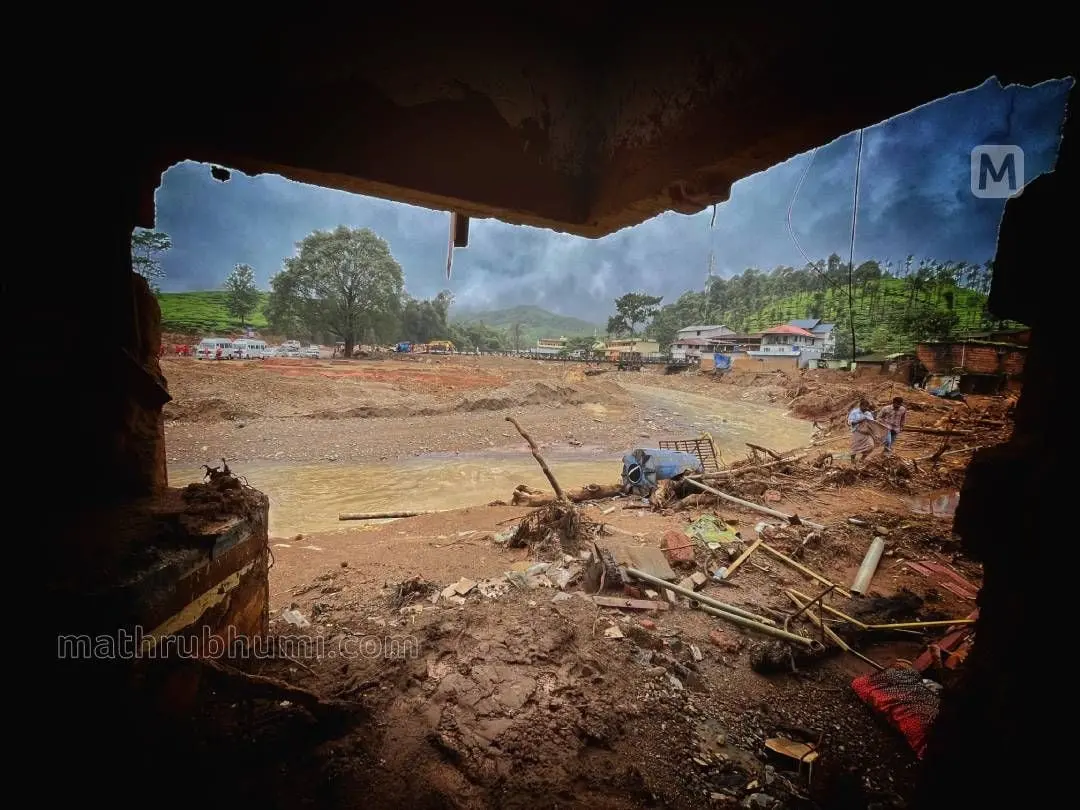
Kozhikode: The massive landslide at Chooralmala, which caused widespread destruction, was triggered by a minor rock fissure that developed in Vellarimala between 2018 and 2021 following earlier landslides, explained Dr K S Sajin Kumar, a renowned geologist and Assistant Professor in the Department of Geology at the University of Kerala.
He said that although the fissure had notably widened by April 2024, it went unnoticed. With the onset of extremely heavy rainfall in June, a landslide was triggered, sweeping away three villages.
Dr Sajin Kumar was speaking at a workshop titled ‘Disaster Preparedness and Climate Adaptation’, held at IIM based on the Chooralmala–Mundakkai landslide.
At Mundakkai, just above Seethammakkundu, a narrow gorge – known as a ‘bottle-neck’ – formed when boulders, rocks, soil and uprooted trees from the landslide got blocked against a hard rock surface. This blockage acted like a dam and contributed to the severe damage caused downstream. This finding emerged from a study led by the University of Kerala.
He added that had this natural dam not formed, the destruction of three villages might have been avoided. Importantly, no human intervention had taken place in the affected area.
According to him, the primary cause of the landslide was extremely heavy rainfall — 586 millimetres over just two days.
A staggering 22,88,100 truckloads of rock and soil were displaced in the landslide. The loss caused solely due to the soil erosion is estimated at ₹5,720 crore.
Kozhikode Corporation Mayor Dr M Beena Philip was the chief guest at the event. Speaking at the function, IIM Director Prof Debashis Chatterjee emphasised that early warning systems should be integrated into the very structure of society.
Prof Prasad Krishna, Director of NIT Calicut, stated that nature is not the enemy — disasters are a response to human interference. He stressed the need for a disaster index and proposed hazard mapping of vulnerable areas to enable effective early warnings.
Prof Rajib Shaw of Keio University, Japan, advocated for adopting Japan's model in disaster risk reduction. He noted that in Japan, communities are well-prepared for self-protection. During a recent earthquake, 98% of the rescue operations were carried out by the people themselves, with only 2% conducted through official mechanisms.
At the event, a comprehensive report on the Wayanad landslide, jointly prepared by IIM, NIT, IIT Bombay and Keio University, was also released.
Other speakers included Prof Sakiko Kanbara from Japan’s Kobe City College of Nursing, Prof Anupam Das, Prof C Mohammed Firoz and Prof Shiny Anilkumar.