Akshara's death was no accident; 3 failures behind Kochi's road tragedies
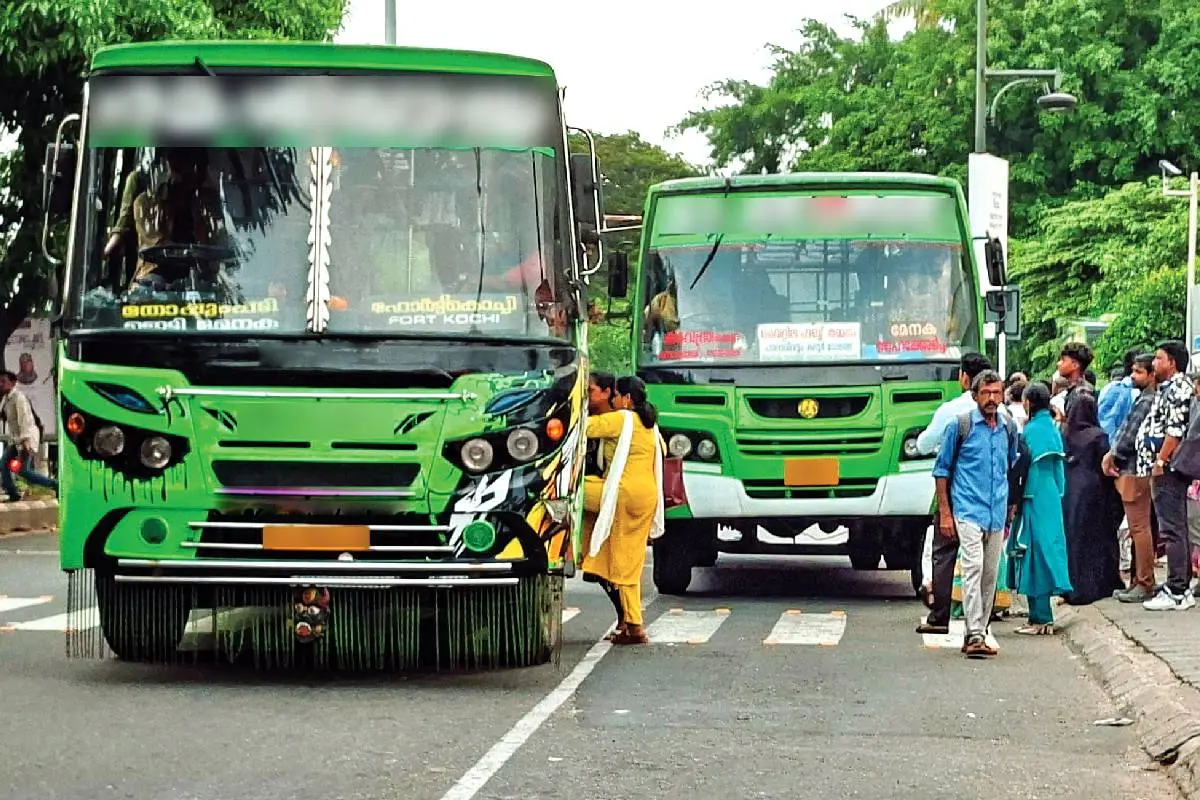
On Wednesday morning, Akshara did everything right. The 29-year-old Infopark professional was walking home from the gym along the very edge of Infopark Road in Kakkanad, because there was nowhere else to walk. A speeding private bus knocked her down and ran over her. She died within hours.
This was no accident. It was the predictable outcome of three failures Kochi has tolerated for decades: a bus system that rewards speed, roads with no room for people, and a law that treats killing by reckless driving lightly.
The numbers are stark. According to the State Crime Records Bureau, Kerala recorded 49,889 road accidents in 2025, killing 3,733 people and injuring 56,922. That is about 137 accidents and ten deaths a day, against 76 accidents a day in 2020. Kerala Police figures put Ernakulam Rural at the top of the state's accident table, with Kochi City not far behind. Official data also show that private buses caused 919 accidents and 115 deaths in 2021, nearly three times KSRTC's count.
Why do buses race? A private bus earns by the passenger, and the bus that reaches the stop first takes the passengers. On September 24, 2026, a Division Bench of the Kerala High Court said as much, holding that unscientific timings and the fare-based revenue model drive racing and overspeeding. It called for structural reform so that speed stops being an economic incentive.
I know how hard that reform is. When I worked on the Kochi master plan, we proposed designating bus routes. The private bus operators' lobby would not permit it. A route-rationalisation plan for Greater Kochi has since stalled, and buses in Kakkanad were reported last week cutting through narrow interior roads without permits to beat the metro-construction traffic.
The second failure is our roads. They follow no hierarchy: arterial roads, collector streets and local lanes blur into one, each carrying buses, lorries, two-wheelers and pedestrians in the same narrow strip. Indian Roads Congress norms call for 3.5-metre lanes and footpaths at least 1.8 metres wide in residential areas and 2.5 metres in commercial ones. Walk down Infopark Road or the Kakkanad–Edachira Road and try to find one.
Thrikkakara Municipality must answer for this. Infopark brings thousands of young professionals into its limits every day, and they get road edges, broken slabs and buses bearing down on them. Thrikkakara is an ideal candidate for planned urban renewal: a rational road hierarchy, widened junctions, continuous footpaths, safe crossings and proper bus bays. That is not a luxury. It is the minimum a municipality owes its people.
The third failure is impairment and impunity. Breathalysers catch alcohol, not narcotics. Kerala Police pioneered saliva kits in 2023 that detect MDMA, ganja and other drugs in five minutes, but they are not used routinely. Every bus driver should be tested at the start of each shift. And under Section 106(1) of the Bharatiya Nyaya Sanhita, causing death by negligence remains a bailable offence, though the maximum sentence is now five years. A driver can kill in the morning and be home by evening. In Akshara's case the police have invoked a homicide charge. That should be the norm.
The remedies are known. Pay operators by the kilometre, not the passenger. Revive route rationalisation and enforce permits without fear of the lobby. Fit every bus with a working speed governor and GPS, monitored live. Make breath and saliva tests mandatory for bus crews. Build footpaths to national standards. And amend the law so that death caused by reckless commercial driving is non-bailable, with the licence cancelled and the owner held liable.
Akshara should have reached home on Wednesday. Kochi can go on counting its dead, or it can build streets that respect life. Let her be the last we mourn in silence.
(The author is an urban planner and public policy professional with over 26 years of experience in urban development and governance, and worked on the Kochi master plan)