'Unfortunately, there is no shortage of issues to explore...,' laments drama tutor at Kalolsavam
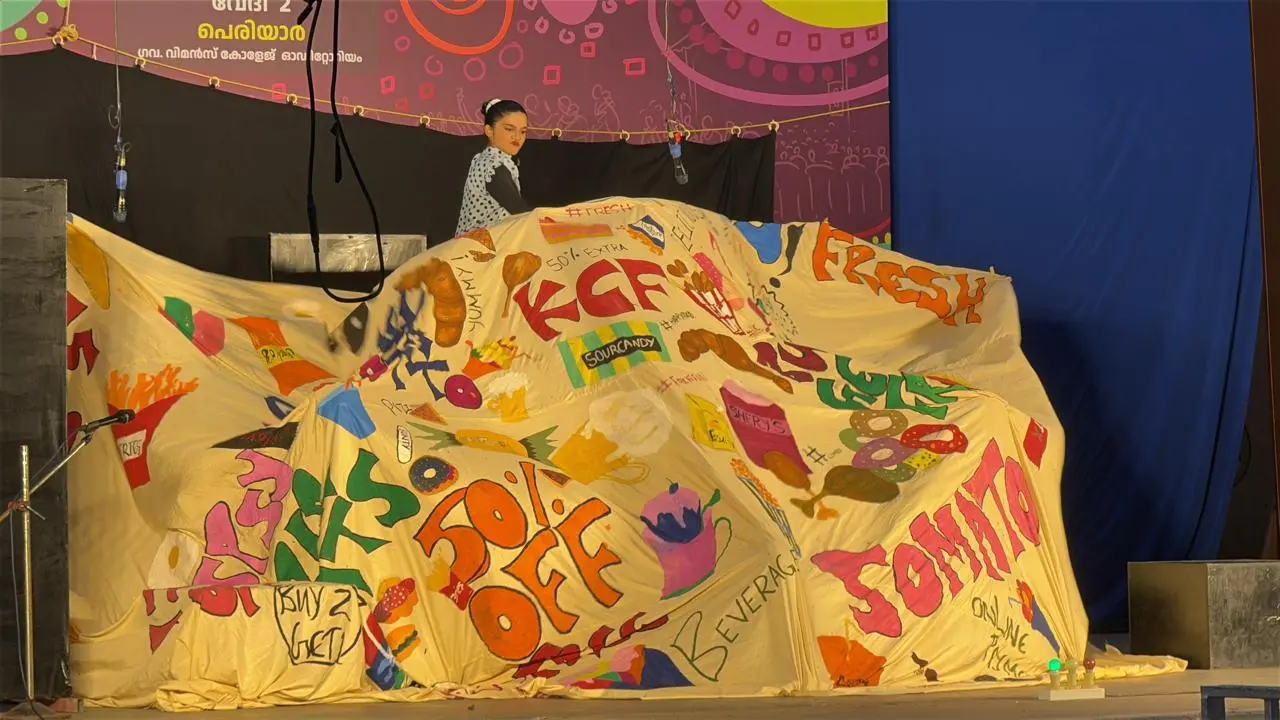
"Unfortunately, there is no shortage of societal issues around us to explore in skits," laments Adam Sha, a passionate drama instructor with a mission to use theater as a tool for social change.
For over 14 years, Adam Sha has brought his teams to the state-level competition, blending theatrical excellence with critical social commentary. This year, he has brought four teams from across Kerala to showcase their talents in English skit.
Themes that matter
Adam’s approach to skit-writing is deeply rooted in his desire to challenge societal norms and address pressing social issues. His topics in this year's Kalolsavam included:
- Corporate hunters
This skit delves into the pervasive influence of corporations on everyday life. From the manipulation of social media to the medical mafia and the corporate grip on food, education, and business, the play highlights how every aspect of human existence is being monitored and shaped by corporate power. - Sale
A historical exploration of Kerala’s trade legacy, this skit takes us from Vasco da Gama’s arrival in 1498 to the modern-day commodification of human life. The play connects the dots between colonialism, independence, and the commercialization of everything, including media, employment, and even personal tragedy, urging the audience to question a society obsessed with sales and marketing. - Trap
In this skit, Adam examines the ways in which humans are still trapped by societal constructs like caste, creed, and religion. Drawing parallels to historical tragedies such as the Wagon Tragedy, it emphasizes how these divisions continue to limit progress, leading the play toward a dramatic conclusion warning that humanity’s failure to confront these issues will lead to disastrous consequences. - Puppets
Adam’s final skit presents a poignant commentary on how, despite 75 years of independence, people remain metaphorically ‘puppets,’ controlled by forces beyond their understanding. Focusing on issues like the Citizenship Amendment Act (CAA) and Dalit rights, the skit suggests that societal apathy and a sense of detachment from urgent issues will only lead to personal consequences in the near future.
Each of these topics is a fearless exploration of the social, political, and cultural issues that plague our society. “I believe the stage is a loud medium. The message reaches people, and as artists, it’s our responsibility to use it to shed light on social evils,” says Adam Sha. “If I don’t do it, it defeats the purpose of me being an artist,” he says.
Inspiring the next generation of performers
One of the most heartening aspects of Adam’s work is his ability to instill confidence in his students. The students from Mannar Nair Samajam Higher Secondary School in Alapuzha were particularly vocal about the impact of Adam’s guidance.
“We’re not used to speaking English at school,” one student admits. “But sir gave us the confidence we needed. He taught us every word, its pronunciation, and its meaning. The practice sessions were a learning period, at the same time, it was interactive and fun too.”
Their performance on stage, especially the ending focused on consumerism and society’s fixation on ‘sale,’ was met with resounding applause.
“This is our first Kalolsavam and probably our last, since we’re in Class 11 and 12,” one of the performers shared. “But we’re so happy that the one time we participated, it was for such an important message.”
A mentor with a vision
Adam Sha’s background in theatrical arts, with a postgraduate degree and membership in the International Mime Theatre (UK), has given him the expertise to guide his students to excellence. He also works as a drama trainer for films, with upcoming projects linked to well-known actor Vikram. His work goes beyond just teaching students to act; it is about giving them the tools to communicate powerful messages through art.
“For me, there was no issue in training these kids,” Adam explains. “They were already well-versed in English, even if they didn’t speak it regularly. I just had to fine-tune their phonetics and vocabulary to make the delivery more dramatic and impactful.”
Role of art in social change
While the skits at Kalolsavam undoubtedly carry weighty messages, there are challenges in the execution. Some performances struggled with clarity, as music occasionally overwhelmed the dialogue, making it hard for the audience to catch the full message. But the effort of these young artists to use Kalolsavam as a platform for social commentary is undeniably commendable.
In the end, what shines through is not just the technical skill of the performers but their courage to tackle uncomfortable topics that often go unnoticed in everyday conversations. The artistic expression they present at Kalolsavam is more than just a performance; it’s a call to action, a plea for society to reflect and improve.
“Kalolsavam is more than a celebration of talent; it’s an opportunity for us to reflect on the issues that matter the most,” says Adam. “I’m not here just to entertain; I’m here to make people think.”