Trump says US will strike trade deal with India, calls PM Modi a 'good friend'
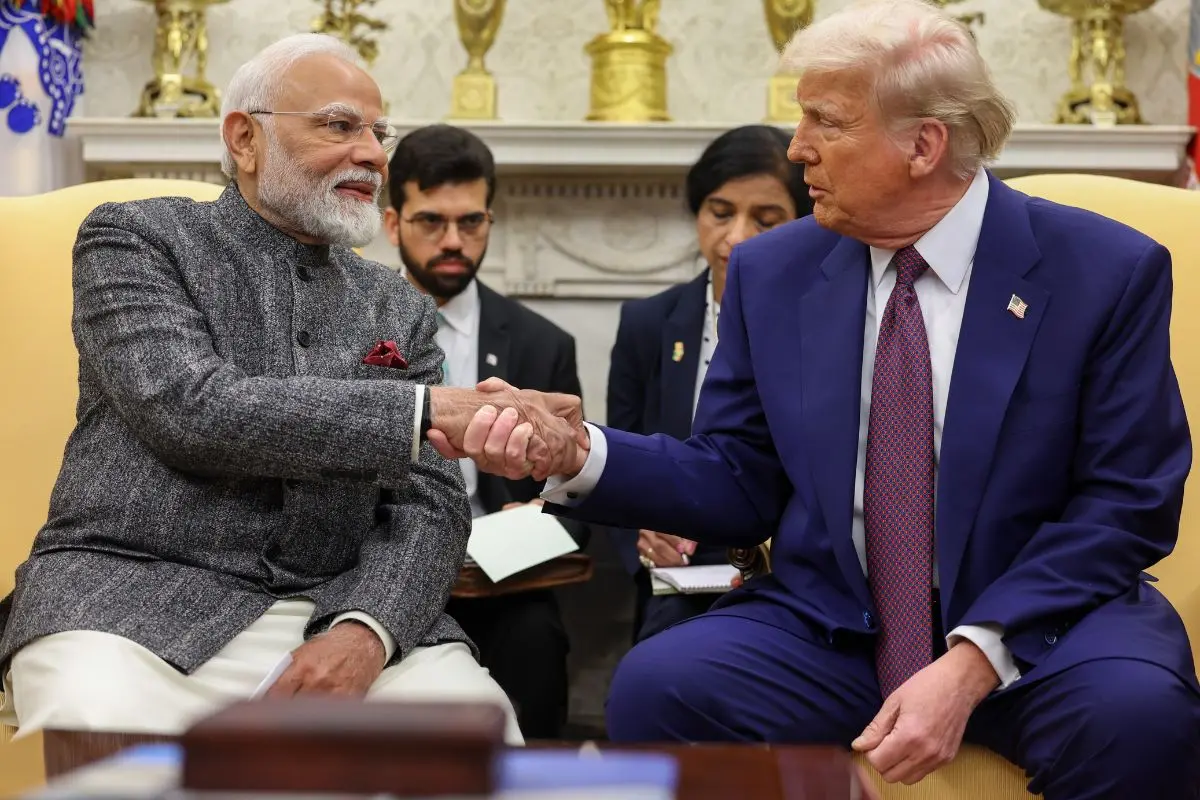
Washington: US President Donald Trump has expressed confidence that the United States and India will reach a trade agreement, describing Prime Minister Narendra Modi as a close friend as negotiations between the two countries continue.
Speaking to reporters in the Oval Office on Thursday, Trump said a deal would be achieved because of the strong relationship between the two leaders.
"We will get to a deal because I like your prime minister a lot. He is a good friend of mine. We get along great, and we are gonna make a deal," Trump said.
His remarks came as India and the US continue discussions on an interim bilateral trade agreement aimed at strengthening economic ties between the two countries.
Trade talks continue after four days of negotiations
A US delegation was in India earlier this week for four days of negotiations, with the latest round of talks concluding on Thursday.
India's Commerce Ministry said the discussions were conducted in a spirit of cooperation and pragmatism. Both sides reaffirmed their commitment to finalising a mutually beneficial agreement that would deepen bilateral trade and economic engagement.
Responding to a question on the ongoing negotiations, Trump criticised India's past tariff policies, claiming that American companies had faced high duties while the US imposed few barriers on Indian businesses.
"They charged tremendous amounts of tariffs to our companies, and we didn't charge them anything," he said.
Trump cites Harley-Davidson tariff dispute
Trump also referred to Harley-Davidson, arguing that high import duties had previously limited the American motorcycle manufacturer's ability to sell its products in India.
According to Trump, India had imposed tariffs of up to 200 per cent on Harley-Davidson motorcycles, making it difficult for the company to operate in the market.
"In the past, they wouldn't let Harley-Davidson sell its motorcycles. They charged a 200 per cent tariff, so Harley-Davidson was precluded. They ended up going to India and building their own plants, which is unfortunate that that happened, but it happens. It was before me," he said.
Trump contrasted this with the treatment of Indian motorcycle manufacturers in the United States, saying they did not face similar barriers.
"They sold motorbikes here, too. You know (how much) we charged them? Nothing. And now it's the exact reverse. We're making a lot of money with India," he said.
Trade framework revised after Supreme Court ruling
India and the US had outlined the framework for the first phase of a Bilateral Trade Agreement (BTA), or interim trade deal, in a joint statement issued on February 7 following a telephone conversation between Trump and Modi.
Under that framework, the US had agreed to reduce tariffs on India to 18 per cent from 50 per cent. It also removed a 25 per cent tariff on Indian goods that had been linked to India's purchases of Russian oil and was expected to reduce the remaining 25 per cent tariff to 18 per cent under the proposed agreement.
However, the process was affected after the US Supreme Court ruled on February 20 against Trump's broad reciprocal tariffs imposed under the International Emergency Economic Powers Act (IEEPA) of 1977.
Following the ruling, Trump announced a 10 per cent tariff on imports from all countries for a period of 150 days, beginning on February 24.
India and the United States have since been renegotiating elements of the trade agreement in light of the court's decision and subsequent policy developments.