Three engines, fresh momentum: Tejas Mk1A production gets a boost
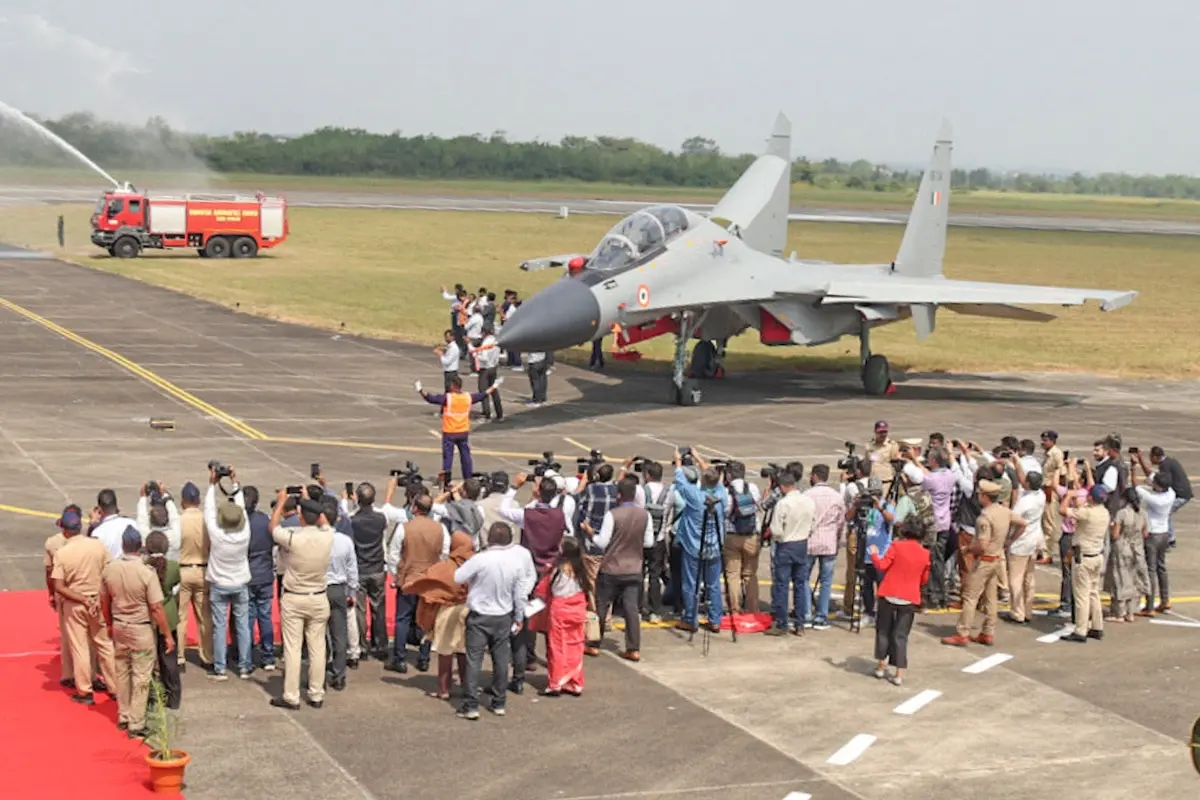
For a fighter aircraft, an engine is not just another component. Without it, even a nearly completed aircraft cannot take to the skies. This is why the latest delivery of three F404-IN20 engines from GE Aerospace to Hindustan Aeronautics Limited (HAL) is important for India’s Tejas Mk1A programme.
GE Aerospace has confirmed that it shipped the three engines to HAL in August 2026. The delivery comes at a time when HAL is trying to increase the pace of Tejas Mk1A production and deliveries to the Indian Air Force (IAF). Engine availability has been one of the key challenges affecting the programme in recent years.
Why three engines matter
Three engines may sound like a small number for a programme involving 180 fighter aircraft. But in aircraft manufacturing, every engine can make a difference. HAL has maintained that its production facilities are ready to build the Tejas Mk1A. However, the aircraft cannot be completed and handed over to the IAF without its engine.
The latest shipment therefore provides some relief to a production line that has been waiting for a more regular flow of F404 engines. With the latest delivery, reports indicate that HAL has now received 10 F404-IN20 engines for the Mk1A programme. HAL is also expecting more engines in the coming months as it works to accelerate aircraft production.
The engine supply problem
The Tejas Mk1A programme has been facing delays partly because of difficulties in getting the F404 engines from GE. GE is contracted to supply 99 F404-IN20 engines to HAL under an agreement signed in 2021. These engines are meant for the initial Tejas Mk1A fleet.
The Indian Air Force has ordered 180 Tejas Mk1A aircraft from HAL, making a steady engine supply particularly important as the manufacturer looks to increase production.
Earlier this year, former HAL Chairman D K Sunil said GE had assured the company that it would deliver 20 F404 engines between June and December 2026. He had also indicated that this could be a conservative estimate, with GE expecting to do better. The three engines delivered in August are part of this larger effort to improve the supply situation.
Why the F404 is so important to Tejas
The F404-IN20 is the engine that powers the single-engine Tejas fighter. The engine has been adapted for India's requirements and belongs to GE Aerospace's widely used F404 family. According to GE, the F404-IN20 is the highest-thrust version of the F404 family and includes features such as a higher-flow fan and single-crystal turbine blades.
The F404 has also been part of the Tejas story from its early years. GE says the engine powered the aircraft during its first test flight in 2008. But today, the bigger question is not whether the engine is suitable for Tejas. It is whether enough engines can be supplied at the right time to keep aircraft production moving.
A production line cannot move faster than its slowest link
The Tejas programme offers an important lesson about modern aircraft manufacturing. Building a fighter aircraft involves thousands of parts and systems coming together. An aircraft manufacturer may have the airframe, avionics and other equipment ready, but a shortage of one critical component can slow down the entire programme.
The F404 engine has effectively become one such critical link for the Tejas Mk1A. This is why the latest GE delivery is positive, but it should also be seen as part of a much bigger requirement. What matters now is not just receiving a few engines, but establishing a predictable supply pipeline.
For HAL, a regular flow of engines would allow the company to plan aircraft assembly, integration, testing and deliveries with greater confidence.
GE had to restart the F404 production line
There is another interesting part to this story. GE had earlier supplied 65 F404-IN20 engines to HAL for the Tejas programme, completing that commitment by 2016. With no further orders at the time, production of the engine was subsequently stopped.
When HAL placed a new order for 99 engines in 2021, GE had to restart the F404-IN20 production line after a five-year gap and reconnect suppliers across its global supply chain.
Restarting an old production line is not as simple as switching a machine back on. Suppliers have to be brought back into the chain, manufacturing capacity has to be restored and quality and production processes have to be brought up to the required standards.
That experience has highlighted a larger issue for India's defence manufacturing ambitions: having an aircraft design and a manufacturing facility is only one part of the equation. A dependable supply chain for critical systems is equally important.
India's bigger challenge is reducing supply dependence
The Tejas is one of India's most important indigenous fighter programmes and is expected to play a major role in strengthening the IAF's fighter fleet. At the same time, the engine remains an area where India continues to depend on an overseas supplier.
This makes the F404 supply situation strategically important. India is working towards building a stronger domestic aerospace and defence manufacturing ecosystem. But large and complex programmes often involve a mix of Indian and international technologies.
The Tejas experience shows that localisation is not only about manufacturing more aircraft in India. It is also about ensuring that critical components can be supplied reliably and, wherever possible, developed and manufactured domestically over the longer term.
The road ahead for Tejas
The delivery of three more engines is certainly a positive development for HAL and the Tejas Mk1A programme. But the real test will be the pace and consistency of future deliveries. HAL has a large order to execute, while the IAF is looking to strengthen its fighter fleet. The faster the engine supply becomes stable, the easier it will be for HAL to move aircraft through its production and testing pipeline.
HAL has also imposed contractual penalties on GE for delays in engine deliveries, with the existing contract providing for liquidated damages in case of delayed supplies. For now, the three engines are a small but important step.
The larger goal is to ensure that India's Tejas production line does not remain ready and waiting for its most important component. For the country's indigenous fighter programme, a reliable engine supply could be the difference between having aircraft in production and having aircraft ready for delivery.