'Why different standards for India?': SC questions food companies over double standards
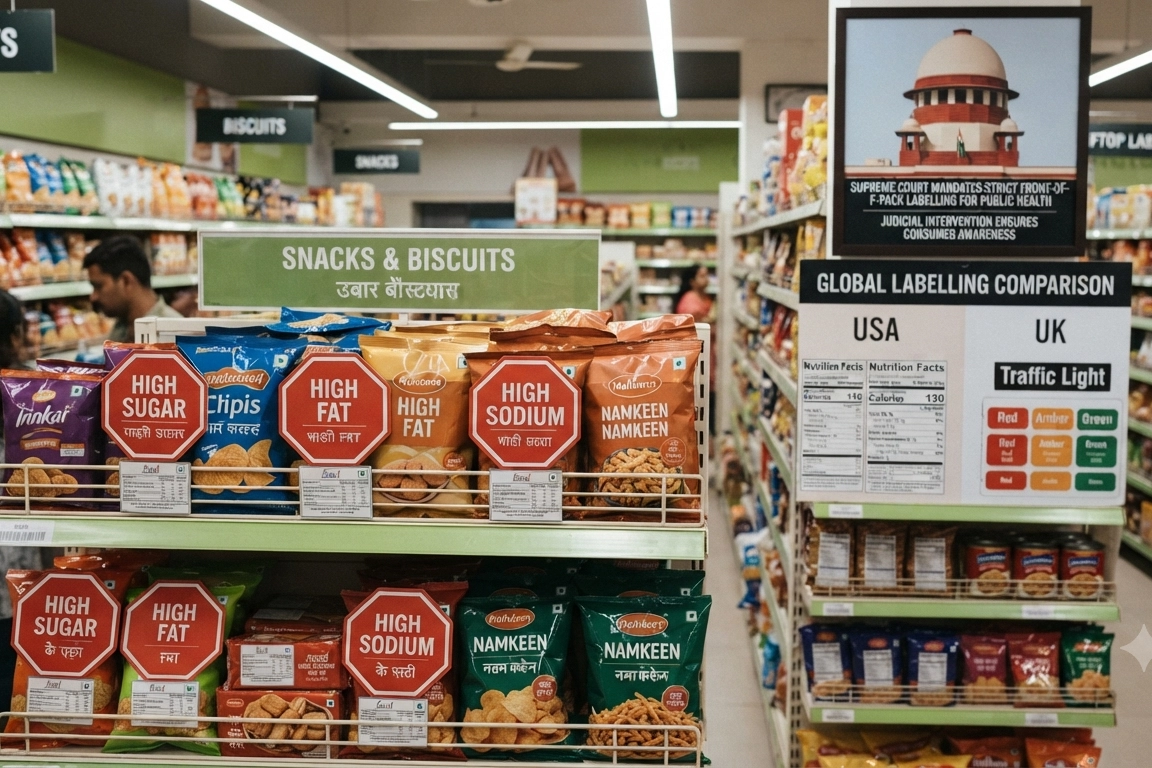
New Delhi: A consumer in India enjoys similar protection as that one has in the US or the UK, the Supreme Court said on Thursday while tightening the food labelling measures on packaged products in the country.
A bench of justices J B Pardiwala and K Vinod Chandran noted that concerns have been raised that certain multinational Food Business Operators (FBOs) operating here adopt practices towards Indian consumers that differ from those they follow elsewhere, including in the composition of their products and in the information provided on their labels.
"Such companies comply with, and in some instances voluntarily adopt, FoPNL (front-of-package nutrition labelling) requirements in other jurisdictions, yet resist similar measures here. If true, such double standards are deeply troubling," the bench said.
"A consumer in India is entitled to no less protection, and no less information, than a consumer in the United States or the United Kingdom," it said.
The top court urged such multinational FBOs to adopt uniform standards across jurisdictions, and to extend to Indian consumers the same regard and respect for their health that they extend to consumers elsewhere.
Front-of-package nutrition labelling (FoPNL) is a nutritional information graphic on food packaging that can assist consumers in making an informed decision about food purchases and healthier dietary choices.
The bench directed the Food Safety and Standards Authority of India (FSSAI) to ensure that FoPNL treats "total sugars" and "saturated fat", rather than "added sugar" and "added fat", as nutrients-of-concern, alongside "salt", in alignment with its own long-standing consensus existing prior to the DGI (Dietary Guidelines for Indians), 2024.
The apex court delivered its verdict on an application filed in a petition by public charitable trust '3S and Our Health Society' which sought directions to the Centre, states and Union territories to implement mandatory FoPNL on packaged foods.
Passing a slew of directions, the bench said, "As regards sweetened beverages that do not exceed the threshold limits for the relevant nutrient-of-concern, the FSSAI shall ensure that no front-of-pack label which is identical or deceptively similar, in appearance, form or shape, to the warning label required for beverages that exceed the threshold limits, is displayed for the purpose of denoting its food category."
It directed the FSSAI to ensure that each hexagon in FoPNL carries a standardised pictorial representation of the nutrient-of-concern, together with the corresponding words "High Fat", "High Sugar" or "High Salt", as the case may be.
It said FSSAI should fix the size of each hexagon in proportion to the principal display panel of the package, such that each hexagon occupies not less than four/five percent of that panel as evidenced by international practices, unless explicit reasons to the contrary exist as stated in Section 18(2)(a)(ii) of the Food Safety and Standards Act, 2006.
The bench said the FSSAI should also prescribe the font size of the text within each hexagon such that it is prominent, conspicuous and readily legible to consumers when viewed together with the pictorial representation of each nutrient-of-concern under normal conditions of purchase and use.
The top court directed the FSSAI to ensure that a robust and exhaustive list of foods, both solid and liquid, which are to be exempted from the application of FoPNL is provided, with sufficient clarity and reason, while simultaneously ensuring that products which must be included in the framework do not escape the warning label.
It said as regards artificial preservatives and other additives, the FSSAI should closely monitor the reformulation of products following the introduction of the FoPNL.
"Where it finds that such additives are being used to offset or defeat the objective of the FoPNL, the FSSAI shall take appropriate measures, including, where necessary, revising the existing regulations in accordance with the statutory process, to curb such use," the bench said.
It said the matter would be listed after 10 weeks for the FSSAI to share the progress on the draft regulations and place an affidavit in that regard before the court.
(Except for the headline, this story has not been edited by Mathrubhumi and is published from a syndicated feed.)