Wangchuk refuses IV fluids despite health concerns; CJP blames police brutality for continued fast
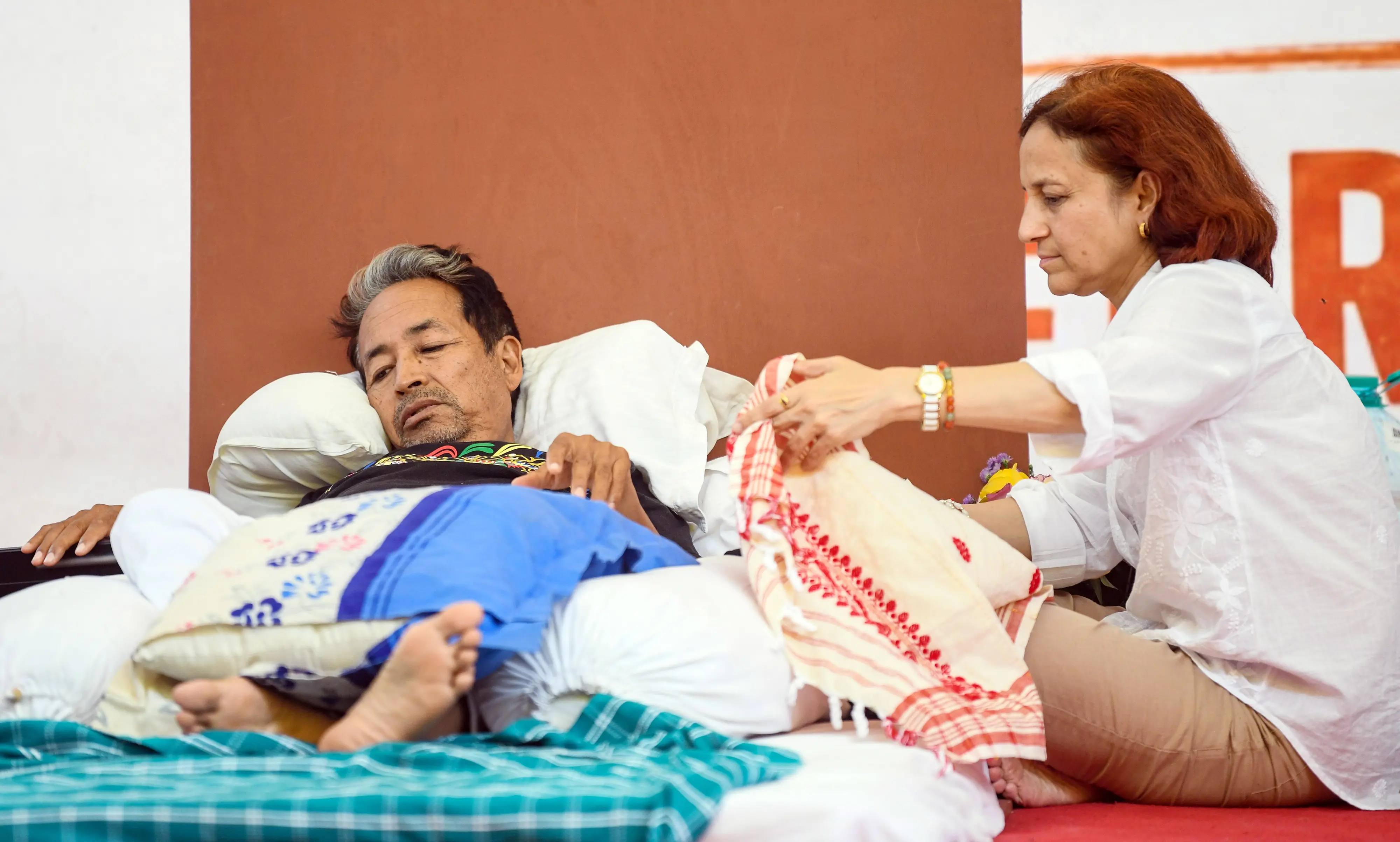
Climate activist Sonam Wangchuk remains under close medical supervision at Delhi's Safdarjung Hospital, where doctors say his vital parameters are stable but his condition continues to require constant monitoring after more than three weeks of fasting.
Wangchuk, who has been on a hunger strike demanding the resignation of Union Education Minister Dharmendra Pradhan over the alleged NEET examination paper leak, was admitted to the hospital on July 18 after his health deteriorated.
While his condition is stable, doctors say several clinical indicators remain a cause for concern.
How is Sonam Wangchuk's health?
According to a health bulletin issued by Vardhman Mahavir Medical College (VMMC) and Safdarjung Hospital, Wangchuk's blood sugar levels continue to remain low, while his serum potassium level was measured at 3.2 mEq/L from a sample collected on Monday night.
He is also suffering from persistent pancytopenia, a condition characterised by anaemia and low white blood cell counts. Doctors said these findings require continuous assessment through serial laboratory investigations.
"At present, Sonam Wangchuk's vital parameters remain stable. However, his blood sugar levels continue to remain on the lower side. His serum potassium level... stands at 3.2 mEq/L, and he continues to have persistent pancytopenia, characterised by anaemia and low leukocyte counts. These clinical and laboratory parameters warrant continued close monitoring through serial investigations," the hospital said.
The hospital said Wangchuk is being treated with oral rehydration solution (ORS) and oral potassium supplements. However, it added that he has repeatedly refused intravenous fluids and glucose despite medical advice.
"He continues to decline intravenous fluids and glucose administration despite repeated medical advice. In view of his ongoing mild to moderate dehydration, persistent laboratory abnormalities, and the physiological stress associated with prolonged fasting, sustained medical supervision and continuous clinical monitoring remain essential," the hospital said.
Doctors added that all necessary medical care is being provided and that further treatment will depend on his clinical progress and laboratory findings.
Why did Wangchuk decide against ending his hunger strike?
According to Abhijeet Dipke, founder of the Cockroach Janta Party (CJP), Wangchuk had agreed to end his fast after supporters appealed to him to prioritise his health.
"Yesterday, Sonam Wangchuk was about to end his hunger strike. We had persuaded him with great difficulty. Yesterday was the 23rd day of his hunger strike, and we had convinced him with great difficulty to break it. We told him, 'Sir, please break your hunger strike; we cannot put your life in further danger. Your life is too much, too valuable for this country,'" Dipke said.
He claimed Wangchuk changed his mind after witnessing the previous day's events during the protest in Delhi.
"He had somehow agreed, but seeing yesterday's brutality, seeing the police's brutality, Sonam sir has decided to continue his hunger strike. He has announced that he will not back down. This is very serious," Dipke said.
Referring to Wangchuk's health, Dipke said discussions with doctors and the activist's family suggested that a prolonged hunger strike carries significant risks.
"From the conversations I've had with Sonam sir, his doctors, and his wife, a human body can tolerate a hunger strike for about 20 to 21 days. Beyond that, his life would be in threat. While he was here, his muscle mass was decreasing, and the doctors had already said that in three to four days, his organs could also get damaged," he said.
Dipke further claimed Wangchuk's decision to continue fasting was influenced by the police action during Monday's protest.
"It is very unfortunate that a person has to extend his hunger strike... seeing the police's brutality yesterday, seeing how the police oppressed the children and beat them with lathis, he will continue his hunger strike," he said.
Meanwhile, Delhi Police have registered FIRs against unidentified persons over alleged vandalism, stone-pelting and damage to police vehicles during the protest march towards Parliament. Police said investigations into the incidents are underway.