‘Satirical youth party questions govt’: Did India invoke CJP protests to counter UN criticism?
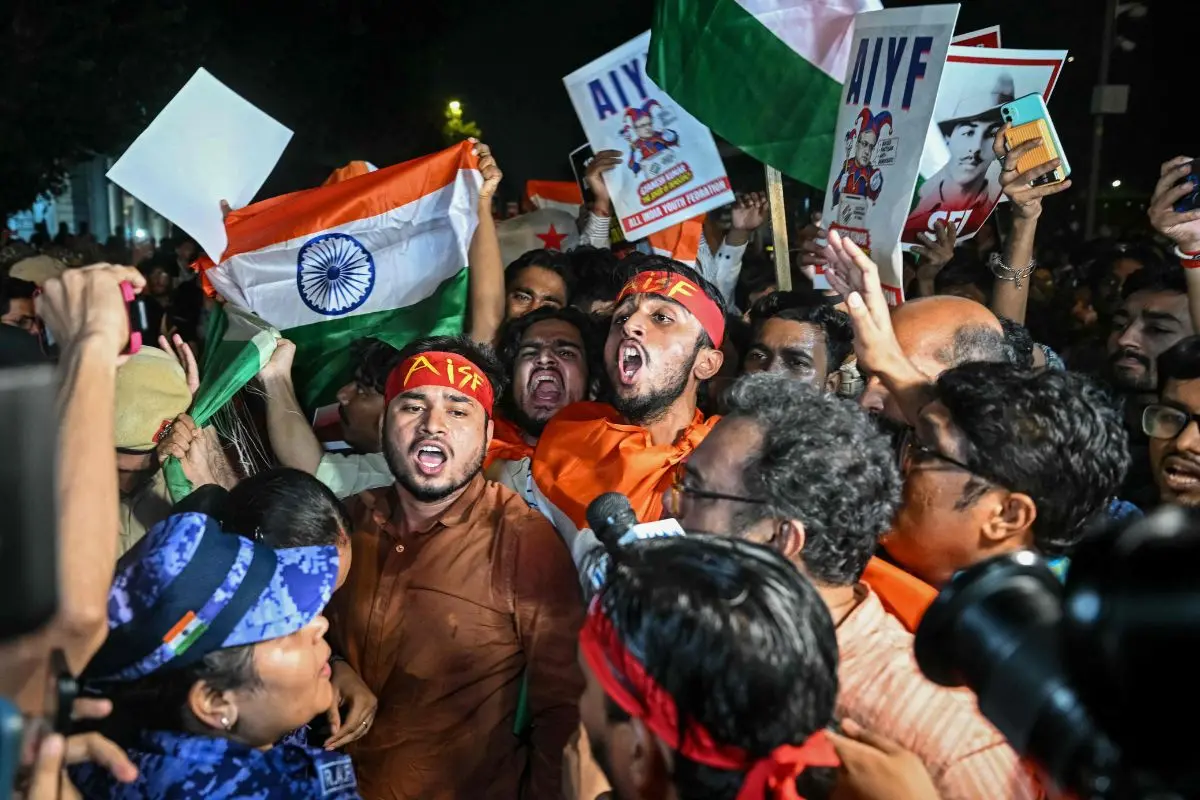
New York: Did India indirectly refer to the Cockroach Janta Party (CJP) protests while defending its record on democratic freedoms at the United Nations? A remark by Indian diplomat Anuj Swarup about a satirical youth political movement questioning the government, marching on the national capital and engaging with senior leaders has drawn attention amid the ongoing debate over youth-led protests in India.
Speaking at the 81st session of the United Nations General Assembly (UNGA) Third Committee, Swarup cited the emergence of a satirical political movement in India to challenge allegations by UN Special Rapporteur Gina Romero that young people in the country face retaliation or stigmatisation for discussing issues such as mental health and gender justice.
Although Swarup did not identify the political movement by name, his reference to a satirical youth party challenging the government and marching on the capital raises the question of whether he was alluding to the CJP movement.
“Ironically, the same report notes that young Indians created a satirical political movement. In which repressive state does a satirical youth party question the government, marches on the capital, and then sits across the table with senior national leaders? The High Commissioner for Human Rights stated in the Human Rights Council last month that dialogue with young leaders is far more effective in the context of youth-led movement in India. Perhaps that update escaped the special rapporteur's attention,” Swarup said.
The remarks formed part of India's response to Romero's report on the rights to freedom of peaceful assembly and association.
Swarup argued that the ability of young people to establish a satirical political movement, openly question the government and interact with senior national leaders demonstrated the space available for political participation in India.
However, the diplomat's statement did not explicitly mention the CJP or its founder Abhijeet Dipke.
India rejects UN rapporteur's allegations
During the interactive dialogue with Romero, Swarup strongly rejected allegations concerning the treatment of young people in India, questioning the evidence cited in her report.
India's Permanent Mission to the United Nations in New York subsequently shared his statement on X.
“Madam Chair, India takes note of the report of the special rapporteur on freedom of peaceful assembly and association. In India, these freedoms, together with freedom of speech and expression, are guaranteed to every citizen under Article 19 of our Constitution, and are protected by an independent judiciary, a free press, and an empowered National Human Rights Commission,” Swarup said.
The Indian diplomat accused the Special Rapporteur of relying on anonymous submissions to make sweeping observations about the condition of young people in the country.
“Yet, the special rapporteur, Ms Gina Romero, asserts that young people in India face retaliation or stigmatisation for discussing mental health or gender justice, though merely citing unnamed submissions in the footnote. This level of arbitrary report writing is precisely the reason that the United Nations and its institutions have lost credibility. A sweeping charge against the world's largest youth population resting on anonymous and unverified claims is not evidence. It is hearsay, dressed up as a UN report, and my delegation rejects it outright,” he said.
Swarup maintained that allegations involving India's youth population should be supported by credible and verifiable evidence rather than unnamed submissions.
Satirical political movement cited as example of democratic participation
The reference to a satirical youth political movement emerged as one of the notable elements of India's rebuttal.
Swarup questioned how a political organisation formed by young people could openly challenge the government, organise a march to the capital and hold discussions with senior national leaders if the country were suppressing democratic participation.
He also referred to observations made by the UN High Commissioner for Human Rights at the Human Rights Council last month, particularly the emphasis on dialogue with young leaders.
The diplomat suggested that Romero's assessment had failed to adequately consider such developments.
His remarks raised the possibility of a reference to the CJP protests, although the statement itself offered no explicit confirmation of that connection.
India highlights response to student protests
Swarup also cited the government's handling of student demonstrations over irregularities in public examinations as an example of what he described as constructive engagement with young people.
He said the government had responded to the protests through legislative changes and institutional reforms aimed at tackling examination fraud.
“When students protested this summer over irregularities in public examinations, the government engaged constructively with the youth. Within weeks, Parliament amended the Public Examinations Act, doubling punishments for paper leaks, carried out a systemic examination overhaul, and created fast-track courts in every state specifically dedicated to prosecuting individuals involved in exam fraud. This is the true testament of democracy in action,” he said.
According to Swarup, the measures demonstrated that the government was willing to address concerns raised by students through democratic and legislative processes.
Over five million youth participated in government initiative
The Indian representative further highlighted the participation of young people in national policymaking, citing the Viksit Bharat Young Leaders Dialogue.
He said more than five million young people had participated in the initiative this year and contributed to discussions on national priorities.
“Youth represents our strength and shared future. In the words of our Prime Minister, ‘Youth's capability will become India's capability, and their success will take India's success to new heights.’ Over 5 million young people took part in the Viksit Bharat Young Leaders Dialogue this year, shaping national priorities directly with the Prime Minister. Several ministers, including the honourable Prime Minister, continue to engage with the youth of our country directly and through social media,” he said.
Swarup presented the initiative as another example of the government's efforts to encourage youth participation and direct engagement with political leadership.
'Verify before she vilifies'
Concluding his intervention, Swarup urged the UN Special Rapporteur to exercise greater caution and scrutiny before making observations about India's human rights record.
He argued that relying on anonymous inputs to draw conclusions about a country of 1.4 billion people undermined the credibility of the reporting process.
“Chair, a mandate holder who relies on anonymous inputs to generalise for 1.4 billion people does a disservice to the very mandate she holds. We urge this special rapporteur to verify before she vilifies and to bring the required rigour and fairness in her reports,” he said.
Earlier on Thursday, Romero had announced that she would present her latest report to the UN General Assembly, highlighting concerns about restrictions faced by young people in several countries.
"Tomorrow I will present my new report to the UN General Assembly. Youth are an important actor, and many States repress, stigmatize and exclude them," she wrote on X.
Romero, a Colombian human rights advocate, serves as the UN Special Rapporteur on the rights to freedom of peaceful assembly and of association.