Sanskrit to save the nation? Amit Shah calls it mother of nearly all Indian languages
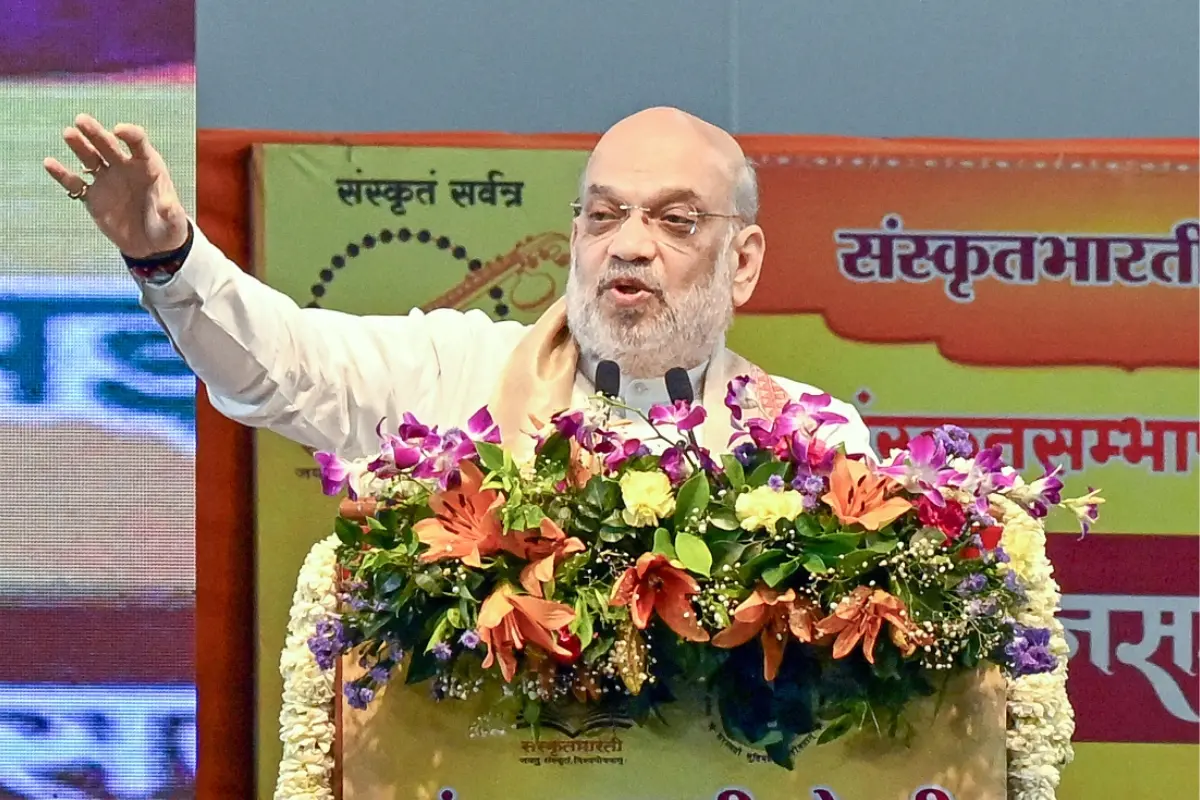
New Delhi: Union Home Minister Amit Shah, addressing the closing ceremony of the 1008 Sanskrit Sambhashan Shivirs in New Delhi on Sunday, described Sanskrit as the "mother of nearly all Indian languages" and said its promotion is closely tied to the country’s broader cultural and educational agenda.
Shah asserted that Sanskrit is among the most scientifically structured languages, a view also held by many linguistic scholars globally. He claimed that its revival would have a cascading positive impact on other Indian languages and dialects.
The event was organised by Sanskrit Bharati, an organisation working since 1981 to promote spoken Sanskrit. Shah commended the initiative for its scale, claiming that over one crore individuals have been introduced to Sanskrit conversation, with thousands of teachers and entire families now using Sanskrit as their primary language in certain parts of India.
He further stated that the decline of Sanskrit predates colonialism and called for long-term efforts for its revival. Shah mentioned that under the current central government, various programmes have been initiated to support Sanskrit’s growth. These include:
The ‘Ashtadashi’ scheme covering 18 projects for Sanskrit development.
Central support for the publication and reprinting of rare texts.
Increased honorariums for recognised Sanskrit scholars.
The elevation of Rashtriya Sanskrit Sansthan to Central Sanskrit University status.
He also referred to the Gyan Bharatam Mission, which has a corpus of ₹500 crore aimed at collecting, preserving, and digitising Sanskrit and Prakrit manuscripts. According to data shared, over 52 lakh manuscripts have been documented, 3.5 lakh digitised, and 1.37 lakh made publicly available through the namami.gov.in portal.
The home minister cited the new National Education Policy (NEP) as placing strong emphasis on India’s traditional knowledge systems, including Sanskrit. He also referenced the ‘Sahasra Chudamani Yojana’, under which retired Sanskrit scholars are being appointed as educators.
Shah argued that Sanskrit holds key insights across disciplines such as medicine, mathematics, astronomy, and philosophy, and that preserving these manuscripts is essential for knowledge transmission. However, independent scholars and linguists have long debated claims regarding Sanskrit’s primacy or exclusivity as a root language for all Indian tongues, noting the influence of other language families like Dravidian and Austroasiatic.
According to organisers, Sanskrit Bharati now operates in 26 countries with 4,500 centres and has conducted the World Sanskrit Book Fair in 2011.
Delhi Chief Minister Rekha Gupta was also present at the event.