Owaisi and Chandrashekhar Azad launch third front in UP, project Azad as CM candidate
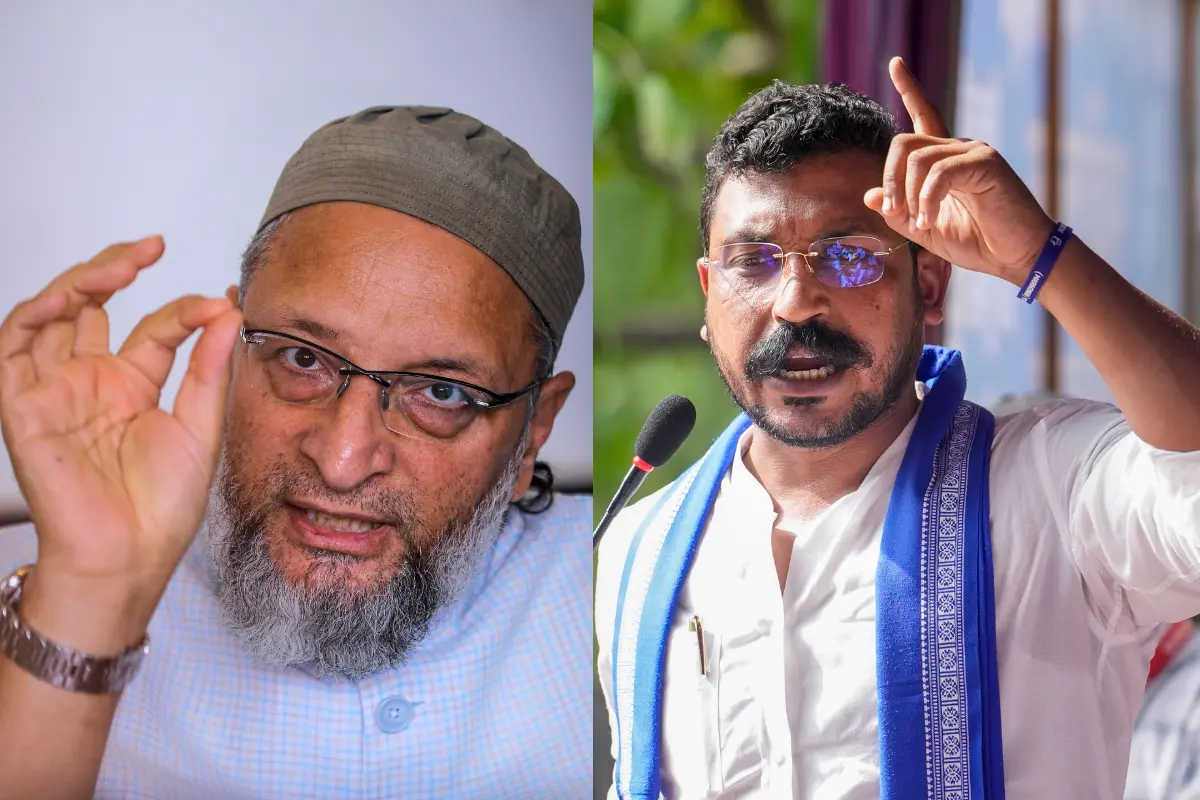
Uttar Pradesh: Ahead of the 2027 Uttar Pradesh Assembly elections, AIMIM chief Asaduddin Owaisi and Azad Samaj Party (Kanshiram) president Chandrashekhar Azad have announced a political alliance called the Samajik Parivartan Morcha, positioning it as a possible third front in the state's electoral contest.
At a joint press conference in Lucknow on Thursday, November 12, the two leaders announced the alliance and named Chandrashekhar Azad as its chief ministerial candidate. The announcement marks an attempt to bring together political support among Muslim and Dalit communities, two significant voter groups in Uttar Pradesh.
The alliance has also outlined health, education and employment as its key priorities. Addressing the press conference, Azad promised free education up to Class 12, improved healthcare facilities and greater employment opportunities for young people.
Why the Owaisi-Azad alliance matters
The new political formation comes at a time when opposition parties are preparing to challenge the BJP government, which has been in power in Uttar Pradesh for a decade.
The Samajwadi Party, led by Akhilesh Yadav, remains a major opposition force and is looking to build an electoral challenge with the Congress. The entry of the AIMIM-Azad Samaj Party alliance could complicate the opposition's vote calculations, particularly in constituencies where Muslim and Dalit voters have a significant presence.
Muslims account for around 20 per cent of Uttar Pradesh's population, while Dalits make up approximately 21 per cent. The alliance appears to be seeking support among these communities, although its actual electoral influence will depend on its candidates, local organisation and ability to convert its political messaging into votes.
Owaisi's earlier attempts to join the opposition camp
Owaisi had previously sought a place in a broader opposition alliance in Uttar Pradesh and had urged the Samajwadi Party and Congress to consider working with the AIMIM. However, those efforts did not result in an agreement.
The Samajwadi Party and Congress are currently engaged in discussions over their electoral arrangements. Both parties have played down the significance of the new alliance.
Samajwadi Party MP from Ayodhya, Awadhesh Prasad, dismissed the tie-up's potential electoral impact, arguing that voters had lost faith in the BJP government and that Akhilesh Yadav was best placed to challenge it.
Congress MP Imran Masood said political parties were free to form alliances, adding that the Congress would decide its own electoral strategy.
The BJP, meanwhile, dismissed the new formation as lacking a clear agenda and expressed confidence that it would not pose a serious challenge in the state.
Could the alliance affect the BJP's electoral prospects?
The possible impact of the new alliance can be examined through the results of the 2022 Uttar Pradesh Assembly elections.
An analysis of those results points to 58 constituencies where BJP candidates finished second. In several of these seats, the combined support of Muslim, Dalit and backward-community voters played a role in determining the outcome.
Some constituencies witnessed particularly narrow margins. In Sirathu, Deputy Chief Minister Keshav Prasad Maurya lost to Pallavi Patel by 7,337 votes. In Itawa, the BJP candidate lost by a margin of just 1,662 votes. In Chandpur, Ramnagar, Isauli, Dibiyapur and Dumariyaganj, the winning margins ranged from 234 to 771 votes.
The emergence of another political front could become significant in such closely contested constituencies. If candidates backed by the new alliance attract even a few thousand votes, they could potentially influence the contest between the BJP and its principal rivals.
However, this does not automatically mean that the alliance would benefit one party or damage another. Its impact will depend on which communities support its candidates, the constituencies where it contests and whether it draws voters away from the BJP, the opposition or both.
Why the 2027 political equations may differ from 2022
The political landscape has changed considerably since the previous Assembly elections.
In 2022, the Rashtriya Lok Dal, led by Jayant Chaudhary, and the Suheldev Bharatiya Samaj Party, led by Om Prakash Rajbhar, were part of the Samajwadi Party-led alliance. Both parties are now aligned with the BJP.
The RLD has a support base in western Uttar Pradesh, while the SBSP has influence among sections of the Rajbhar community. Their shift in political alignment means that the opposition's electoral arithmetic is different from what it was in 2022.
This also makes it difficult to use the previous election results alone to predict the outcome of the next contest. The new Owaisi-Azad alliance adds another variable to an already changing political landscape.
What lies ahead for the Samajik Parivartan Morcha?
The alliance has announced its chief ministerial candidate and identified broad policy priorities, but several questions remain unanswered. Its seat-sharing arrangements, candidate selection, organisational reach and detailed election manifesto will be important indicators of its political strength.
The challenge will be to translate its proposed Muslim-Dalit support base into a wider electoral coalition. It will also have to establish whether it can attract voters beyond the communities it is seeking to consolidate.
For now, the Samajik Parivartan Morcha has introduced a new political player into the run-up to the 2027 Uttar Pradesh Assembly elections. Whether it becomes a decisive third force or mainly influences contests in closely fought constituencies will depend on how its campaign develops.
What the alliance could mean for UP politics
The Owaisi-Azad tie-up introduces a new variable into an election where the BJP and the Samajwadi Party-led opposition are expected to be the principal contenders.
For the Samajwadi Party: The alliance could compete for sections of the Muslim and Dalit electorate that have been important to the opposition's electoral strategy.
For the BJP: A divided opposition vote could potentially help BJP candidates in closely contested constituencies. However, the alliance could also attract voters dissatisfied with the ruling party.
For Dalit politics: Chandrashekhar Azad's position as the alliance's chief ministerial candidate gives the Dalit-focused Azad Samaj Party a more prominent role in the state's wider political contest.
For AIMIM: The alliance gives Owaisi a new route to contest the election after his attempts to secure a place in the broader opposition arrangement failed.
The central question is not simply how many votes the alliance can secure, but whose votes it will attract. Its electoral impact will depend on its ability to build support across communities and constituencies rather than relying only on the arithmetic of the 2022 results.