Outdated rules, missing readings: Why Delhi's Diwali pollution controversy is far from over | Explainer
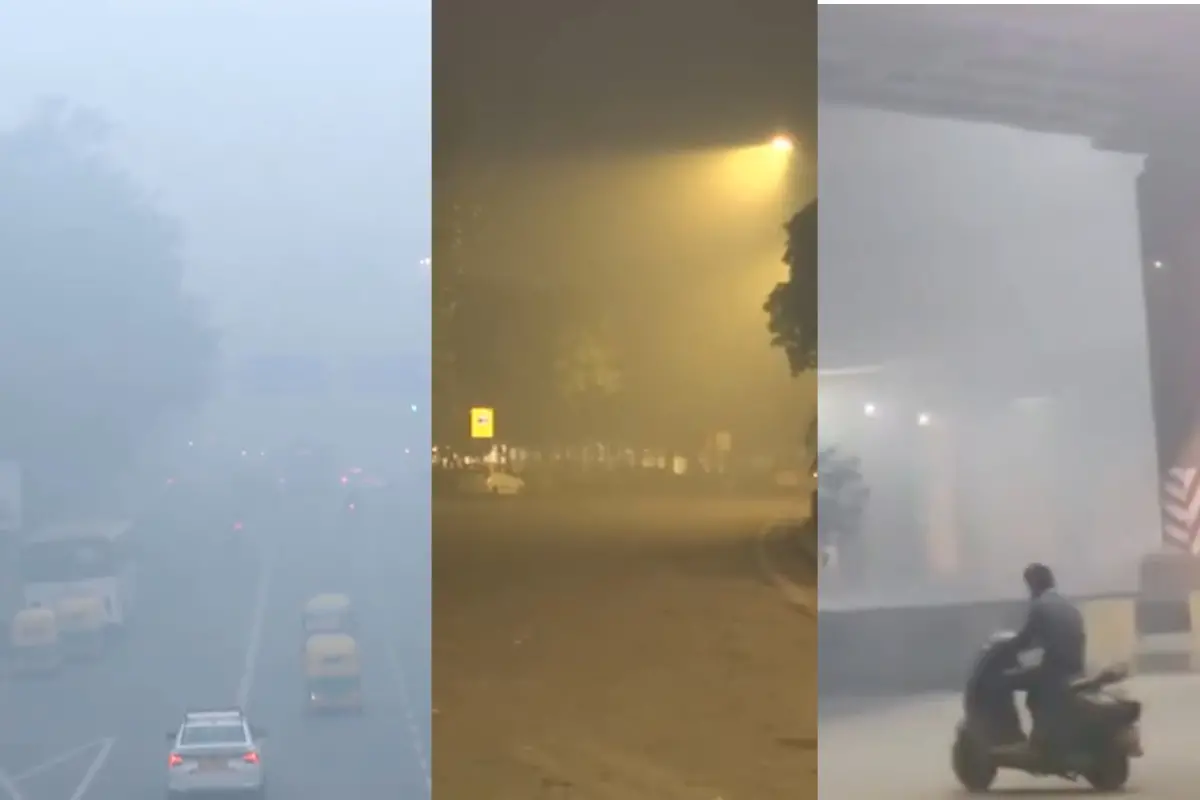
Delhi’s air quality remained stuck in the ‘very poor’ category on Wednesday morning, with the overall Air Quality Index (AQI) recorded at 308 at 8:40 am. However, a fierce political row over missing pollution data continues across the national capital. The controversy erupted after official monitors failed to record peak pollution levels on Diwali night, prompting opposition parties to allege a deliberate attempt to conceal toxic smog levels.
The Central Pollution Control Board (CPCB) issued an 11-point clarification on Tuesday, attributing missing figures to technical limits rather than under-reporting. Yet, political leaders and environmental experts argue that outdated measurement rules have left citizens in the dark during the city’s worst health crisis.
Why sensors went blank on Diwali night
The regulatory board explained that particulate matter analysers installed under the National Air Quality Index (NAQI) in 2015 were calibrated to measure concentrations only up to 1,000 micrograms per cubic metre (µg/m³). When Diwali fireworks pushed toxic PM2.5 levels beyond this ceiling—exceeding World Health Organisation (WHO) daily safety limits by up to 66 times—the automated system flagged the figures as outside range. Consequently, 45 out of Delhi’s 59 monitoring stations registered blank hourly bands.
In a statement posted on X, the CPCB stated: "The particulate matter analysers deployed at the time of introduction of the NAQI were calibrated for a measurement range of 0–1,000 µg/m³. Accordingly, consistent with this, the designed system of automated data validation treats hourly readings beyond the calibrated range as outside range, and such readings are not used in the computation". The watchdog added: "During extreme episodes, which are occasional like Diwali firecracker bursting, this may appear as a data gap at the particular station concerned, and those hours do not contribute to the 24-hour average of relevant pollutant for concerned station".
An Environment Ministry source defended the system, saying: "It is not that the data is missing. We have the data. However, that data is not used in the calculation". "Those data missing bands that you see on CPCB, we have the complete data. However, that data is not used in the calculation," the source repeated.
Opposition alleges deliberate data cover-up
This explanation has failed to satisfy political critics across party lines. Aam Aadmi Party (AAP) Delhi president Saurabh Bharadwaj questioned official integrity in a video message on X: "The government which shuts down air quality monitoring stations on the night of Diwali, the government that does data fraud, how will you trust such a government?". Senior Congress lawmaker Ajay Maken echoed the concern on social media, asking: "If Diwali night's PM2.5 (toxic particulates) is not in the record, who will answer for that air?".
Congress spokesperson Pawan Khera stressed that missing figures do not alter reality. "There is one thing the people of Delhi can be certain of: the fact that the data has gone missing doesn't mean the pollution has disappeared too," Khera remarked.
Samajwadi Party president Akhilesh Yadav also mounted a fierce attack on X. "The corrupt BJP government sitting in Delhi wants to cover up the unbearable suffering caused by pollution with a blanket of false statistics. Ask those innocent children, the sick and the elderly who are fighting for their lives with every breath what the truth about pollution levels really is," Yadav posted. He added: "The BJP was a liar, is a liar and will remain a liar".
Outdated 2015 rules spark calls for overhaul
Ministry insiders concede that while physical monitoring instruments have been upgraded over the years, the data-validation framework of 2015 remains unchanged. Internal deliberations are currently underway among two to three CPCB scientists to revise the methodology, though no formal external expert committee has been set up. "It is the right time, rather high time. It is a late thing. This should have been revised two-three years ago. If they had revised it and incorporated everything properly, these issues would not have arisen," a ministry source acknowledged.
Meanwhile, Congress leader Pawan Khera revealed that air pollution was unexpectedly dropped from the revised agenda of the Parliamentary Standing Committee on Home Affairs for its November 17 meeting. "The committee first circulated the agenda for its November 17 meeting on November 5, and it included air pollution. In the revised agenda circulated later, the issue was removed," Khera noted. "At a time when the situation demands greater urgency, the government has instead dropped the subject altogether," he charged.
Khera further pointed to an RTI response showing that a review of the National Ambient Air Quality Standards (NAAQS) initiated in 2020 remains stuck. "According to a report published in October 2026, the CPCB’s reply to an RTI query shows that the revised technical report was submitted in December 2025 and is still under consideration by the relevant steering committee. Six years on, the review remains incomplete," Khera stated. "It is clear that air quality in Delhi and across the country, and the health of the people who breathe it, is not among the government's priorities. If a matter so central to public health in the national capital can be deferred indefinitely, it raises a serious question: how seriously will public health be treated anywhere else?" he asked.
Discrepancies between official figures and private tracking platforms
Public confusion has been compounded by stark differences between official AQI numbers and private air-tracking platforms like IQAir and AQI.in. On November 9, following Diwali celebrations, AQI.in data revealed that 93 of the world's 100 most polluted cities were in India. Furthermore, when Mandir Marg monitors resumed recording eight hours after peak fireworks, readings hit 879 µg/m³—58 times the WHO daily limit.
Addressing discrepancies, the CPCB clarified that official AQI is capped at 500, which marks the upper boundary of the 'Severe' health category. "Beyond this level, the AQI remains in the 'Severe' category and extrapolation of the index would not alter the assigned health impact category," the board stated. It added: "The difference in AQI values is thus attributable to differences in measurement of pollutant concentration and in methodology, and not to under-reporting". The board explained that private apps capture short-term hourly spikes, whereas the official NAQI reflects a 24-hour running average of eight key pollutants to assess sustained health exposure.
Current ground reality and weather forecast for Delhi
On Wednesday morning, 29 out of 59 monitoring stations in Delhi reported 'very poor' air quality, while the rest recorded 'poor' levels. Severe AQI was not reported at any station. Heavily polluted localities included Chhawla (398), Chandni Chowk (383), ITO (369), and Pusa (361).
Stage III emergency restrictions under the Graded Response Action Plan (GRAP) remain enforced across Delhi-NCR, with water sprinklers deployed across roads. Relief may be on the horizon, as the India Meteorological Department (IMD) predicts rising wind speeds in the coming days to help disperse toxic smog, alongside morning mist and temperatures ranging between 14 and 29 degrees Celsius.