45 days, 65 crore devotees, over ₹3 lakh crore revenue: Maha Kumbh 2025 ends on a note of devotion
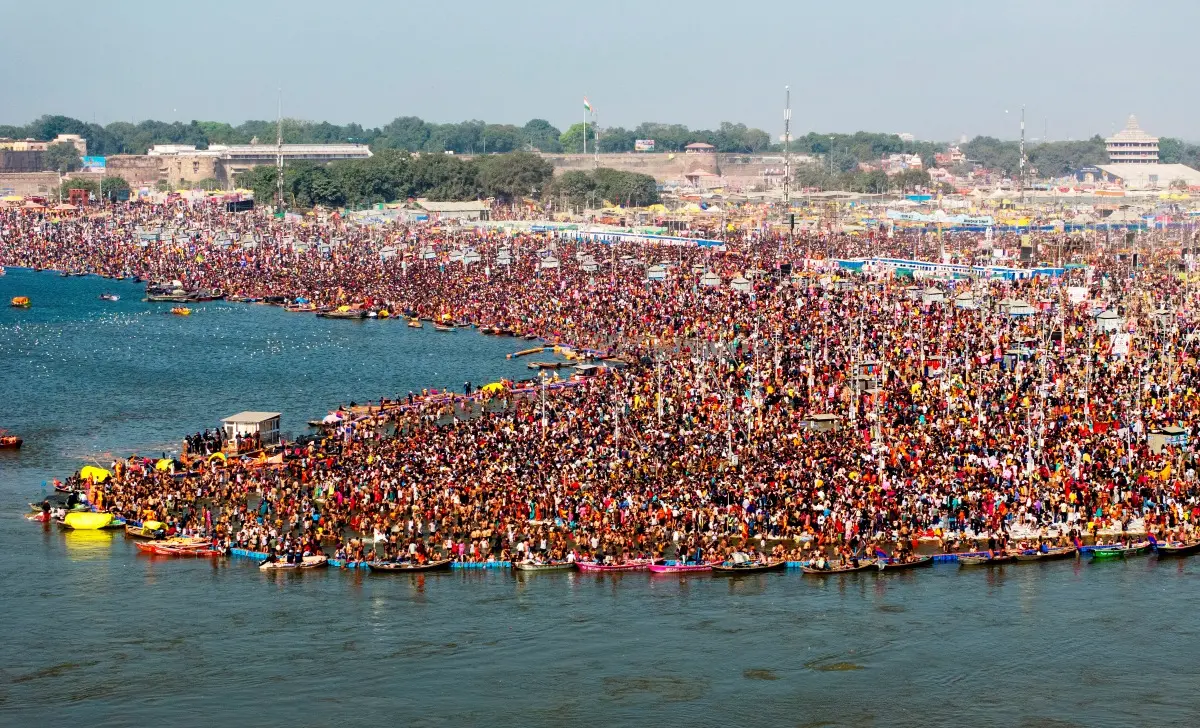
Prayagraj: As Maha Kumbh 2025 draws to a close, it leaves behind an indelible mark not just on faith and tradition but also on the economy and political discourse. With an unprecedented 65 crore pilgrims gathering in Prayagraj, the event has sparked conversations about religious devotion, economic impact, and governance challenges. From stampedes and sanitation concerns to billion-dollar economic projections, Maha Kumbh 2025 has been a spectacle of both devotion and debate.
The economic boom: A ₹3 lakh crore opportunity
The Uttar Pradesh government, led by Chief Minister Yogi Adityanath, has claimed that Maha Kumbh 2025 will inject over ₹3 lakh crore into the state’s economy. Industry experts and trade bodies, including the Confederation of All India Traders (CAIT), estimate that businesses across sectors—ranging from FMCG and hospitality to fintech and technology startups—have leveraged this mass gathering to expand their markets.
Historically, the Kumbh Mela has been a revenue-generating powerhouse. The 2013 edition yielded ₹12,000 crore against an investment of ₹1,017 crore, while in 2019, earnings skyrocketed to ₹1.2 lakh crore. With an estimated ₹7,500 crore expenditure this time, Maha Kumbh 2025 is projected to generate at least ₹2 lakh crore in returns. The Yogi government sees this as a stepping stone toward Uttar Pradesh’s $1 trillion economy ambition.
However, skepticism surrounds these figures. Opposition leaders and critics argue that while businesses may have profited, the state's infrastructure was put under immense strain. The sheer number of attendees—more than the entire population of the United States—raises questions about resource allocation and long-term sustainability.
A 144-year phenomenon or political narrative?
One of the biggest debates surrounding this year’s Kumbh Mela is whether it truly happens once in 144 years. West Bengal Chief Minister Mamata Banerjee questioned the claims that this Kumbh Mela is a once-in-a-lifetime event occurring after 144 years. She pointed out that Gangasagar takes place annually, while the Kumbh Mela is held once every 12 years. Referring to the Puri temple, she mentioned that the neem wood idol is replaced every 12 years, following specific rules and traditions. Highlighting that every place has its own customs, she noted that the Kumbh Mela was also held in 2013, based on what she had heard. She added that if her understanding was incorrect, she was open to being corrected.
Swami Avimukteshwaranand Saraswati, the Shankaracharya of Jyotish Peeth, also criticized the administration for propagating what he called "false narratives" to exaggerate the significance of this year’s event. He accused the government of failing in crowd management and disregarding the safety of pilgrims.
BJP leader Suvendu Adhikari dismissed these concerns, stating that historical and astrological calculations validate the once-in-144-years cycle. He accused Mamata Banerjee of attempting to undermine Sanatana Dharma for political gain. The debate highlights the intersection of religion and politics, where faith is often leveraged for electoral mileage.
Tragedy and chaos amidst the grand spectacle
Despite the grandeur, Maha Kumbh 2025 was marred by multiple incidents, including a tragic stampede that claimed at least 30 lives. The January 29 chaos near the Sangam banks, during the second 'Amrit Snan,' raised concerns about crowd management. Opposition parties alleged that the Yogi government concealed the actual death toll, a claim the administration has vehemently denied.
Beyond the stampede, sanitation and water quality also became contentious topics. The Central Pollution Control Board reported high levels of fecal coliform bacteria in the Ganga, raising concerns about the safety of ritual dips. However, Yogi Adityanath rejected these findings, insisting that the river remained fit for both ‘snan’ (bathing) and ‘aachman’ (ritual drinking).
Technology meets tradition: AI and underwater surveillance
For the first time in its history, Maha Kumbh saw extensive use of artificial intelligence and modern surveillance tools. Over 3,000 cameras, including 1,800 AI-enabled ones, were deployed to track footfall, ensuring security and resource management. Underwater drones monitored river activity, while over 60,000 personnel were on duty to prevent stampedes and other incidents.
Despite these advancements, the sheer volume of pilgrims made crowd control a herculean task. The event saw over half a dozen fire incidents, though no casualties were reported. This fusion of ancient tradition with modern security measures reflects India's evolving approach to managing large-scale religious gatherings.
As the final ‘snan’ on Mahashivratri marks the official conclusion of Maha Kumbh 2025, the event’s impact continues to be debated. For millions of devotees, it was a once-in-a-lifetime spiritual journey. For businesses, it was a lucrative opportunity. For politicians, it became a battleground of narratives.
(With inputs from agencies)