Kashmir free of India-born terrorists after 35 years, says Union Home Minister Amit Shah
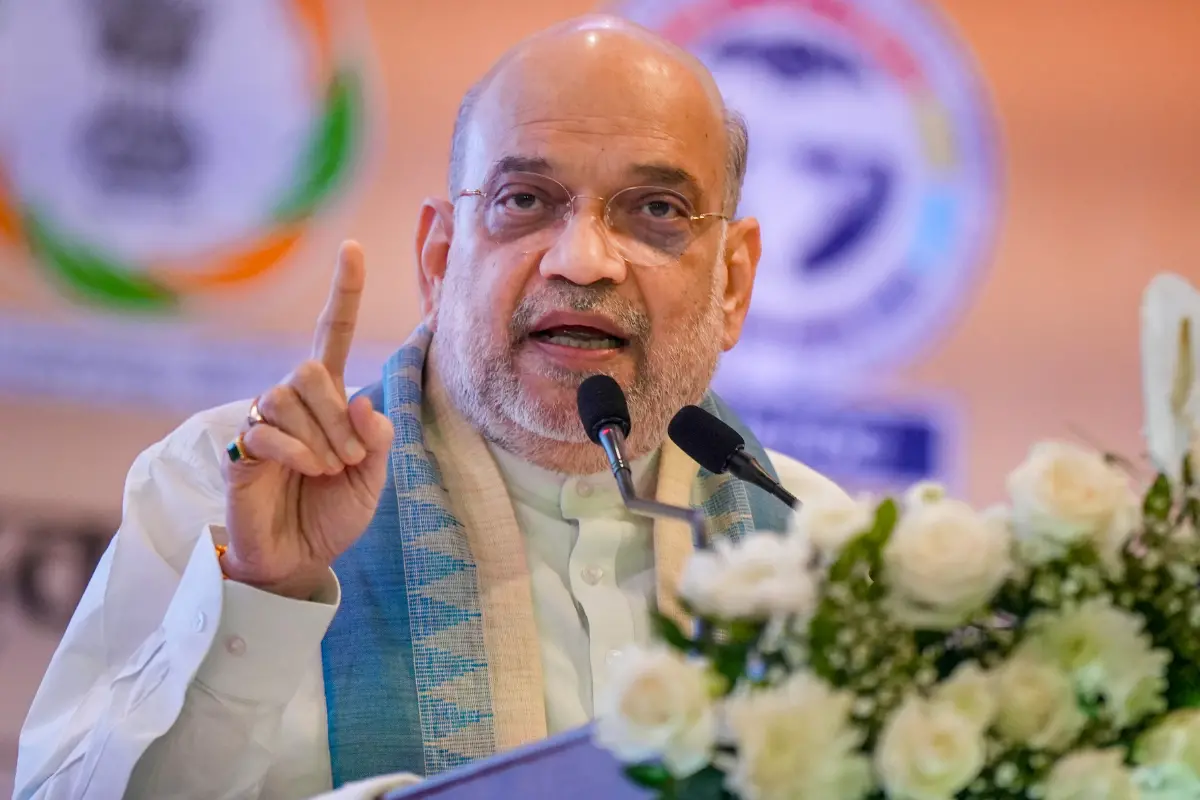
New Delhi: In what he termed a "major milestone" in the battle against terrorism, Kashmir is now free from India-born terrorists after 35 years, Union Home Minister Amit Shah declared on Thursday, whilst underscoring the necessity of reinforcing "proactive action" within the nation's counter-terrorism framework.
Addressing the annual anti-terror conference in the capital on Thursday, Shah maintained that entire terrorist networks must be thoroughly investigated and their operational capabilities dismantled through coordinated efforts.
"We will not achieve success unless we strike at the entire terrorist network in a coordinated and comprehensive manner," the minister said.
Shah attributed these tangible on-ground results to Prime Minister Narendra Modi's 'zero-tolerance' stance towards terrorism.
"With the elimination of Lashkar (Lashkar-e-Taiba) terrorist Lateef Bhat, the entire Kashmir has become free from the presence of India-born terrorists," he said, noting that the "situation has come about after 35 years."
Bhat, who carried a bounty of Rs 15 lakh and was wanted in connection with a November 11 assault on a CRPF post that wounded three paramilitary personnel, was killed by security forces on Wednesday during an encounter in South Kashmir's Kulgam district.
To eradicate the intertwined threats of terrorism, organised crime, and narcotics, Shah stated that it is imperative to bring offenders and masterminds sheltering overseas before Indian courts. Highlighting the government's crackdown on transnational syndicates, he noted that 303 fugitives have been extradited or brought back to India from 36 nations since 2019 through joint initiatives by the Central Bureau of Investigation (CBI), the Union Home Ministry, and intelligence agencies.
Shah observed that whilst India has been a victim of terrorism and has confronted such violence "for a long time", an absence of coordinated action among state police forces had previously been evident.
"Over time, during the tenures of successive governments, gradual efforts were made to overcome these shortcomings. Today, we can say with satisfaction that in this vast country -- from Kashmir to Kanyakumari and from Dwarka to Kamakhya -- we are putting in place a system under which a uniform strategy to combat terrorism will operate right down to the level of every police station," he stated.
The Home Minister cited the dismantling of the banned Popular Front of India (PFI) as a prime example of effective, synchronised policing across the country.
"In a single night, police forces from 11 states, along with central agencies, jointly dealt a major blow to the PFI network. This operation is now a case study for the entire world," Shah remarked.
He further noted that the Shahzad Bhatti Network — operated by Pakistan-based gangster Shahzad Bhatti — has been proscribed as a terrorist organisation under the Unlawful Activities (Prevention) Act (UAPA), with over 40 of its modules dismantled nationwide, resulting in more than 100 registered cases and upwards of 271 arrests.
The defining mark of an effective agency lies in apprehending operatives and incarcerating them before they can execute an attack, he said, adding that this operational model must be studied, adopted, and replicated across all regions.
Inaugurating the two-day conference organised by the National Investigation Agency (NIA), Shah advocated for an 'ecosystem approach' underpinned by deeper Centre-state collaboration, asserting that probing entire networks can preempt numerous incidents before they materialise.
Shah noted that whilst the provisions of the UAPA have been fortified on the legal front, the flow of intelligence must be made smoother and more resilient at the institutional level. He urged state administrations to bolster the cyber-expert wings of their Anti-Terrorism Squads (ATS), institute mechanisms to relay station-level intelligence up to the Director General of Police level, and prioritise a quadrilateral regional security grid in border states, where "illegal religious structures" have been completely cleared.
He pointed out that the NIA has broadened its operational footprint with 16 new branch offices, two zonal offices, and 70 special courts, alongside expanded jurisdiction to probe offences impacting Indian interests overseas. Additionally, the Multi-Agency Centre (MAC) was overhauled in 2023 utilising advanced technology to bring cybersecurity, narcotics, organised crime, and radicalisation hotspots under its ambit, alongside establishing a National Memory Bank, he said.
During the proceedings, Shah released an NIA publication titled Fail-Safe Investigation, e-launched the agency's 'Pushti' portal, laid the foundation stone for an NIA office complex in Chandigarh, and inaugurated an NIA residential complex in Maidangarhi, New Delhi. He also conferred decorations upon seven NIA officers and personnel.
Urging all attendees to ensure the conference remains "result-oriented", Shah emphasised that in counter-terrorism, "our goal must be shared, united, and there must be clear accountability."
"Unless the goal is shared, accountability in achieving that goal will be unclear, and success will be impossible," he added.
Union Minister of State for Home Affairs Bandi Sanjay Kumar, Home Secretary Govind Mohan, Intelligence Bureau Director Mahesh Dixit, and NIA Director General Rakesh Agarwal were also present at the event.
PTI