Did Justice Satish Chandra Sharma disclose his son’s ECI connection before hearing Medha Roopam’s plea?
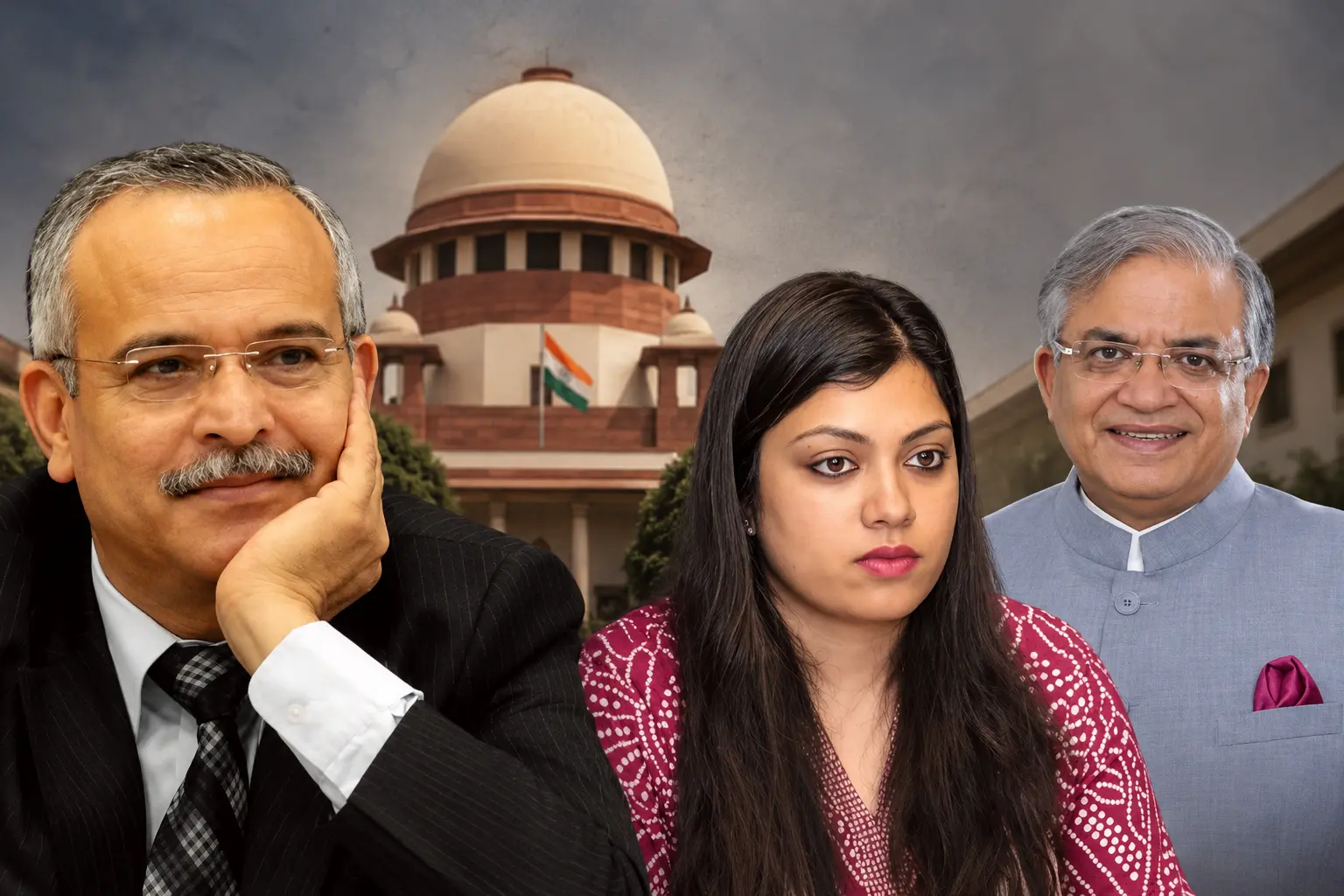
The question before a court is never merely what a judge decides. It is also whether a reasonable observer can see that decision as entirely detached from every outside interest.
That distinction has assumed significance around Supreme Court Justice Satish Chandra Sharma after a newly surfaced professional connection involving his son and the Election Commission of India (ECI).
According to details available on the Madhya Pradesh High Court website, Justice Sharma’s elder son, who enrolled as an advocate in 2017, is the standing counsel for the ECI before the Madhya Pradesh High Court.
He is also standing counsel for the Central Board of Direct Taxes and the Income Tax Department. Justice Sharma’s younger son, enrolled in 2020, is the standing counsel for the Madhya Pradesh Public Service Commission.
The disclosure acquires significance because Justice Sharma was part of the two-judge Supreme Court bench hearing challenges to the 2023 law governing the appointment of the Chief Election Commissioner (CEC) and Election Commissioners.
On September 23, Justice Sharma took the view that the challenge raised substantial questions concerning Parliament's law-making power under Article 324(2) of the Constitution and should be considered by a Constitution Bench.
Justice Dipankar Datta took a contrary view. The matter was consequently referred to a larger bench.
In his opinion, Justice Sharma also dealt with the argument that the present selection mechanism could be considered structurally biased because of the executive-heavy composition of the Selection Committee.
He held, prima facie, that the committee could not be regarded as biased merely because the executive had a dominant presence.
The issue now being raised is not, however, a claim that the judge's son’s professional association with the ECI actually influenced his judicial reasoning.
There is no established evidence presented here to make such an allegation. The question is narrower, but fundamental to judicial propriety: whether such a professional relationship creates an appearance of possible conflict that ought to be disclosed and considered by the parties.
That question becomes more striking when another matter heard by Justice Sharma's bench on the very same day is examined.
On September 23, a bench headed by Justice Sharma and comprising Justice N Kotiswar Singh granted interim relief to Gautam Buddh Nagar District Magistrate Medha Roopam in her challenge to an Allahabad High Court order concerning the detention of Delhi University student Akriti Chaudhary under the National Security Act.
The Allahabad High Court had quashed the detention and directed that Rs 5 lakh in compensation be paid to Chaudhary, with the amount to be recovered from the salaries of officials involved, including Roopam.
The Supreme Court subsequently clarified that its stay was confined to the High Court's strictures and the salary-recovery direction, and did not stay the quashing of Chaudhary's detention.
Roopam is the daughter of Chief Election Commissioner Gyanesh Kumar, a fact independently reported when she was appointed Gautam Buddh Nagar's district magistrate.
That familial connection, by itself, does not establish any impropriety.
But it adds another layer to the questions now being asked about Justice Sharma's hearing of the matter, particularly when considered alongside his son's professional connection with the ECI.
There was already a separate controversy surrounding the listing of Roopam's petition.
Legal publication LiveLaw reported that the matter was heard by the Justice Sharma-led bench even though that bench did not have the regular roster for preventive detention matters under the roster then in force.
The report also noted that connected matters arising from the same detention episode were pending before a bench led by Justice BV Nagarathna.
The unusual combination of circumstances therefore raises a larger institutional question about transparency and the appearance of impartiality.
On one side is a case concerning the constitutional framework for selecting the country's Election Commissioners.
On another is a matter involving the daughter of the incumbent Chief Election Commissioner.
And now there is the newly surfaced fact that the Supreme Court judge hearing both matters has a son who is professionally empanelled as standing counsel for the Election Commission before the Madhya Pradesh High Court.
The central issue is not whether Justice Sharma can be presumed to have been influenced by his son's professional association.
Such an inference cannot be made without evidence. Nor does a lawyer's representation of a government or constitutional body automatically establish a conflict for a judge who happens to be the lawyer's parent.
However, judicial independence has a second dimension beyond actual bias.
It also concerns public confidence that adjudication is free from relationships or circumstances that could reasonably create an impression of partiality.
The principle is often expressed in the familiar formulation that justice must not only be done, but must also be seen to be done.
Against that standard, the circumstances surrounding the two September 23 matters are likely to invite scrutiny.
It remains unclear whether Justice Sharma disclosed his son's professional connection with the ECI to the parties in the election-law challenge or in the Medha Roopam proceedings, and whether the issue was considered before the matters were heard.
Those questions are ultimately about institutional safeguards, not a conclusion about the judge's motives or the correctness of his orders.
The larger concern is straightforward: when a Supreme Court judge's immediate family member has a professional relationship with an institution that is directly at the centre of one case, and another case involves the daughter of that institution's current head, should the circumstances be disclosed and examined openly to preserve confidence in the process?
For a judiciary whose authority rests substantially on public trust, even the appearance of a conflict can become a matter worthy of examination.