Vijay’s biggest political move yet: 23 ministers sworn in as Congress returns after decades
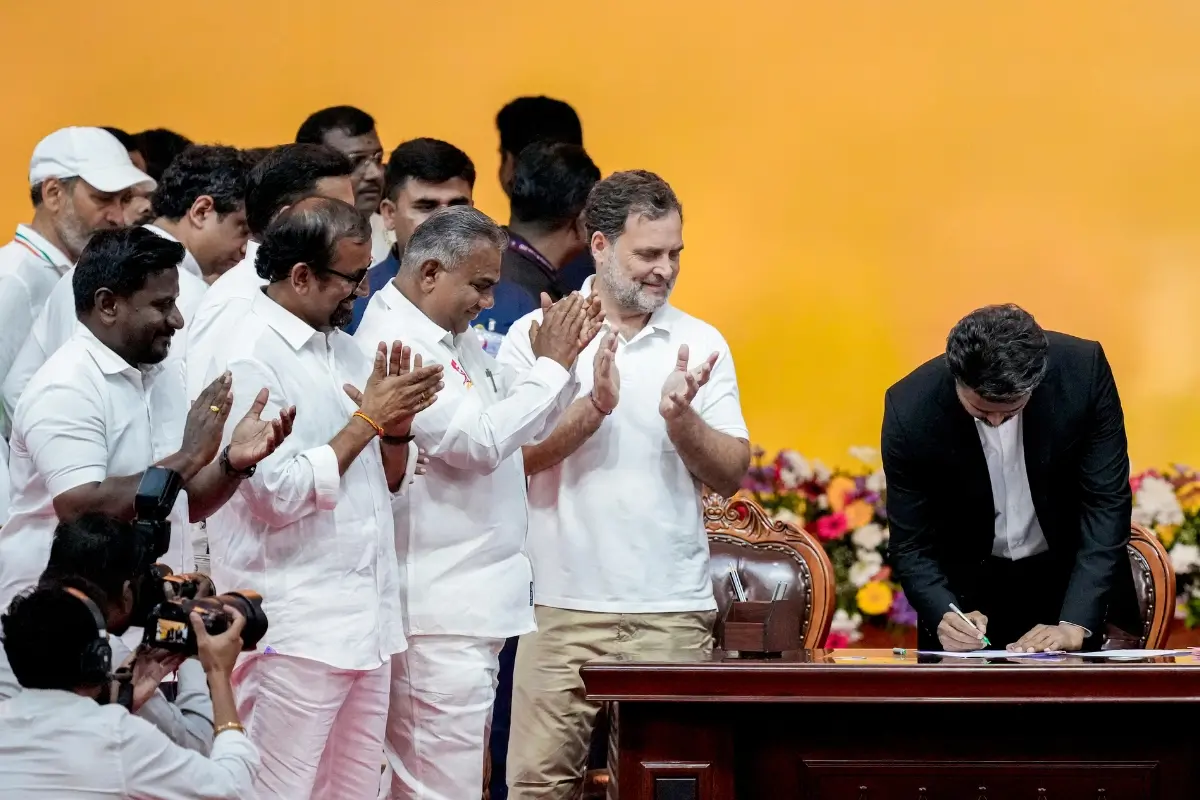
Chennai: Nearly two weeks after forming government in Tamil Nadu, Chief Minister C Joseph Vijay carried out the first major expansion of his maiden Cabinet, inducting 23 legislators into the ministry during a swearing-in ceremony held at Lok Bhavan in Chennai.
Governor Rajendra Vishwanath Arlekar administered the oath of office to the newly inducted ministers. The expansion included 21 legislators from the Tamilaga Vettri Kazhagam (TVK) and two Congress MLAs, signalling a broader coalition-building strategy by the Vijay-led administration.
Among the first legislators sworn in were TVK MLAs Srinath, S Kamali, C Vijayalakshmi and R V Ranjithkumar.
Congress returns to Tamil Nadu government after decades
One of the biggest political developments from the Cabinet expansion was the Congress party’s return to the Tamil Nadu government after nearly six decades.
Congress leaders S Rajesh Kumar and P Viswanathan were inducted into the Cabinet after receiving approval from the party high command. Congress general secretary K C Venugopal described the move as “historic”, noting that the party had not been part of a Tamil Nadu government since 1967.
The Congress’ long absence from state power traces back to the rise of Dravidian politics in Tamil Nadu. In 1967, DMK founder CN Annadurai led the first non-Congress government in the state, permanently reshaping Tamil Nadu’s political landscape.
Since then, both the DMK and AIADMK largely avoided accommodating alliance partners in Cabinet positions despite electoral alliances with national parties, including the Congress.
Vijay pushes coalition-driven governance
The Cabinet expansion reflected TVK’s attempt to strengthen coalition unity and build a broader secular political front in the state.
Senior TVK leader and minister Aadhav Arjuna said Chief Minister Vijay wanted allied parties that supported the government to be represented within the administration.
“CM wants the Cabinet to function like one family. He wants the parties that extended support to be represented in the Cabinet,” Arjuna said.
Political observers view the move as a shift from short-term political calculations toward coalition coherence and ideological alignment.
AIADMK rebels kept out despite trust vote support
The expansion also drew attention for who was not included in the Cabinet.
Several rebel AIADMK legislators who had supported the Vijay government during the crucial floor test were ultimately denied ministerial berths. Reports indicated that TVK leadership debated accommodating leaders such as SP Velumani and C Ve Shanmugham but later rejected the idea.
Sources within the alliance suggested that pressure from Left parties played a major role in the decision. CPI(M) leaders had publicly warned that inducting AIADMK rebels into the Cabinet could affect their support for the government.
TVK leaders were also reportedly concerned about corruption allegations involving certain rebel leaders and the possible political optics of rewarding legislators associated with rival camps so early in the government’s tenure.
A senior TVK leader reportedly said that inducting leaders facing investigations could damage the government’s image of “clean politics”.
VCK and IUML may still join government
Discussions are still ongoing regarding possible Cabinet berths for the Viduthalai Chiruthaigal Katchi (VCK) and the Indian Union Muslim League (IUML), both key allies in the ruling coalition.
VCK chief Thol Thirumavalavan has indicated that the party will hold internal consultations before taking a final decision on joining the government.
Within VCK, there is reportedly growing support for transitioning from long-standing protest politics to direct participation in governance.
The IUML is also engaged in discussions with the ruling coalition as TVK attempts to consolidate a wider secular alliance in Tamil Nadu politics.
Left parties to support government from outside
Although Left parties significantly influenced the Cabinet composition, they are expected to continue supporting the government from outside rather than joining the ministry directly.
TVK leaders believe this arrangement allows Left parties to maintain ideological independence while still supporting the coalition’s stability in the Assembly.
Political strategists within the ruling alliance reportedly viewed a broader secular coalition as more stable than a numerically stronger but politically volatile arrangement involving AIADMK rebels.
Rebels lose leverage after floor test
The influence of rebel AIADMK legislators appeared to weaken soon after the trust vote, particularly after senior leaders publicly reaffirmed support for AIADMK general secretary Edappadi K Palaniswami.
This reportedly reduced speculation about a leadership split within the AIADMK and weakened the bargaining position of the rebel faction.
At the same time, continued pressure from alliance partners and concerns over public perception further reduced the likelihood of their inclusion in the Vijay Cabinet.
The Cabinet expansion is being viewed as one of the first major political tests for Chief Minister Vijay, who is attempting to balance governance, coalition management and ideological positioning shortly after assuming office.
By prioritising alliance partners over rebel legislators, the TVK leadership appears to be signalling that long-term coalition stability and political messaging will take precedence over immediate numerical convenience.
The expansion also marks a significant moment in Tamil Nadu politics, with Congress formally returning to state power after decades and TVK attempting to position itself as the centre of a broader anti-BJP secular front in the state.
(With PTI inputs)