No elections for students, warnings for protesters: Jamia campus tensions rise
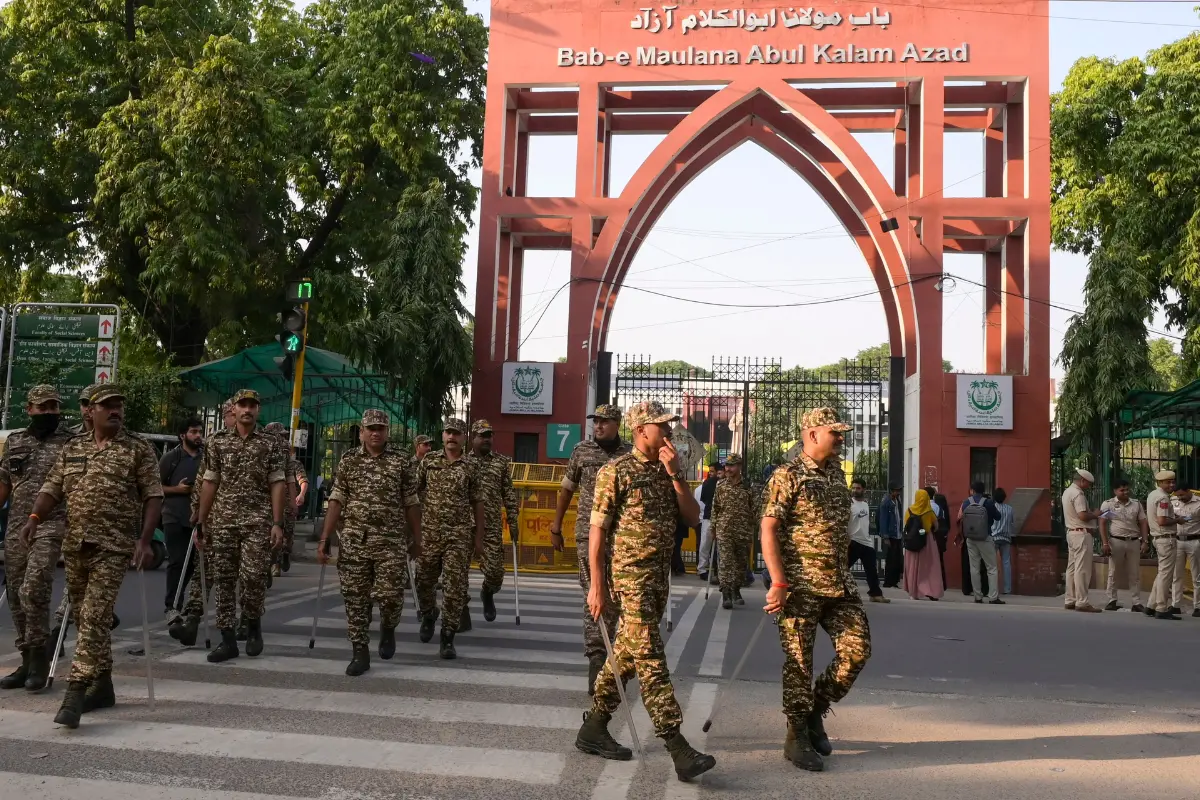
Jamia Millia Islamia in Delhi moved classes online on Saturday amid escalating student protests over the demand to restore student union elections. The agitation, which began on October 12, has continued despite attempts by the university administration to clear the demonstration site near Gate 7.
The campus has witnessed a heavy police presence over the past week. Five students are reportedly on hunger strike, while three have been rusticated.
On Saturday, university security guards attempted to clear the protest site, removing tents and banners. Students resisted the move, and a commotion followed as guards asked protesters to leave. Two ambulances were called to the site to take away the hunger-striking students.
The protesters subsequently moved into the political science department near Gate 7 and continued their agitation.
Students allege force was used to clear protest site
Mohammad Athnan, a former president of the National Students’ Union of India (NSUI) at Jamia, alleged that the administration used force to remove protesters and that security guards damaged tents at the demonstration site.
Athnan said the students intended to continue their protest until their demands were addressed. He also said the agitation could intensify from Monday, when students were expected to return to campus after the Puja holidays.
The students are demanding the restoration of student union elections, withdrawal of the rustication orders and the resignation of Proctor Mohammad Asad Malik over the handling of the protests.
Athnan also called for an investigation into graffiti reading “Free Kashmir” found on a wall of the chemistry department. He suggested that those responsible could be attempting to discredit the protest, but this allegation has not been independently established.
University forms committee to draft student union constitution
Jamia has not held student union elections since 2006. On October 21, the university established a five-member committee of professors to draft a constitution for the student union.
The committee is expected to examine the circumstances surrounding the union’s dissolution, relevant court rulings and recommendations of the Lyngdoh Committee, which laid down guidelines for student union elections in Indian universities.
However, the committee’s composition has become another point of contention. Elaiya Kumar, a research scholar at Jamia, said protesters lacked confidence in a panel that did not include student representatives.
Kumar also questioned the university’s stated concerns about possible violence as a reason for not holding elections.
What are the students demanding?
The agitation centres on three principal demands:
- Restoration of student union elections: Students want the university to resume elections, which have been discontinued since 2006.
- Withdrawal of rustication orders: Protesters are seeking the reversal of disciplinary action against three students.
- Proctor’s resignation: Students are demanding the resignation of Mohammad Asad Malik over the administration’s response to the agitation.
The university’s decision to establish a committee indicates that work on a proposed union constitution has begun, but students have questioned whether the process adequately represents their interests.
The dispute over student representation
The Jamia protests raise broader questions about student representation, disciplinary action and the management of demonstrations on university campuses.
The gap between the administration’s decision to appoint a committee and the protesters’ demand for student representation illustrates the central disagreement: whether the process for restoring elections is sufficiently inclusive and credible to those seeking a union.
The university’s stated concern about potential violence also brings campus security and democratic participation into the debate. The Lyngdoh Committee recommendations and relevant court rulings are expected to inform the proposed constitution, but the outcome will depend on the university’s process and the applicable legal framework.
The move to online classes and the attempted clearance of the protest site mark a further escalation in the dispute. With students threatening to continue their agitation after the Puja holidays, the university faces pressure to address the demands while managing campus operations and safety.