The Indira Gandhi myth: Power, nepotism and the erosion of democracy
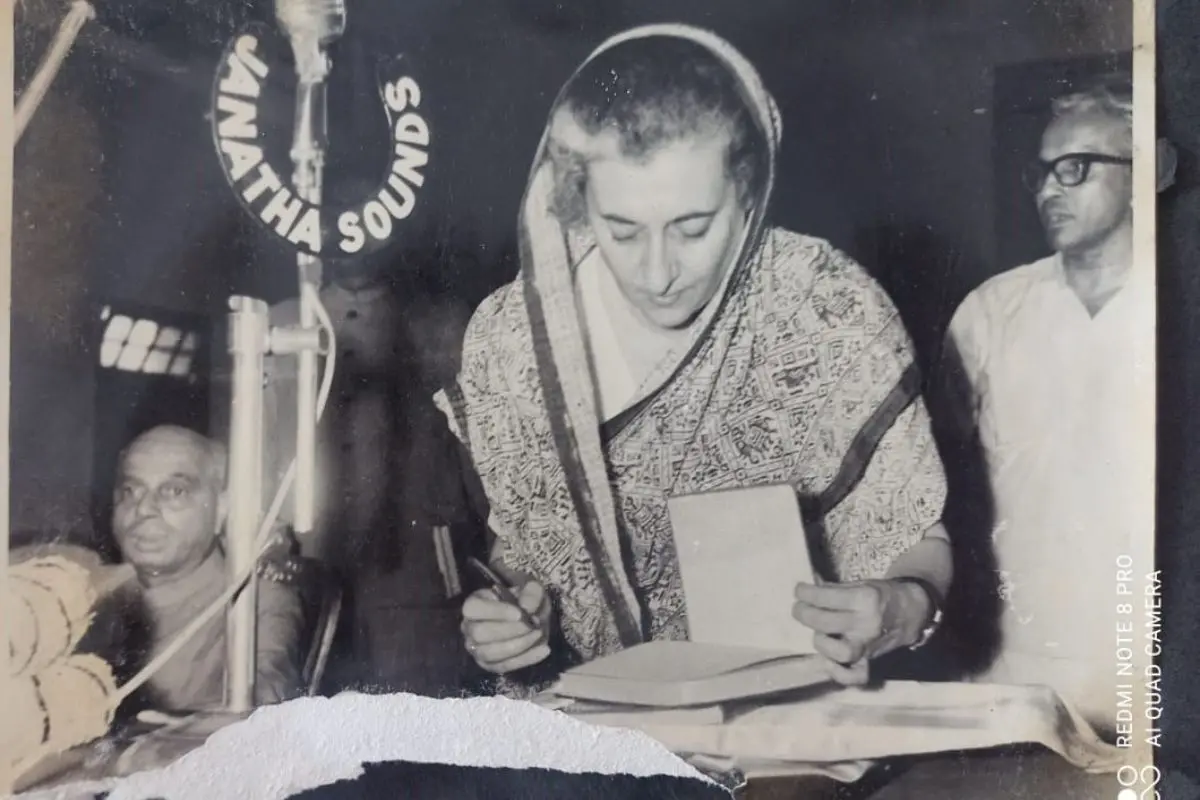
On her death anniversary, it is worth remembering that Indira Gandhi's political legacy was considerably more complicated than the carefully cultivated mythology surrounding her. She changed India, certainly. But she also changed the Congress in ways the party has never recovered from.
Every October 31st, we are treated to the familiar ritual of political remembrance. Indira Gandhi is invoked, her achievements enumerated, her assassination recalled and, inevitably, the Emergency is presented as an unfortunate blemish on an otherwise illustrious political career. Anyone who dares to question this carefully curated inheritance is promptly reminded of the Green Revolution, the 1971 war, the liberation of Bangladesh and India's nuclear ambitions. All perfectly legitimate historical achievements. What is rather less legitimate is the expectation that these achievements should purchase her permanent immunity from scrutiny. Indira Gandhi was undoubtedly one of the most consequential political figures in independent India. But consequential and admirable are sadly not synonyms. Nor does an impressive list of achievements entitle a political leader to consign the more unsavoury chapters of her career to the archives.
The Emergency remains the most spectacular indictment of her political judgement. When the Allahabad High Court invalidated her election in June 1975, the appropriate response in a functioning democracy would have been to face the political consequences. Instead, she chose to suspend the democratic life of an entire country to protect her own political survival. Opposition leaders were imprisoned, the press was censored, civil liberties were curtailed, and constitutional institutions were reduced to instruments of executive convenience. India did not need saving from democracy, but Indira Gandhi needed saving from an adverse judicial verdict. But perhaps the most revealing feature of the Emergency was the emergence of Sanjay Gandhi, a man without an elected mandate or constitutional office who nevertheless acquired extraordinary authority. His infamous sterilisation campaign and the demolition of slums around Turkman Gate were not isolated administrative aberrations, but consequences of a political culture in which personal proximity to the Prime Minister mattered more than constitutional accountability. Citizens were coerced, government officials were bullied, and human dignity was treated as an inconvenience to a programme devised by an unelected political heir. Sanjay Gandhi was not merely an overenthusiastic son who occasionally overstepped his brief. His brief, in effect, was whatever his mother permitted him to make of it. The machinery of government was mobilised to fulfil his ambitions, and an entire country was made to understand the difference between constitutional authority and the authority of being Indira Gandhi's son.
The rot, however, did not begin and end with the Emergency. Indira Gandhi progressively dismantled the Congress as an institution, weakening its internal leadership and concentrating authority around herself. A party that had once accommodated formidable regional leaders and competing political traditions increasingly became an organisation whose principal qualification for advancement was proximity to one family. Political loyalty replaced organisational independence, patronage became an instrument of political management, and the party's internal democratic culture steadily withered.
Consider the extraordinary episode of December 1978. Two Congress supporters, Bholanath Pandey and Devendra Pandey, hijacked an Indian Airlines aircraft demanding Indira Gandhi's release following her arrest. They used toy pistols and a cricket ball presented as a grenade. Both were later acquitted and entered electoral politics under the Congress banner, becoming legislators. One would have thought that hijacking an aircraft was a fairly unconventional qualification for public office. Apparently, political loyalty was a more compelling credential. This was not simply an amusing political anecdote. It was a revealing illustration of the culture of personal allegiance that had taken hold of the Congress. The party was increasingly being shaped around the fortunes of one individual rather than the principles and institutions it claimed to represent.
Indira Gandhi's relationship with the RSS and the politics of religious mobilisation also deserves a more nuanced examination than current political narratives allow. Her dealings with the organisation were not always defined by the ideological hostility Congress leaders project today. Political calculations and tactical accommodations frequently mattered more than ideological consistency. The Emergency itself exposed the willingness of different political organisations, including elements of the RSS, to negotiate with the regime.
Her decision to launch Operation Blue Star in June 1984 was another consequential political gamble. The military operation inside the Golden Temple had devastating repercussions, including the profound alienation of sections of the Sikh community. Her assassination by two of her Sikh bodyguards in October that year was a national tragedy, but what followed was even more shameful. The organised killing of Sikhs in several parts of the country, with Congress politicians and elements of the state machinery implicated in the violence. Thousands of innocent citizens paid the price for a political crisis they did not create. An assassination does not automatically confer sainthood, just as a leader's achievements do not erase the consequences of her decisions. Indira Gandhi deserves a place in Indian history, but not a place beyond historical judgement. No one needs to deny her achievements to examine her failures. The Green Revolution, the 1971 war and the nuclear test of 1974 were important milestones. But neither Bangladesh nor Pokhran can be invoked to excuse the destruction of civil liberties, the empowerment of an unelected political heir or the systematic weakening of a national political institution.
Perhaps the most enduring damage Indira Gandhi inflicted was not the twenty-one months of Emergency rule alone. It was the political culture she left behind. The concentration of power, the subordination of institutions to individuals, the elevation of family loyalty over organisational merit and the transformation of the Congress into a party increasingly dependent on one family's political fortunes. History is not a family photograph album in which inconvenient faces can be cropped out. And the Congress would do well to understand that its continued attempt to turn Indira Gandhi into an unquestionable political inheritance is not preserving its history. It is perpetuating the very political culture that has progressively impoverished its future.
(The author is a National Award winner for Best Narration and an independent political analyst. Views expressed are personal.)