India's first bullet train under manufacture in Bengaluru's BEML facility
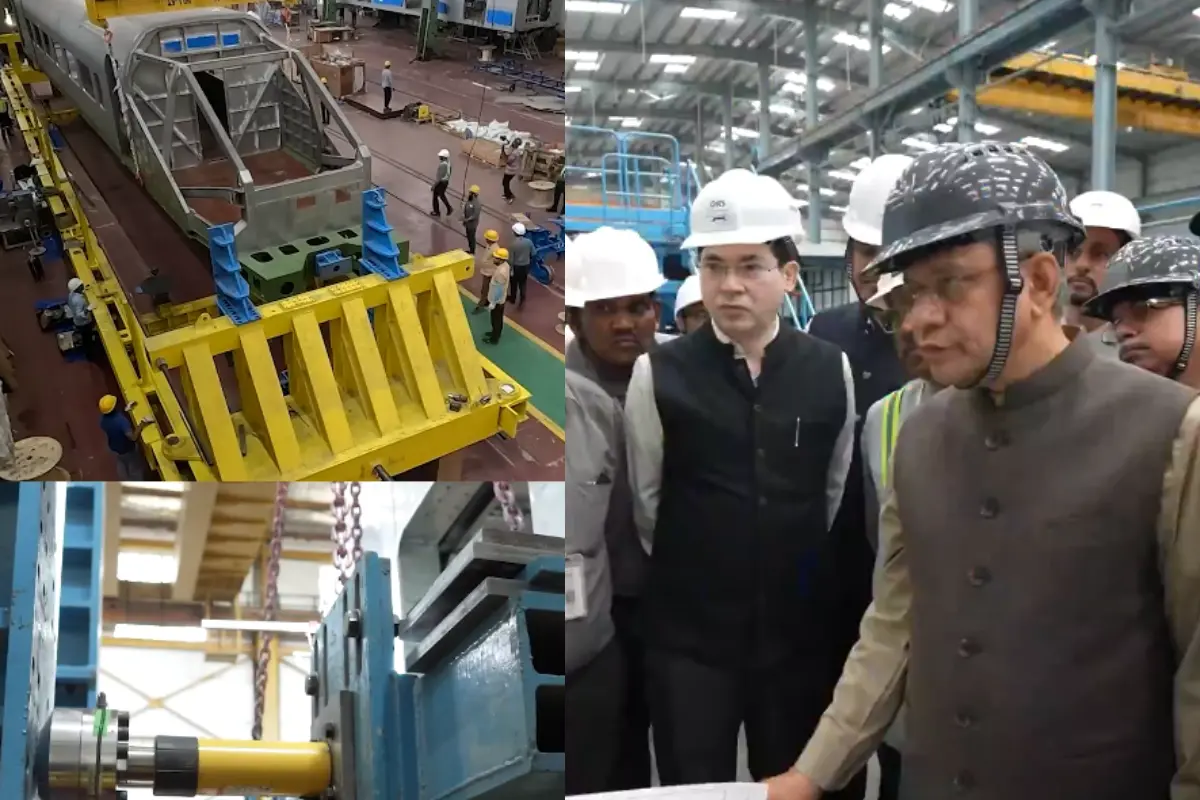
Bengaluru: India’s first indigenously manufactured bullet train is taking shape at the Bharat Earth Movers Limited (BEML) facility in Bengaluru for the Mumbai-Ahmedabad High-Speed Rail (MAHSR) corridor, marking a major step in the country’s efforts to develop domestic capabilities in high-speed rail technology.
Railway Minister Ashwini Vaishnaw inspected the manufacturing work at the facility on Sunday and expressed satisfaction over the progress, highlighting the emphasis on quality and adherence to international standards.
Speaking to ANI after the inspection, Vaishnaw said all major components of the train were being manufactured, integrated and tested, and that the overall process was progressing well.
“Today, I conducted a thorough inspection of the bullet train currently being manufactured at BEML. The progress is excellent. All major components of the bullet train are being produced, integrated, and tested; the entire process is advancing very well, with a special emphasis on quality,” Vaishnaw said.
“Given that a vacuum is created around the train at such high speeds, managing and sustaining atmospheric pressure is critical—testing is conducted at loads of 1500 kilonewtons. Great attention has been paid to every aspect, and each component has been tested according to international standards,” he added.
According to the Ministry of Railways, the train has been designed specifically for Indian conditions, with a focus on passenger convenience, accessibility, operational efficiency and safety. The project is expected to strengthen India's domestic manufacturing capabilities in the high-speed rail sector.
The train is designed to achieve a maximum test speed of 280 kmph, while its planned operational speed is 249 kmph. Measuring approximately 202 metres, it will have eight coaches — four motor cars and four trailer cars — with an estimated passenger capacity of 557, including two designated spaces for Divyangjan and Persons with Reduced Mobility (PRM).
The configuration comprises seven standard-class coaches with 3x2 seating and one executive-class coach with 2x2 seating. Driver's cabs at both ends will be equipped with an intelligent onboard control system to support decision-making and coordination with the operation control centre. Two eight-coach trainsets can also be coupled to form a 16-coach formation to meet future operational requirements.
Passenger comfort has been a key consideration in the interior design. The coaches will have ergonomically designed seats developed in accordance with Indian anthropometric requirements, with adequate legroom. Other features include LED lighting, overhead baggage racks, additional floor-mounted luggage stands for larger bags and power outlets for laptops and mobile devices.
The train will also have bio-digester toilets designed to minimise effluent generation, wide windows at every seating row and sealed, single-piece gangways connecting the coaches to allow passengers to move between compartments.
A passenger information system will provide updates throughout the journey. LCD screens will display information in English, Hindi and regional languages, while public address systems will provide audio guidance and automatic announcements. Emergency talk-back units in passenger cabins and vestibules will enable travellers to communicate directly with train crew members. A Wi-Fi-based infotainment system will also allow passengers to access preloaded entertainment content.
Accessibility features include coach floors aligned with platform heights to facilitate level boarding and retractable footsteps integrated into the doors to reduce the horizontal gap between the train and platform. Dedicated seating and toilet facilities for Divyangjan and PRM passengers, wheelchair-friendly doors and Braille-enabled information signage are also part of the design.
Each coach will be equipped with two heating, ventilation and air-conditioning (HVAC) units to regulate temperature and humidity across different climatic conditions.
The train incorporates several features to reduce noise and vibration, including sound insulation in the car body and floor structure, noise-damping coatings, skirts, bogie covers and aerodynamic fairings.
It will operate on a 25 kV, 50 Hz single-phase AC traction system supplied through a heavy compound catenary. Its regenerative braking system will recover energy during braking and feed it back into the electrical system, improving energy efficiency.
The aerodynamic design has been developed using Computational Fluid Dynamics (CFD) simulations to study airflow around the train. The nose and carbody profiles have been optimised to reduce air resistance and turbulence, while mitigating tunnel pressure waves and sonic boom effects.
The HVAC rooftop profile, roof panels and airflow deflectors have also been incorporated into the aerodynamic design. Special wind-guiding exterior profiles are intended to support smoother airflow, while the sealed carbody will help manage pressure differences and maintain passenger comfort during high-speed travel and tunnel operations.