Over 20 Indian ships carrying LPG, crude oil stuck in Strait of Hormuz amid Middle East conflict
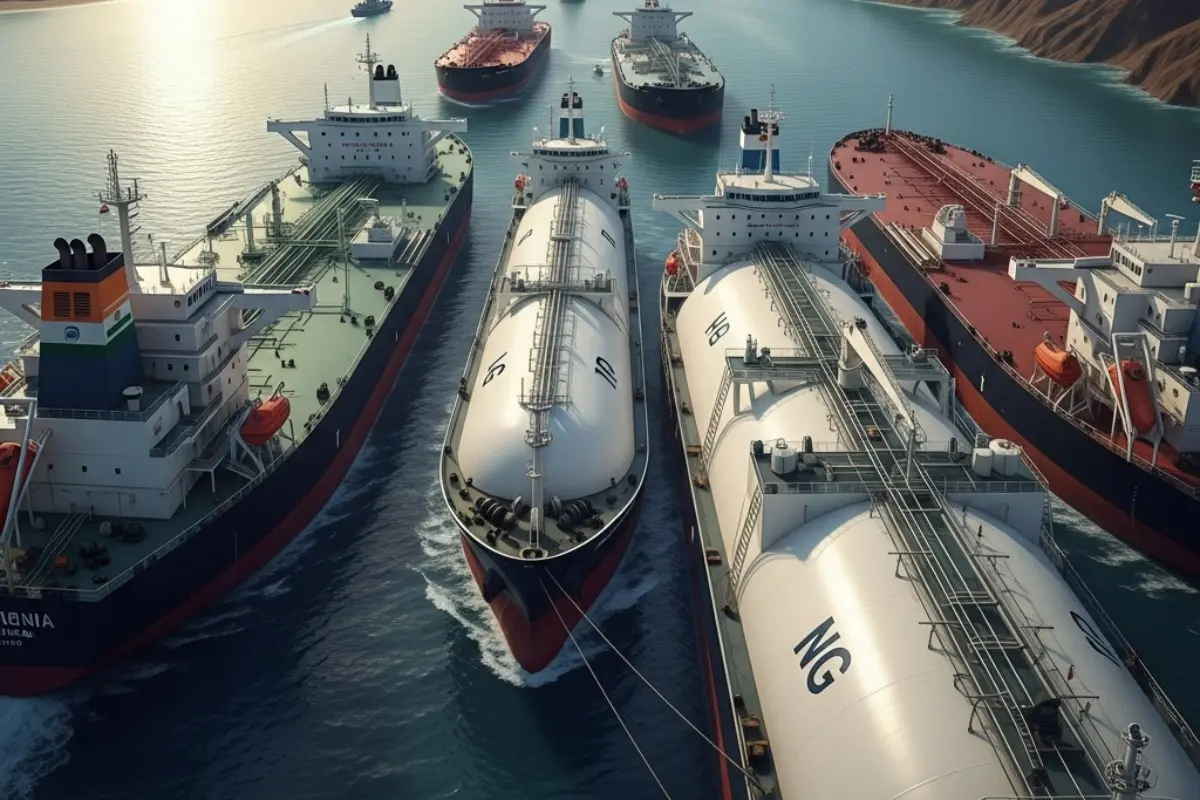
New Delhi: At least 10 foreign-flagged vessels carrying energy supplies bound for India are currently stranded in the Persian Gulf, the Indian government has confirmed. These are in addition to 18 Indian-flagged ships, transporting liquefied petroleum gas (LPG), crude oil, and liquefied natural gas (LNG), which remain anchored west of the Strait of Hormuz, a key shipping route severely disrupted by the ongoing conflict in the Middle East.
Speaking at a press briefing on the regional fallout, Rajesh Kumar Sinha, Special Secretary in the Ministry of Ports, Shipping, and Waterways, said that among the ten foreign-flagged ships, three are carrying LPG, four are crude oil tankers, and three are LNG carriers.
Among the 18 Indian-flagged vessels, three are LPG tankers, one is an LNG carrier, and four are crude oil tankers. One empty tanker is in the process of being filled with LPG. A total of 485 seafarers are on board these ships.
These vessels are part of around 500 ships affected in the narrow strait since the escalation of the West Asia conflict.
Government focuses on safe passage
“The government’s top priority is to ensure that Indian-flagged vessels carrying cargo to India are allowed to pass safely through the Strait of Hormuz,” Sinha said.
He added that the affected area is not limited to the strait itself, but includes surrounding waters classified as a high-risk area.
Insurance premiums for commercial shipping in the region have risen sharply. Prior to the conflict, premiums were around 0.04 percent of the insured value. Sinha noted that in one instance, premiums have increased to 0.7 percent, and they could rise further as the situation develops.
The conflict erupted on 28 February when the United States and Israel began bombing Iran. Tehran has responded with regional strikes and has sharply restricted access to the strait, which in peacetime handles one-fifth of global crude oil and LNG.
Iran, however, recently stated that non-hostile vessels could transit the waterway after coordinating with Iranian authorities.
Eight Indian-flagged ships successfully transit strait
So far, eight Indian-flagged vessels have managed to navigate the strait safely. Among them are two LPG carriers, BW TYR and BW ELM, transporting a combined total of approximately 94,000 tonnes of LPG.
BW TYR is expected to arrive in Mumbai on 31 March, while BW ELM is scheduled to reach New Mangalore on 1 April.
When asked whether India plans to send vessels that have already discharged cargo back to the Gulf to load additional supplies, Sinha said, “Our first priority is to get Indian-flagged vessels out. We have not yet reached the stage of sending them back for refills.”
The government has been closely monitoring the evolving situation in West Asia, focusing on the safety of Indian seafarers, vessel movements, and port operations.
“All Indian seafarers in the region are safe, and no incidents involving Indian-flagged vessels have been reported in the past 24 hours. The situation has remained stable over the last 72 hours as well,” Sinha confirmed.
India’s energy security amid regional conflict
Since the outbreak of war, four Indian-flagged LPG tankers have safely passed through the strait. Pine Gas and Jag Vasant, carrying a total of 92,612 tonnes of LPG, reached Indian ports between 26 and 28 March.
Earlier, MT Shivalik and MT Nanda Devi transported around 92,712 tonnes of LPG to Mundra Port in Gujarat and Kandla Port on 16 and 17 March respectively.
The oil tanker Jag Laadki, carrying 80,886 tonnes of crude oil from the UAE, reached Mundra on 18 March. Another tanker, Jag Prakash, transporting gasoline from Oman to Africa, also crossed safely and is en route to Tanzania.
Originally, 28 Indian-flagged vessels were in the Strait of Hormuz when hostilities began. 24 were on the west side and four on the east. In recent days, six from the west and two from the east have successfully sailed to safety.
Strait of Hormuz: A critical lifeline
Iran’s control of the strait has posed a serious challenge for countries like India, which relies heavily on imports for its energy needs. Approximately 40 percent of India’s crude oil, more than 50 percent of its LNG, and around 90 percent of its LPG imports pass through Hormuz, highlighting the strait’s strategic importance.
New Delhi has engaged Tehran diplomatically to ensure safe passage for Indian ships through this vital waterway.