Operation Sindoor details out! 9 terrorist camps taken out in 25 minutes
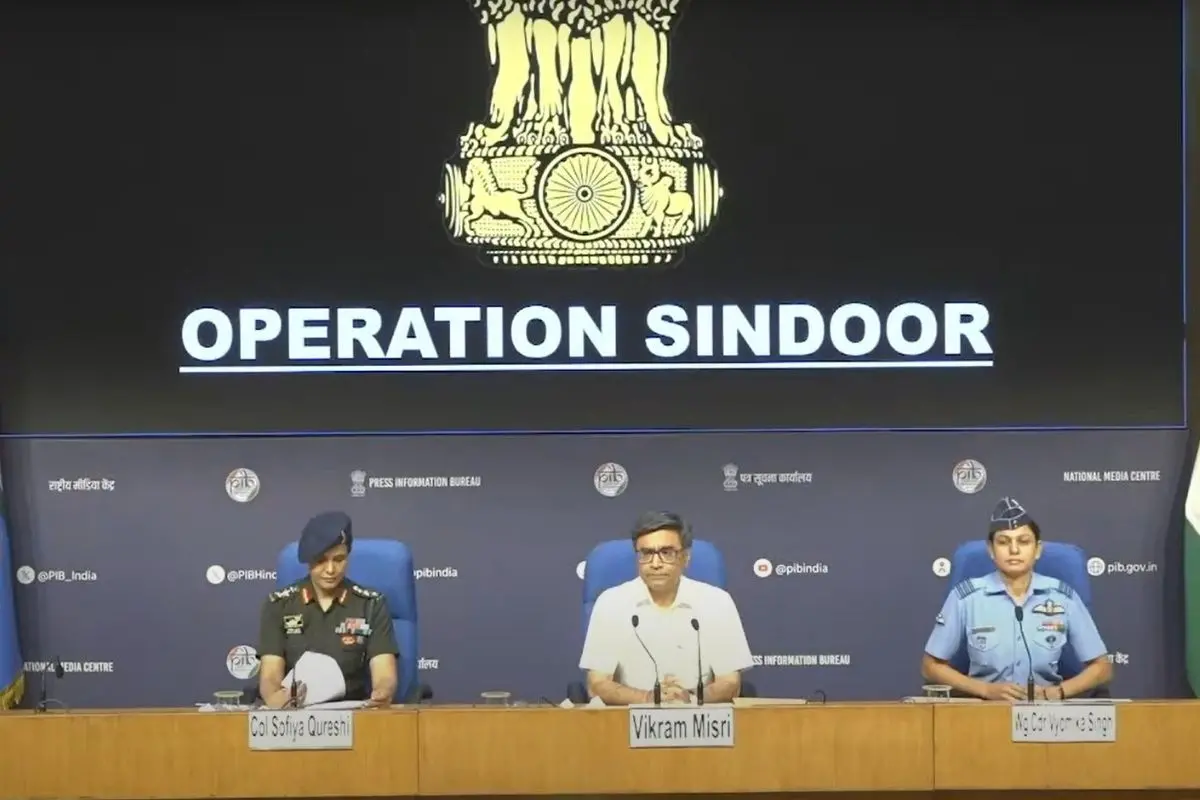
New Delhi: Pahalgam terror strike is the most serious incident since the 2008 Mumbai attack considering the fact that the civilians were attacked, said Foreign secretary Vikram Misri during a media briefing here on the Operation Sindoor. He was accompanied by Col. Sofiya Qureshi and Wing Commander Vyomika Singh of the Indian Army during the briefing.
“As you are all aware, on April 22, 2025, Pakistani and Pakistan-trained terrorists belonging to the Lashkar-e-Taiba carried out a savage attack on Indian tourists at Pahalgam in Jammu and Kashmir in India. They murdered 26 people, including one national of Nepal, causing the largest number of civilian casualties in a terrorist attack in India since the 26th November 2008 attacks in Mumbai. The attack in Pahalgam was marked by extreme barbarity, with the victims mostly killed with headshots from close range and in front of their families. Family members were deliberately traumatised through the manner of the killing, accompanied by the exhortation that they should take back the message,” Misri said.
He then added, “The attack was clearly driven by the objective of undermining the normalcy returning to Jammu and Kashmir. In particular, it was designed to impact the mainstay of the economy, tourism, with a record 23 million tourists visiting the valley last year. The calculation, presumably, was that harming growth and development in the Union Territory would help keep it backward and create fertile ground for continued cross-border terrorism from Pakistan. The manner of the attack was also driven by an objective of provoking communal discord, both in Jammu and Kashmir and the rest of the Nation. It is to the credit of the government and the people of India that these designs were foiled.”
“A group calling itself ‘The Resistance Front’ has claimed responsibility for the attack. This group is a front for the UN-proscribed Pakistani terrorist group, Lashkar-e-Taiba. It is notable that India had given inputs about the TRF in the half-yearly report to the monitoring team of the UN's 1267 Sanctions Committee in May and November 2024, bringing out its role as a cover for Pakistan-based terrorist groups,” he said.
The foreign secretary then pointed out that earlier too, in December 2023, India had informed the monitoring team about Lashkar and Jaish-e-Mohammad operating through small terror groups such as the TRF. Pakistan's pressure to remove references to TRF in the April 25 UN Security Council Press Statement is notable in this regard, he added.
Misri further said that the investigations into the Pahalgam terror attack have brought out the communication notes of terrorists in and to Pakistan. “The claims made by the Resistance Front and their reposting by known social media handles of the Lashkar-e-Taiba speak for themselves. Identification of the attackers based on eyewitness accounts, as well as other information available to law enforcement agencies, has also progressed. Our intelligence has developed an accurate picture of the planners and backers of this team,” he said.
“The features of this attack also tie in with Pakistan's long track record of perpetrating cross-border terror in India, which is well documented and beyond question. Pakistan also has a well-deserved reputation as a haven for terrorists from around the world, with internationally proscribed terrorists enjoying impunity there. In addition, Pakistan has been known to willfully mislead the world and international forums, such as the Financial Action Task Force, on this issue,” Misri said.
“The Sajid Mir case, in which this terrorist was declared dead and then, in response to international pressure, brought back to life, found alive and arrested, is the most glaring example,” he added.
Misri also said, “The latest attack in Pahalgam has understandably generated deep anger in Jammu and Kashmir, and in other parts of India. Following the attacks, the Government of India naturally responded with a set of initial measures relating to our engagement with Pakistan. You are all aware of the decisions that were announced on the 23rd of April.”
Elaborating on what prompted India to carry out Operation Sindoor, the foreign secretary said, “However, it was deemed essential that the perpetrators and planners of the 22nd April attack be brought to justice. Despite a fortnight having passed since the attacks, there has been no demonstrable step from Pakistan to take action against the terrorist infrastructure on its territory or on territory under its control. Instead, all it has indulged in are denials and allegations. Our intelligence monitoring of Pakistan-based terrorist modules indicated that further attacks against India were impending. There was thus a compulsion both to deter and to pre-empt.”
The official also stated that the actions were measured, non-escalatory, proportionate and responsible. They focused on dismantling the terrorist infrastructure and disabling terrorists likely to be sent across to India.
“You would also recall that the Security Council on 25th April 2025 had issued a Press Statement on the Pahalgam terror attack, underlining, and I quote, ‘The need to hold perpetrators, organisers, financiers and sponsors of this reprehensible act of terrorism accountable and bring them to justice’. India's latest actions should be seen in this context,” he concluded.
Col Sofiya Qureshi and Wing Commander Vyomika Singh also briefed the media further on the surgical strike.
Col Qureshi said the operation was carried out to deliver justice to the innocent Pahalgam victims and their families. The surgical strike was carried out on terror camps in several areas of Pakistan including PoJK. The officer also listed out the nine terror camps and explained why each were targeted.
She said the nine terror targets were chosen based on credible intelligence and their involvement in cross-border terrorism.
Wing Commander Vyomika Singh said the selection of weapons was done carefully to avoid civilian deaths and that no military establishment was also targeted.