Historic Rafale Marine landing on INS Vikrant: How France's jet is being modified for Indian Navy
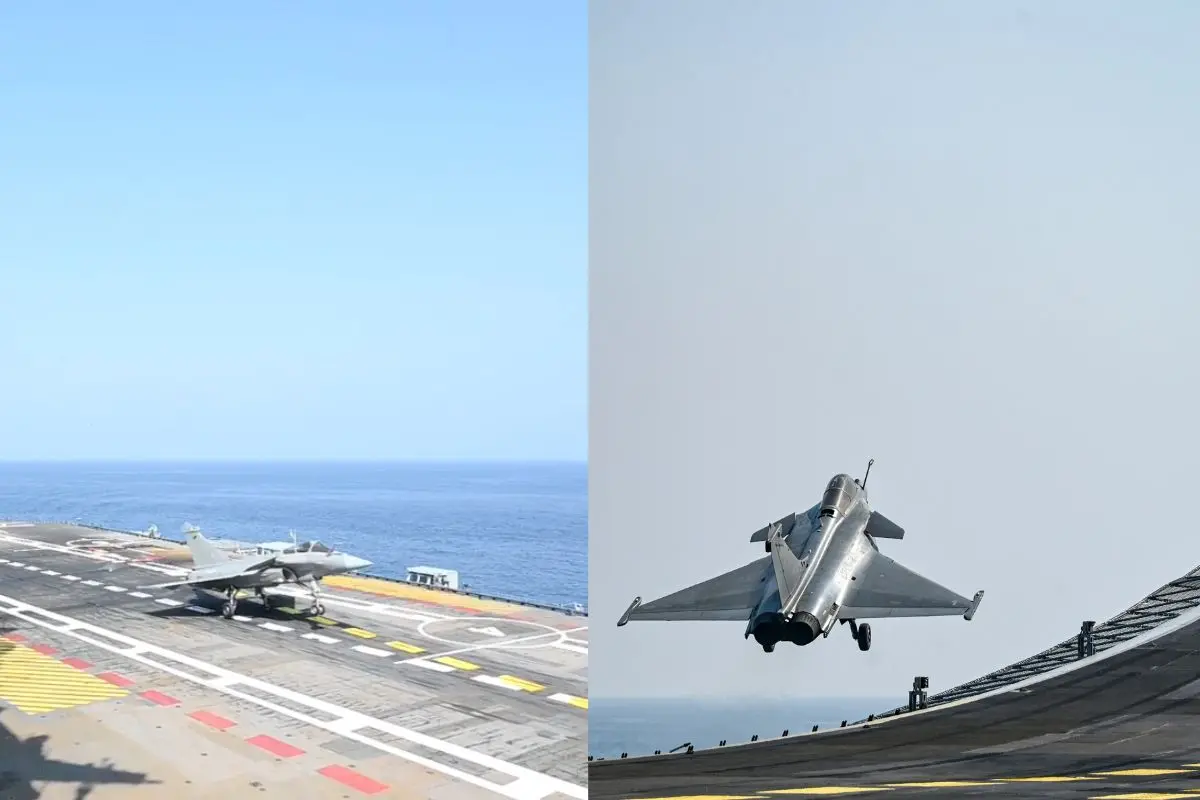
In a major milestone for India's naval defence, a French-built Rafale Marine fighter jet successfully landed on India's indigenous aircraft carrier, INS Vikrant, on Thursday, 29 October. The warplane completed the touchdown on its very first attempt during ongoing sea trials. According to the Indian Navy, this successful landing marks the formal beginning of sea trials to operationalise the aircraft for naval fleet duties.
A historic touchdown at sea
Before embarking on carrier landings at sea, the naval fighter underwent preliminary testing in Goa. Defence officials stated on Wednesday that these shore-based trials evaluated aircraft modifications required to operate safely from INS Vikrant. Operating from the INS Hansa naval station, the jet was fitted with a telemetry pod to collect critical flight performance data. These trials aimed to certify take-off and landing procedures specifically for Indian warships. The testing facility at INS Hansa replicates the ski-jump flight deck design used on Indian carriers, offering a controlled environment for pilots. The ocean touchdown confirmed earlier unconfirmed news reports that a landing demonstration was scheduled for 29 October, prior to official Navy announcements.
Adapting French design to Indian carriers
Built by Dassault Aviation for the French Navy, the Rafale Marine was originally designed for France's Charles de Gaulle aircraft carrier. The French vessel uses a catapult-assisted mechanism to launch jets into the sky. By contrast, India’s two operational carriers—INS Vikrant and INS Vikramaditya—rely on a Short Take-Off But Arrested Recovery (STOBAR) system. This setup uses a curved ski-jump ramp at the bow to launch aircraft into the air, alongside arresting wires to catch them upon landing. Initial land-based ski-jump trials were conducted in Goa back in 2022 to verify the aircraft's basic suitability.
Solving space challenges on board
Operating a jet from a warship requires careful attention to physical dimensions. The Rafale Marine features a wingspan of approximately 10.9 metres. Reports indicate this width could pose space challenges when moving the jet between the flight deck and lower storage hangars using ship elevators. To address this, naval authorities are exploring minor aircraft modifications and small carrier adjustments to ensure smooth handling and storage across both ships.
Details of the ₹63,000 crore deal
These ongoing trials follow an inter-governmental agreement signed between India and France on 28 April 2025. Valued at around ₹63,000 crore, the contract covers 26 Rafale Marine fighters, comprising 22 single-seat combat aircraft and 4 twin-seat trainers. According to defence officials, deliveries are scheduled to begin by late 2028 or early 2029. This deal makes India the first international customer to procure the naval variant of the Rafale jet. The purchase includes pilot training, flight simulators, weapons packages, essential hardware, and long-term maintenance support. In addition, the agreement provides supplementary gear for the Rafale jets already operated by the Indian Air Force.
Boosting sea control and local manufacturing
In alignment with the government's Aatmanirbhar Bharat policy, the agreement includes a technology transfer provision to integrate Indian-made weapons onto the aircraft. Once delivered, the 26 fighters will operate from both INS Vikrant and INS Vikramaditya, boosting the Navy's overall fleet strength. The aircraft will be deployed for diverse missions, including fleet air defence, maritime strikes, reconnaissance, and shore strikes. By targeting hostile aircraft, the Rafale Marine fleet will protect warship formations and enforce sea control while keeping naval units beyond the reach of enemy strike weapons.