Ex-CJI Chandrachud’s handling of judicial appointments: Experts divided over Justice Kaul’s critique
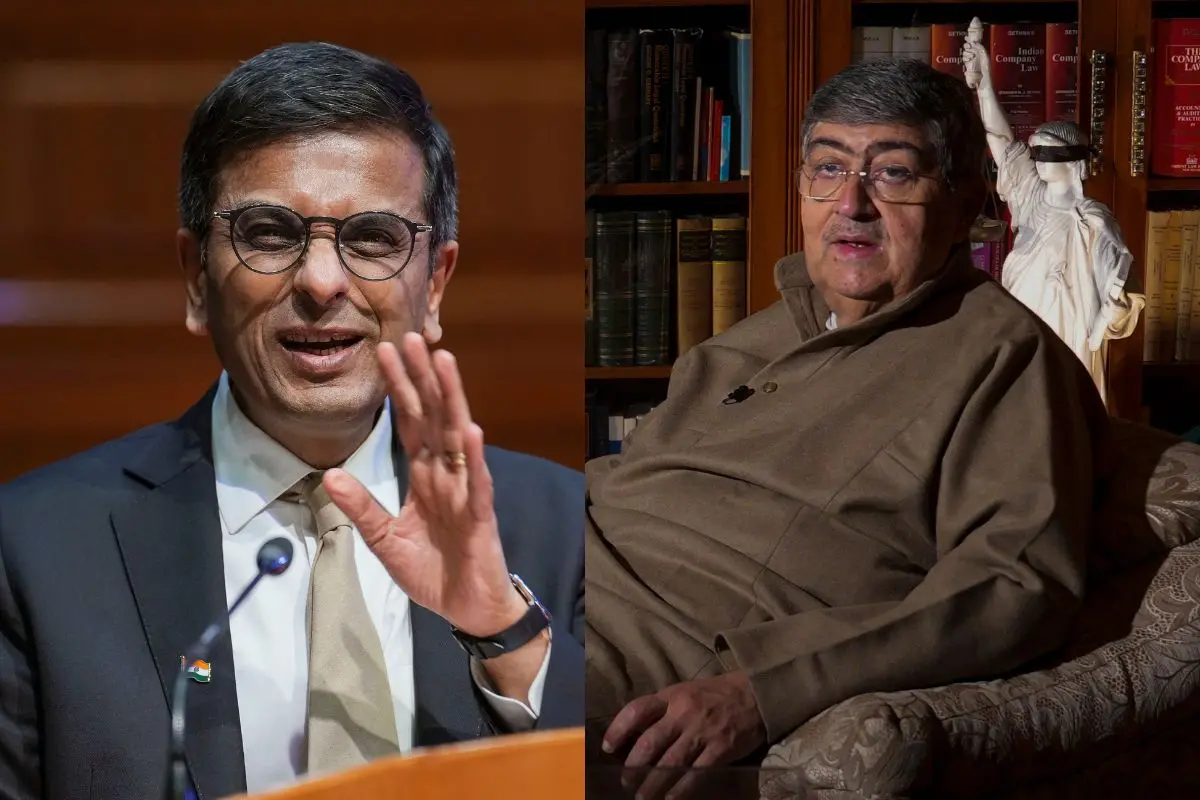
New Delhi: Former Supreme Court judge Sanjay Kishan Kaul’s sharp criticism of former Chief Justice of India D Y Chandrachud’s administrative tenure and approach to judicial appointments has drawn mixed reactions from prominent legal experts, with one defending the former CJI's legacy and another endorsing the critique.
The contrasting views follow comments made by Justice Kaul during an interview with The Wire ahead of the publication of his memoir, ‘Without Fear or Favour’. In the interview, Kaul alleged that Chandrachud displayed unnecessary deference toward the executive, particularly regarding administrative affairs and judicial appointments.
Defending Chandrachud's tenure, constitutional law expert and senior advocate Rakesh Dwivedi characterised it as a landmark period for the Indian judiciary, rejecting assertions that the former CJI yielded excessively to executive influence in appointment matters.
“CJI Chandrachud's tenure as a judge and the Chief Justice of the Supreme Court of India was a glorious golden period for the Indian judiciary. There is hardly any sphere of litigation where he has not ruled for the future. Ever since he stepped into the court, it was disciplined judicial business, appropriate hearing, courtesy to all lawyers – even juniors – and quick, sound judgements,” Dwivedi told PTI.
Dwivedi noted that benches headed by Chandrachud delivered rulings across a wide range of significant matters, including entry tax, Aadhaar privacy, mines and minerals, the Insolvency and Bankruptcy Code, arbitration, federal disputes over industrial alcohol, minority status, the Ayodhya dispute and the abrogation of Article 370.
“His pen flowed with magnificent soundness, brilliance and statesmanship. As the CJI, he introduced digitisation and AI, and systematised mentioning. He enabled the Mitti cafe, which showed empathy for the specially-abled.
“I do not think he was deferential to the government. He struck down the electoral bonds law. He ruled against the prestigious Aadhaar law. However, for a judge, who was second to say that Chandrachud, as the CJI, did not live up to his expectations, post-retirement, is unbecoming, to say the least,” the senior lawyer said.
Addressing Justice Kaul’s observations in his book regarding unmet expectations during Chandrachud's tenure, Dwivedi remarked, “We all expect many things from judges, but it doesn't turn out the way we want, and this can be said against any judge.”
Regarding the reassignment of specific cases away from Justice Kaul’s bench, Dwivedi added, “And if some case was taken away from his bench, it must have been for reasons the master of roster thought good. This is small bickering, and if it is for buttressing book sales, it is saddening,” he said.
Conversely, senior advocate and former Supreme Court Bar Association (SCBA) president Vikas Singh supported Kaul’s critique, alleging that Chandrachud’s public image of judicial independence did not align with his actual conduct.
“Justice Kaul is absolutely right because Justice Chandrachud used to project himself to be very different from what he actually was. A lot of chief justices actually did what the Centre wanted, but they also did not try to behave as if they were very different or they were very independent.
“There was a complete double face on the part of Justice Chandrachud… He was always double-speaking, talking this side and also talking that side.
“You could not depend upon him. What he talked about in a conversation was not something he actually meant, ever. That is one feature of Justice Chandrachud which, I think, Justice Kaul has very rightly commented upon,” Singh said.
Singh further claimed that concerns extended beyond judicial appointments to the allocation of sensitive cases, alleging that matters previously assigned to a particular bench were re-allocated to different benches during Chandrachud's leadership.
Commenting on the National Judicial Appointments Commission (NJAC) verdict of 2015, Singh suggested that although the Supreme Court struck down the commission, procedural provisions establishing a candidate eligibility pool and a dedicated secretariat could have been preserved, as they were severable from executive involvement.
Singh also questioned case allocation methods, arguing that while the CJI as master of the roster determines case categories for different benches, individual case assignments within those categories should be automated or randomised. He asserted that transferring cases after a bench had already issued notice undermines this standard and risks selective case allocation.
Referring to Kaul’s account of a Prevention of Money Laundering Act (PMLA) review matter being reassigned, Singh acknowledged that while the timing of Kaul’s statements coincides with his book release, the underlying issues remain relevant.
“The timing of Justice Kaul's comments may not be appropriate, but I think whatever he has said was long overdue. Timing it before his book release definitely has something to do with it, because he would want people to read his book. If such news doesn’t come out before the book release, not many people will read it. It may not be appropriate in that sense, but why not? I think it was over-delayed, and now comments have rightly come out in the open,” Singh said.
“His (Chandrachud's) behaviour with the government was differential, not only in the matter of appointment to the collegium, but also in the matter of placement of certain sensitive matters before judges to please the Centre,” he added.
PTI