Delhi to Lucknow in 2 hours, Varanasi in 3.5 hours: New bullet train corridor approved
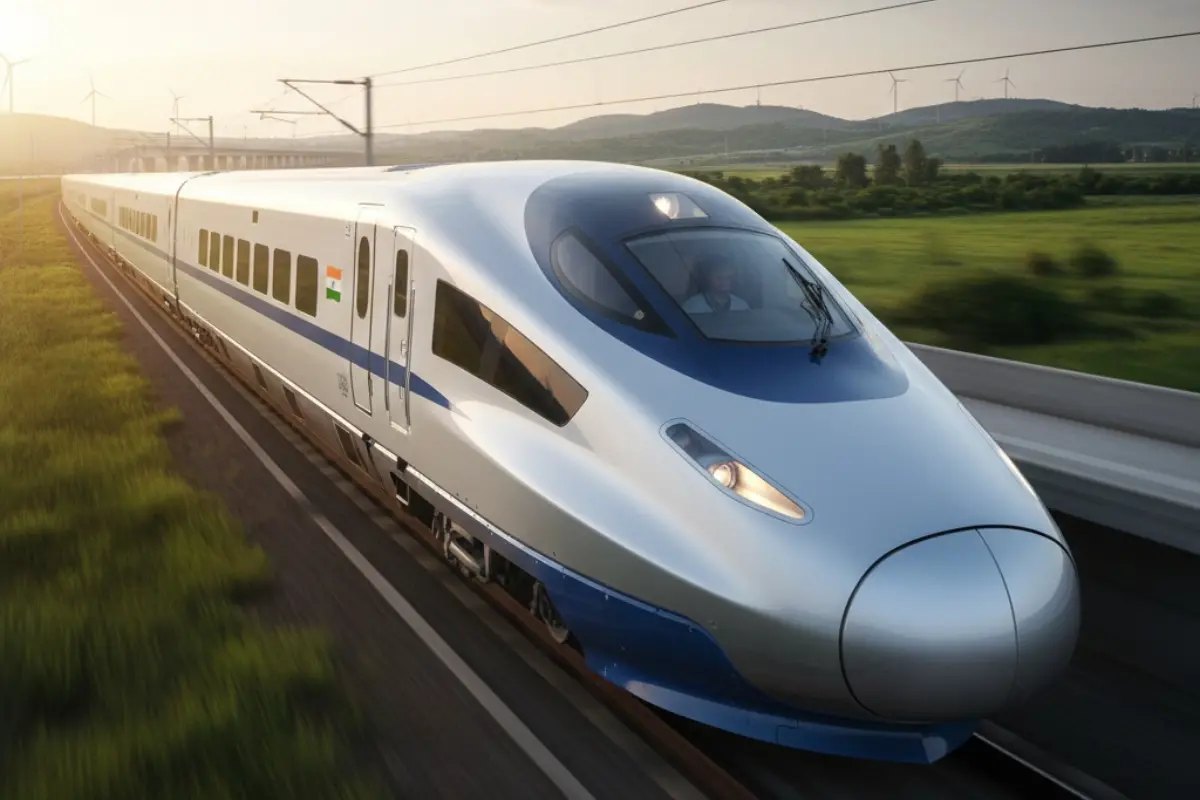
Varanasi: Prime Minister Narendra Modi has approved the northern corridor of India's bullet train project, which will connect major cities including Delhi, Agra, Lucknow, Varanasi and Patna, Railway Minister Ashwini Vaishnaw announced on Saturday.
The proposed high-speed rail corridor is expected to significantly reduce travel times across northern India, with the Delhi-Agra journey projected to take just 59 minutes and Delhi-Kanpur travel reduced to one hour and 45 minutes.
Speaking in Varanasi ahead of the flagging-off of new Vande Bharat Sleeper Express services between Varanasi and New Delhi, Vaishnaw said the project would benefit millions of passengers, particularly young people, middle-income families and small-scale industries.
"The prime minister has approved the north corridor of the bullet train, which will change the lives of many. The vision for the bullet train shared by the prime minister will greatly benefit the youth, the middle-income group, and artisans in small-scale industries. People will remember Prime Minister Modi for the next 100 years for this initiative."
Delhi to Agra in 59 minutes, Varanasi in 3 hours 35 minutes
According to the railway minister, the proposed northern bullet train corridor will connect Delhi, Agra, Kanpur, Lucknow, Ayodhya, Varanasi, Prayagraj, Patna and Siliguri before extending to Guwahati.
The project is expected to bring several major cities within a few hours of one another, offering faster intercity travel across Uttar Pradesh and neighbouring states.
Vaishnaw outlined the projected travel times for key routes along the corridor.
The Delhi-Kanpur journey is expected to take one hour and 45 minutes, while passengers travelling from Delhi to Lucknow could reach their destination in two hours and 12 minutes.
The Lucknow-Varanasi journey is projected to take one hour and 21 minutes, while the distance between Varanasi and Delhi could be covered in three hours and 35 minutes.
The proposed Delhi-Agra travel time of 59 minutes is expected to be among the major highlights of the project.
However, the minister did not specify a timeline for the completion or commencement of passenger services on the corridor.
Bullet train construction to be fully 'Make in India'
Vaishnaw said the government intends to ensure that the construction of the high-speed rail project relies on Indian expertise and manufacturing capabilities.
From the pillars supporting the elevated tracks to the girders used in construction, the project would be developed domestically, he said.
"The construction is progressing rapidly. It will be fully 'Make in India', built by the youth and welders of India," the minister said.
He described the bullet train initiative as a major step towards transforming India's transport infrastructure while creating opportunities for skilled workers and domestic industries.
Vaishnaw targets Congress, Samajwadi Party over railway funding
During his address, Vaishnaw also criticised the Congress and Samajwadi Party over what he described as inadequate railway investment in Uttar Pradesh during their previous terms in power.
He questioned the allocation made to the state when the Samajwadi Party governed Uttar Pradesh and the Congress-led government was in power at the Centre.
"To those who are today politically challenging the BJP, I would like to ask: When the Samajwadi Party was in power in the state and the Congress was in power at the Centre, how much of a budget did they allocate to UP? When the SP was in power at the state, and the Congress at the Centre, the budget for the railways in UP was only Rs 1,000 crore for a state that is larger than some countries."
Accusing the two parties of neglecting the state's railway infrastructure, Vaishnaw said the situation had changed under the BJP-led governments at the Centre and in Uttar Pradesh.
"These 2 'ladke' (an apparent reference to Rahul Gandhi and Akhilesh Yadav) used to commit injustice to UP," he said.
The minister claimed that railway allocations had increased substantially since Modi became prime minister and Yogi Adityanath assumed office as Uttar Pradesh chief minister.
"After Yogi Adityanath became the chief minister of UP, the budget has increased significantly; it has doubled, tripled, and then increased by 18 times. Today, UP is receiving a budget of Rs 20,000 crore," the Union minister noted.
Varanasi gets 10 new MEMU services
Alongside the bullet train announcement, Vaishnaw said 10 Mainline Electric Multiple Unit (MEMU) services were being introduced to improve connectivity within Varanasi and surrounding areas.
The new services are intended to address the growing transport requirements of the expanding city, particularly for commuters, traders and pilgrims.
"As you are all aware, when cities expand, there arises a need for new modes of transport to facilitate travel from one end to the other. That is why the prime minister took the initiative to introduce new MEMU services in Banaras. These services are commencing today. Covering locations such as Banaras City, Banaras Cantt, Banaras Station and Rajatalab, these MEMU services will operate throughout the day across the city. This will prove to be a significant convenience for the youth of Banaras, as well as for small-scale traders, travellers arriving from distant places, and the many pilgrims and devotees visiting the city," he said.
The services will connect important railway stations and localities, including Banaras City, Banaras Cantt, Banaras Station and Rajatalab.
A separate daily MEMU service will also connect Varanasi with Prayagraj.
The train will operate from Prayagraj Rambagh station through Jhusi, Handia Khas, Gyanpur Road, Madhosingh and Rajatalab before reaching Banaras.
According to Vaishnaw, all 10 MEMU services are being launched as part of the government's efforts to strengthen local and regional railway connectivity.
Minister praises response to Vande Bharat Sleeper train
Vaishnaw also referred to the response received by the Kolkata-Guwahati Vande Bharat Sleeper train, claiming that even critics of the Indian railway system had acknowledged its quality.
He cited coverage by international media organisations while discussing the train's facilities and passenger experience.
"Some of our critics travelled in it. Eurostar, which is considered to be Europe's best, and the BBC, which are our critics, sent reporters to find loopholes. But they praised us and made videos."
The railway minister said the government's focus remained on modernising passenger services, expanding connectivity and developing new railway infrastructure across the country.