‘Full sense of satisfaction’: CJI BR Gavai delivers emotional farewell on last working day
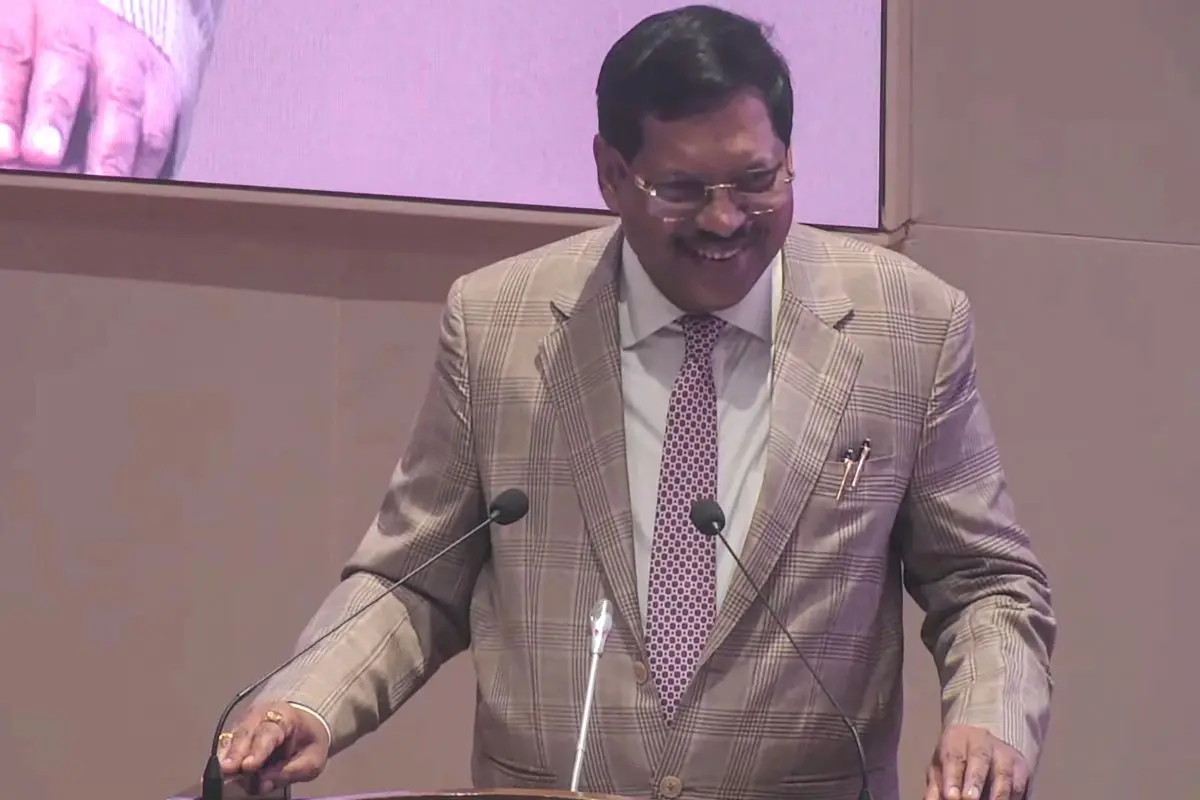
New Delhi: Outgoing Chief Justice of India Justice B R Gavai on Friday said he was leaving the institution “with a full sense of satisfaction and contentment” and as a “student of justice” at the conclusion of a legal and judicial career spanning nearly four decades.
At a packed ceremonial bench that included Chief Justice-designate Surya Kant and Justice K Vinod Chandran, Justice Gavai said the warm tributes and poems by Attorney General R Venkataramani and senior advocate Kapil Sibal had left his “voice choking with emotions”.
“When I leave this courtroom for the last time… I leave this court with a full sense of satisfaction, a full sense of contentment that I have done whatever I could have done for this country… Thank you. Thank you very much,” the visibly emotional CJI told a courtroom filled with law officers, senior advocates and young lawyers.
Colleagues recalled the imprint left by Justice Gavai, the second Dalit and first Buddhist Chief Justice of India after K G Balakrishnan, on the higher judiciary.
“I always believe that everybody, every judge, every lawyer, is governed by the principles on which our Constitution works, equality, justice, liberty and fraternity — and I tried to discharge my duties within the four corners of the Constitution that is so dear to all of us,” he said.
Justice Gavai, who was sworn in as the 51st CJI on May 14 for a tenure of a little over six months, will demit office on November 23, 2025, with Friday being his last working day.
Reflecting on his journey, he said, “When I joined the (legal) profession in 1985, I entered the school of law. Today, as I demit the office, I do so as a student of justice.”
He described his over 40-year trajectory, from lawyer to high court judge, to Supreme Court judge, and finally Chief Justice of India, as “deeply satisfying”.
Every public office, he stressed, must be seen not as a seat of power but as “an opportunity to serve society and the nation”.
Recalling his admiration for Dr B R Ambedkar and his father, a politician who was a close associate of the Constitution’s chief architect, Justice Gavai said his judicial philosophy was shaped by Ambedkar’s commitment to social, economic and political justice.
“I always tried to balance fundamental rights with the Directive Principles of State Policy,” he said, adding that many of his judgments sought to harmonise constitutional freedoms with the imperatives of sustainable development and environmental protection.
Quoting the principle that “a judge must not alter the material but may iron out the creases”, he said this had guided him throughout his judicial tenure.
On his preference for simplicity in drafting, he remarked, “I always believe that judgments should be written for the end consumers. I do not have a flair for academics or literature…”.
He said environmental causes had been close to his heart and referred to his long association with issues of ecology and wildlife.
“In all these years, I tried to protect the rights of citizens while ensuring that the environment and wildlife were preserved,” he noted.
On running the top court, Justice Gavai underlined that “all decisions I took as CJI were taken collectively… I believed we must function as an institution”.
CJI-designate Surya Kant, paying an emotional tribute, said Justice Gavai was “more than a colleague… he was my brother and a confidant, and a man of immense integrity”.
“He handled cases with patience and dignity. He encouraged young lawyers. His firmness was always laced with humour… Not a single day went by when he didn’t threaten an insistent lawyer with costs, but he never imposed one,” Justice Kant said.
Attorney General Venkataramani drew on the Marathi meaning of “Bhushan,” ornament or adornment, to say that Justice Gavai had adorned the judiciary and the legal fraternity.
Solicitor General Tushar Mehta, recalling first meeting him as a puisne judge, said, “You never changed as a human being.”
Mehta also praised what he called a “fresh breeze of Indianness” in recent verdicts, pointing to the Constitution Bench ruling on governors as being grounded entirely in indigenous jurisprudence. “Judgment should be a judgment, not an article for a law review,” he remarked.
Supreme Court Bar Association president Vikas Singh highlighted the outgoing CJI’s simplicity, recalling his remark that he did not take security to his village: “If someone is killing me in my own village, I do not deserve to live.”
Senior advocate Kapil Sibal hailed Justice Gavai’s journey as a jurist, saying his elevation to the Supreme Court symbolised the “enormous social churning” that has taken place in the country.
Sibal said Justice Gavai’s career showed that a person could reach the highest judicial office and still retain the simplicity of a common citizen.
Justice Gavai was appointed an additional judge of the Bombay High Court on November 14, 2003, and became a permanent judge on November 12, 2005. He was elevated to the Supreme Court on May 24, 2019.
He joined the Bar on March 16, 1985, and served as standing counsel for the Municipal Corporation of Nagpur, Amravati Municipal Corporation and Amravati University.
With inputs from PTI