BJP 'Sankalp Patra' for Maharashtra Election promises 25 lakh jobs, doles for women, loan waivers
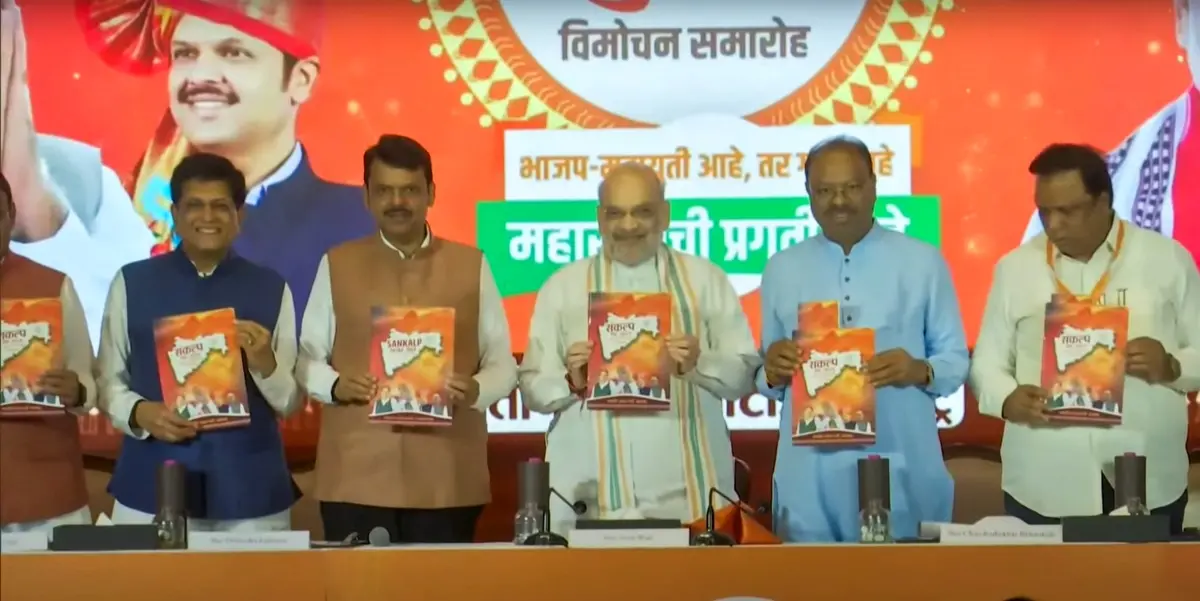
Union Home Minister Amit Shah released Bharatiya Janata Party's 'Sankalp Patra' or manifesto for the November 20 Maharashtra assembly polls in Mumbai. Shah, who was joined by Piyush Goyal, Maharashtra Deputy Chief Minister Devendra Fadnavis, and Chandrashekhar Bawankule for the release of the BJP manifesto, said that the Sankalp Patra fulfills the aspirations of the people of the state.
The BJP's manifesto includes a monthly allowance of Rs 2,100 for women, equating to an annual benefit of Rs 25,200.
The party aims to empower 50 lakh women as "Lakhpati didis" by 2027 with the help of a Rs 1,000-crore revolving fund.
For farmers, the manifesto promises a loan waiver of up to Rs 15,000 and a 20% subsidy on the minimum support price (MSP).
The party also aims to stabilize the prices of essential commodities and reduce electricity bills to alleviate household expenses.
To ensure food security, the BJP has proposed the Akshya Anna Yojana, which would provide free food grains to low-income families.
In healthcare, the party plans to introduce the Vivekananda Youth Health Card for annual health check-ups targeting young people. Additionally, the manifesto outlines a policy for senior citizens that includes Aadhaar-enabled services and dedicated outpatient departments for their medical needs.
The manifesto promises tuition and examination fee reimbursements for students from marginalized communities, such as Other Backward Classes (OBC), Special Backward Classes (SBC), Economically Weaker Sections (EWS), and the Vimukta Jati and Nomadic Tribes (VJNT).
The BJP has also pledged financial support of up to Rs 10,000 per student for educational expenses and aims to create 25 lakh new job opportunities.
To foster entrepreneurship, the party promises interest-free loans of up to Rs 15 lakh and the establishment of a Chhatrapati Shivaji Maharaj Aspiration Centre in every district.
A state-wide skill census is also planned to align training programs with the demands of the job market.
The BJP manifesto introduces Vision Maharashtra @2028, aimed at transforming the state into a USD 1 trillion economy by 2028. Key investment areas include making cities like Nagpur, Pune, and Nashik hubs for aerospace industries.
The manifesto also emphasizes Maharashtra’s potential as a leader in fintech and artificial intelligence (AI), pledging investment in AI and robotics training programs through Marathi and Atal Tinkering Labs.
For senior citizens, the BJP plans to increase pensions from Rs 21,500 to Rs 82,100.
A significant focus on rural development is highlighted by the promise to construct roads in 45,000 villages, improving connectivity and infrastructure across the state.
The BJP has also stated that the Vision Maharashtra @2028 blueprint will be unveiled within the first 100 days of forming the government, outlining the roadmap to achieve their ambitious economic and social targets.
"Maharashtra has been a leading state across different eras. The Bhakti Andolan began here when needed, and Shivaji Maharaj launched his movement from this land. Our focus is on farmers’ and the poor’s welfare, with schemes proposed for women's empowerment and the overall progress of Maharashtra," Shah said.
The Congress party has already released its manifesto, promising five major guarantees for voters. The key pledges include Rs 3,000 per month for women and free bus travel for women and girls under the Mahalakshmi Yojana, a loan waiver of up to Rs 3 lakh for farmers with an incentive of Rs 50,000 for timely repayments, a caste-based census, the removal of the 50% reservation cap, and health insurance coverage up to Rs 25 lakh along with free medication and monthly assistance of up to Rs 4,000 for unemployed youth.
Maharashtra Chief Minister Eknath Shinde had expressed skepticism over the Congress's ability to fulfill these promises, referencing past instances where similar pledges fell through. "Congress has made such promises in states like Karnataka, Rajasthan, and Himachal Pradesh, only to later claim there were ‘printing mistakes’ or insufficient funds, seeking financial assistance from the Centre,” Shinde said. “They are deceitful and unreliable. Rahul Gandhi promised ‘Khata Khat,’ but it was our government that delivered ‘Pat Pata pat."
The Maharashtra election campaign is witnessing fierce competition between the ruling Mahayuti alliance—comprising the BJP, Eknath Shinde's Shiv Sena, and the Ajit Pawar-led faction of the NCP—and the opposition MVA coalition, which includes Congress, Shiv Sena (UBT), and the Sharad Pawar-led NCP (SP). The MVA aims to reclaim power in the state and challenge the Mahayuti’s dominance.
One of the most anticipated electoral battles will take place in Baramati, where Ajit Pawar of the NCP will face a challenge from his nephew, Yugendra Pawar, son of Shrinivas Pawar. Baramati gained attention during the 2024 Lok Sabha elections when Supriya Sule defeated Sunetra Pawar by a significant margin of 1.5 lakh votes.
Voters in Maharashtra will head to the polls on November 20, with the counting of votes for all 288 constituencies slated for November 23. In the previous assembly elections of 2019, the BJP secured 105 seats, while Shiv Sena and Congress won 56 and 44 seats, respectively. The 2014 elections saw the BJP winning 122 seats, Shiv Sena taking 63, and Congress securing 42.