Bank strike 2026: September 11, 28, 29, 30 strikes announced; indefinite strike from October 26
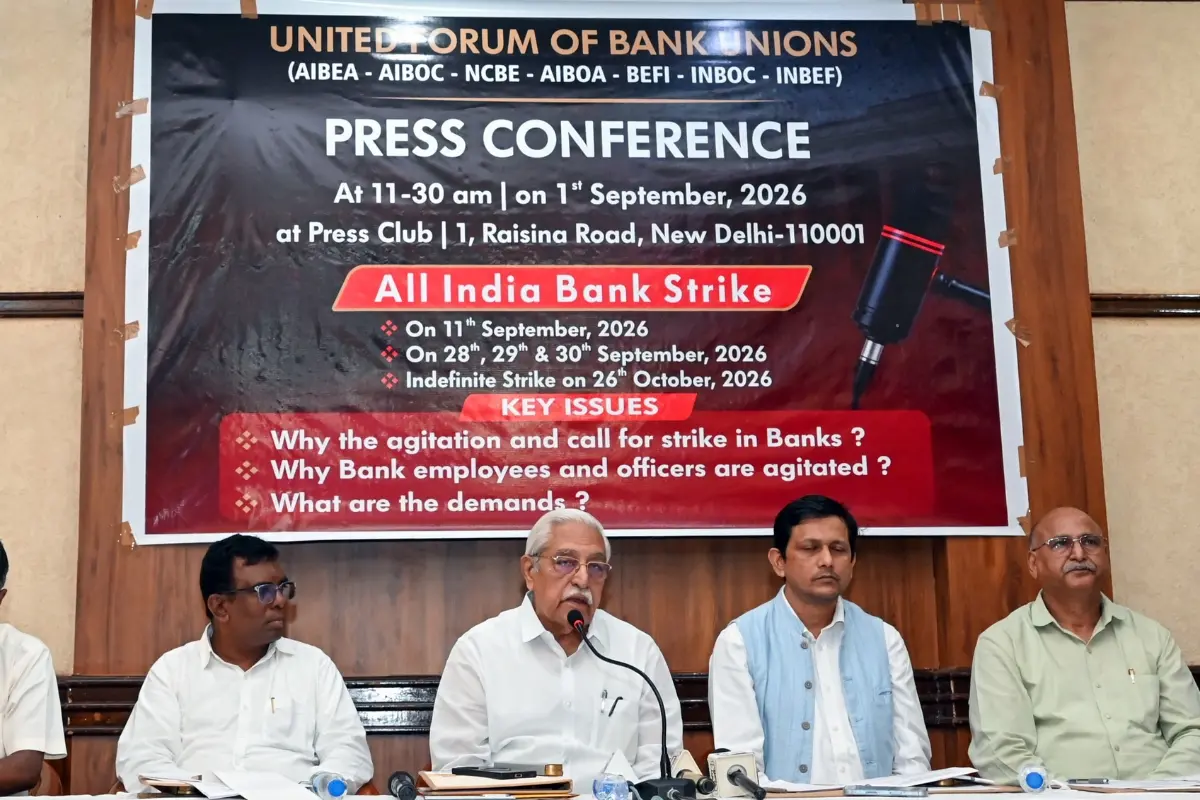
New Delhi: Bank customers across India could face disruptions in the coming weeks as the United Forum of Bank Unions (UFBU) has announced a series of nationwide strikes over demands including a five-day working week and changes to the Performance Linked Incentive (PLI) scheme.
The unions have called for a nationwide bank strike on September 11, followed by further strikes on September 28, 29 and 30.
If their demands are not addressed, the UFBU has threatened an indefinite strike from October 26.
The UFBU represents unions covering a large section of the banking sector, including public sector banks, private sector banks, foreign banks, regional rural banks and cooperative banks.
Why are bank employees going on strike?
One of the major demands of the bank unions is the implementation of a five-day banking week, under which banks would remain closed on Saturdays and Sundays.
According to the unions, the banking sector had agreed to the proposal in 2024.
Under the proposed arrangement, the existing system of two Saturdays off each month would be replaced with holidays on every Saturday and Sunday.
To compensate for the additional weekly holiday, working hours from Monday to Friday would reportedly be increased by 40 minutes each day.
While employees have agreed to the proposal, the demand is still awaiting approval from the Finance Ministry, according to the unions. They have been pressing for its implementation for nearly two years.
Unions oppose new PLI formula
The UFBU has also opposed a new Performance Linked Incentive (PLI) formula introduced for senior bank officers.
The unions have demanded discussions with the government over the scheme and described the new formula as 'unilateral and discriminatory'. They have also called for its withdrawal.
The existing PLI scheme was introduced in November 2020 following an agreement between the Indian Banks' Association (IBA) and bank employees' unions. It covered employees and officers from Scale I to Scale VII.
Under the earlier system, incentives were linked to the bank's overall performance and profitability.
Employees could receive an incentive ranging from a minimum of one day's salary to a maximum of 15 days' salary.
Why has the new PLI scheme triggered opposition?
The unions claim that in November 2024, the Department of Financial Services (DFS), under the Finance Ministry, directed banks to introduce a new incentive formula for officers from Scale IV to Scale VII.
Unlike the earlier system, the new formula places greater emphasis on an individual officer's performance rather than the overall performance of the bank.
According to the unions, the new scheme could allow certain officers to receive incentives of up to 365 days' salary, compared with the maximum of 15 days' salary under the previous bilateral agreement.
India's banking sector has around 8 lakh employees, of whom approximately 40,000 officers are in Scale IV to Scale VII, accounting for roughly 5 per cent of the workforce.
The UFBU has alleged that while the maximum incentive for the remaining 95 per cent of employees would be limited to one day's salary, officers covered by the new formula could potentially receive incentives of up to 365 days' salary.
The unions subsequently raised the issue with the IBA and proposed changes to the government's formula.
However, the UFBU claims that it has not received a response from either the DFS or the government.
Unions call new system discriminatory
The UFBU has argued that the new DFS formula goes against the uniform PLI arrangement agreed upon under the earlier bilateral agreement.
The unions have also raised concerns that the new system could lead to officers being categorised as 'good performers' and 'poor performers', potentially creating disparities among employees.
According to the unions, the revised system could also increase banks' expenditure disproportionately by providing significantly higher incentives to a small section of the workforce.
With multiple strike dates announced in September and an indefinite strike threatened from October 26, banking operations could face disruptions if the deadlock between the unions and the government continues.