Why has redefining Aravalli hills sparked protests from Gurugram to Udaipur?
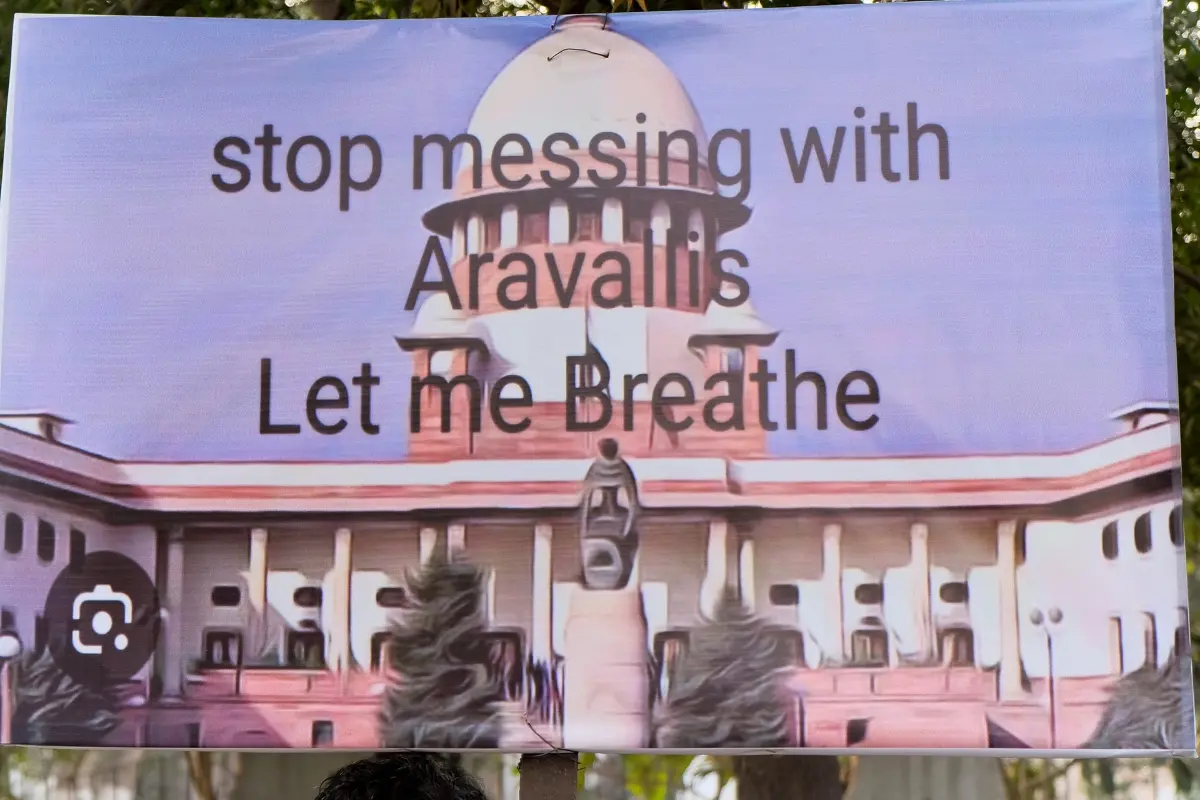
Rajasthan: Environmentalists and activists have protested across Haryana and Rajasthan after the Supreme Court accepted a new definition of the Aravalli Hills, raising fears that mining and commercial activities could threaten one of India’s oldest mountain ranges.
The Supreme Court last month approved recommendations from a Union Environment Ministry committee redefining the Aravalli Hills and Ranges. According to the new definition, an “Aravalli Hill” is any landform in designated Aravalli districts with an elevation of 100 metres or more above its local relief, while an “Aravalli Range” is defined as a collection of two or more such hills within 500 metres of each other.
Environmentalists warn that this definition excludes smaller hills, opening the door for mining, construction, and commercial activity in previously protected areas.
Protests from Gurugram to Udaipur
Following the Supreme Court order, environmental activists staged peaceful demonstrations in Gurugram, outside Haryana cabinet minister Rao Narbir Singh’s residence. Members of the “Aravalli Bachao Sanstha” joined social organisations and locals to demand stricter protection of the mountain range.
In Udaipur, lawyers and activists carried banners and raised slogans such as “Save Aravalli, Save the Future” and “No Aravalli, No Life.” The demonstrations highlighted public concern over potential ecological damage.
Ecological Importance of the Aravalli Hills
The Aravalli range, one of India’s oldest mountain ranges, acts as a natural barrier for Delhi-NCR, preventing desertification, controlling air pollution, and supporting groundwater recharge. Environmentalists argue that mining and development in areas below 100 metres could destabilise ecosystems, increase air toxicity, and reduce water security.
Activists stress that the Aravallis play a crucial role in protecting the environment for future generations and maintaining regional biodiversity.
Political Opposition and Criticism
Rajasthan Assembly Opposition Leader Tika Ram Jully criticised the central government’s move to redefine the Aravalli Range. Jully pointed out the contradiction between government tree-planting campaigns and allowing large-scale mining, warning that these actions could accelerate desertification and ecological degradation.
Jully emphasised that without the Aravallis, the area extending to Delhi could face severe environmental consequences, including water scarcity and worsening air quality.
Activists Demand Full Protection
Protesters and environmentalists are urging the government to declare the Aravalli hills fully protected and implement a clear conservation policy. They insist that safeguarding the range is essential not just for ecological balance, but also for the long-term security and health of communities across Haryana, Rajasthan, and Delhi-NCR.
“Nature cannot be compromised in the name of development,” one protester said. “The conservation of Aravalli is directly linked to the future of coming generations.”