'There’s no one agenda, narration which is right': Polish producer Ewa Puszczyńska on cinema's role at IFFI 2026
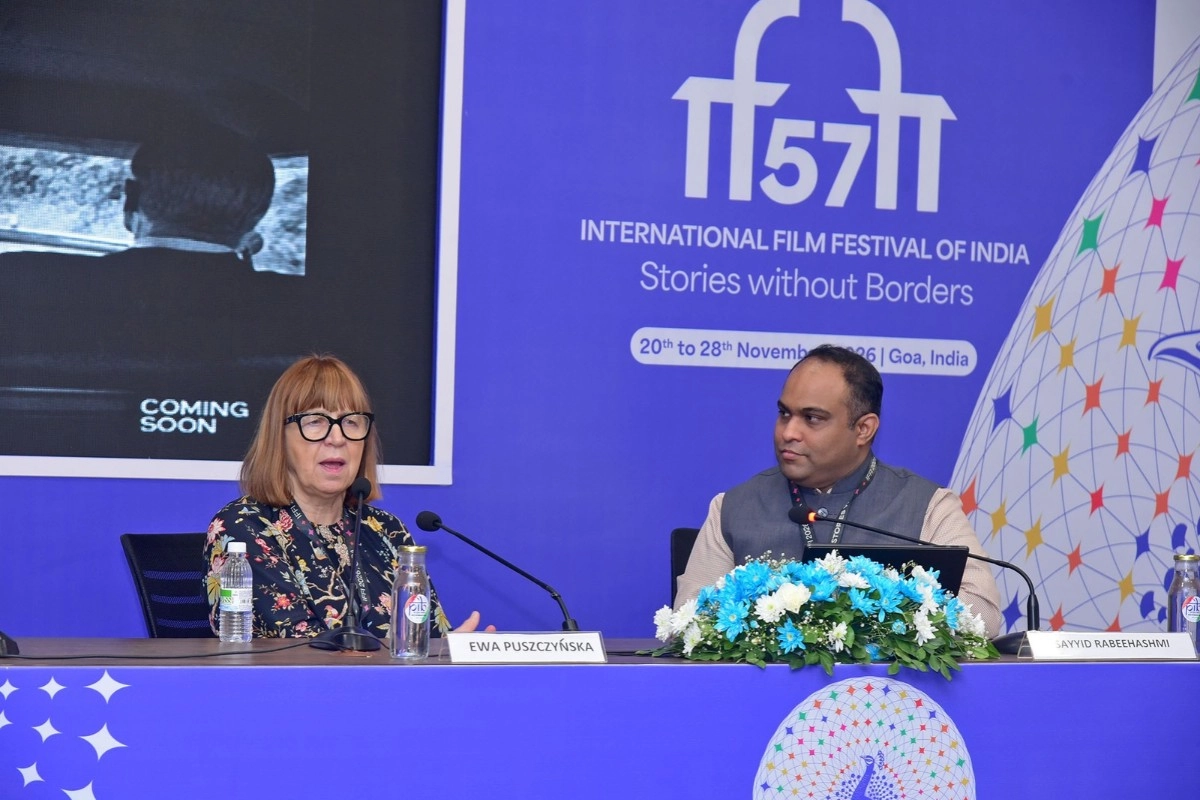
Could the little-known story of Polish children who found refuge in India during the Second World War become the subject of a film? Acclaimed Polish producer Ewa Puszczyńska is interested in exploring the possibility. Speaking at the 57th International Film Festival of India (IFFI), where her film ‘Fatherland’ opened the festival, she expressed hope that the project could move forward.
Puszczyńska said she had discussed the subject with IFFI Festival Director Ashutosh Gowariker, who has already written a script based on the historical connection. She is keen to continue the conversation and explore how the story could be brought to the screen.
The story of Polish children who found shelter in India during the war offers an interesting starting point for a film about the relationship between the two countries. Puszczyńska's interest in the subject also comes at a time when Fatherland, her latest production, looks at questions of identity, history and belonging.
At a press conference during IFFI, the producer spoke about the ideas behind the film and why cinema continues to matter in a world where people often struggle to understand perspectives different from their own.
"Films may not change the world overnight, but they can open minds, encourage dialogue and inspire people to reflect on the world around them," was the message running through her interaction. She believes films should make audiences look beyond their familiar surroundings and engage with other experiences.
"We have to talk to people through our films. We have to open people's minds to other sides of life, to other sides of the world," she said.
A story set in a divided Europe
Directed by Paweł Pawlikowski, ‘Fatherland’ is set in Europe in 1949, a period when the divisions between East and West were becoming increasingly pronounced. The film follows celebrated German writer Thomas Mann and his family, using their experiences to examine the relationship between individuals, their homeland and the society around them.
For Puszczyńska, the film's questions are not limited to the period in which the story is set. The idea of belonging, particularly in a world shaped by migration, remains relevant today.
"Where is your fatherland? Is it the country you live in, or is it the language you speak? Is it where your history comes from, or is it the country where you live?" she asked.
She also spoke about the growing tendency among people to hold on to their own versions of events without making an effort to understand others. There is no single narrative that can claim to be the only right one, she pointed out, stressing the need for conversations and common ground.
The film also looks at the influence of culture on society, the pressures within families and the expectations placed on children of celebrated artists. It examines how the achievements of well-known parents can become a difficult standard for the next generation to live up to. Through these personal relationships, the story connects larger historical changes with the lives of ordinary people.
A visual connection to Ida and Cold War
For viewers familiar with Pawlikowski and Puszczyńska's earlier collaborations, ‘Fatherland’ may have a recognisable visual style. The film was shot in black and white and uses a 4:3 aspect ratio, much like ‘Ida and Cold War’.
Puszczyńska said the decision was made to give the film a look that suited the period. She also suggested that Fatherland could be seen as the third film in a trilogy following the two earlier collaborations.
Although the story is set in Germany, most of the production took place in Poland. Nearly 95 per cent of the film was shot there, with locations chosen to recreate the Germany of 1949. The project is an international co-production involving Poland, Germany, Italy and France, with much of its creative and technical team coming from Poland.
The 57th IFFI opened with ‘Fatherland’, bringing Puszczyńska's latest work to Indian audiences. The press conference was moderated by Sayyid Rabeehashmi.