When the suspect becomes the story: Reading Pradhama Drishtya Kuttakkar alongside Nayattu
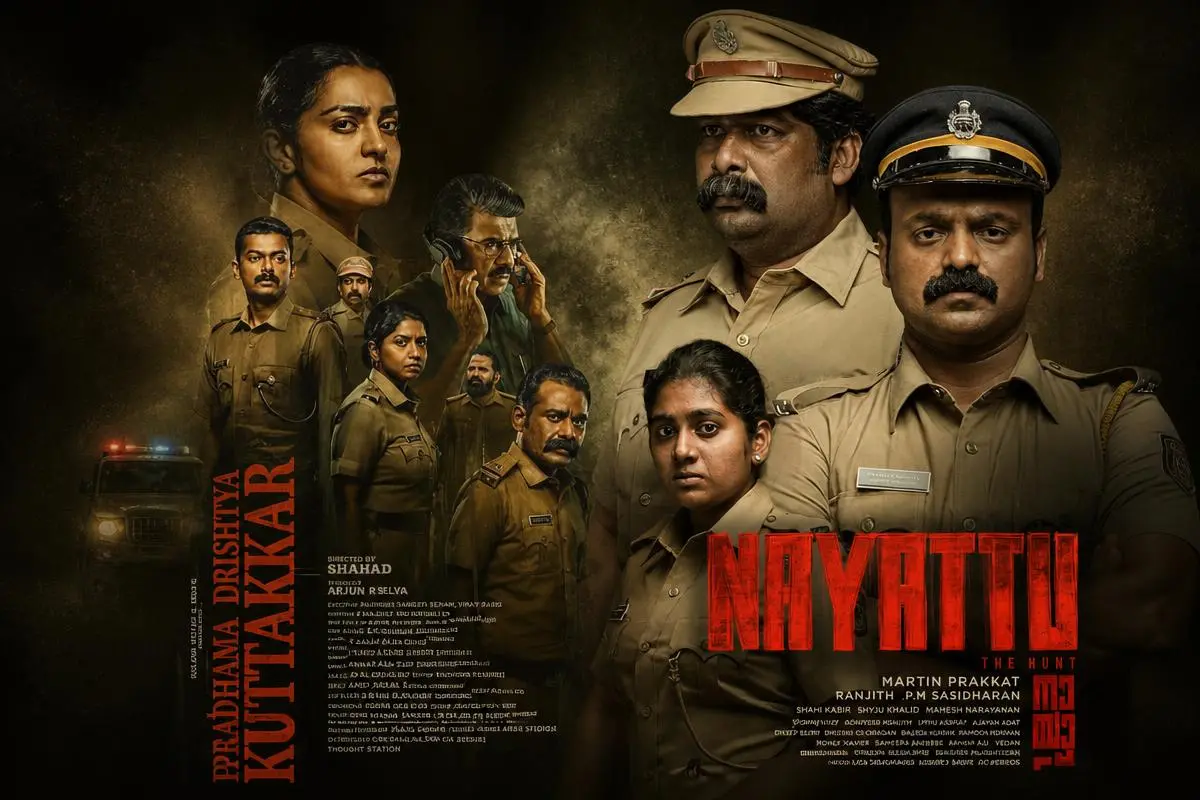
Malayalam cinema has rarely treated crime as merely a puzzle waiting to be solved. Again and again, its most compelling crime stories have asked a more uncomfortable question: who gets labelled a criminal, and who gets to decide?
That question provides an interesting entry point into Pradhama Drishtya Kuttakkar and Nayattu. Though separated by their narratives, characters and filmmaking approaches, both films place individuals inside systems that are larger than them. The crime is only one part of the story. The real tension emerges from what happens after suspicion takes hold.
In a conventional crime thriller, the investigation usually moves towards an answer. Evidence is collected, suspects are eliminated, and the mystery eventually gives way to a culprit. But films such as Nayattu complicate that familiar structure. Here, the machinery of investigation itself becomes part of the conflict.
The question is no longer simply who committed the crime, but what happens when the system needs someone to be guilty.
Nayattu, directed by Martin Prakkat, builds its drama around three police officers who find themselves caught in circumstances that rapidly spiral beyond their control. What begins as an incident turns into a battle involving politics, policing, caste, media attention and institutional pressure.
The film's most unsettling idea is that truth and justice do not necessarily travel along the same path.
The three officers are not presented as uncomplicated heroes. Their profession gives them authority, but the same institution that gives them that authority can also turn against them. As the pressure mounts, survival becomes increasingly important, and the line between protecting oneself and manipulating the truth begins to blur. This is where Nayattu becomes more than a police thriller.
The film asks whether a person can remain an individual once the system has assigned them a role. Once someone is identified as a suspect, accused or criminal, everything that follows can begin to be interpreted through that label.
Pradhama Drishtya Kuttakkar can be read through a similar lens, particularly in its interest in perception and suspicion. Its very premise invites attention to the gap between what appears to have happened and what may actually have happened.
The phrase “at first glance” is important here. A first impression can become a conclusion remarkably quickly. In crime narratives, that process is often accelerated by the urgency to identify a culprit. But suspicion is not proof, and appearance is not always reality.
That distinction becomes particularly significant when cinema examines institutions such as the police, the media and the justice system. Each institution has its own methods of constructing a version of events. A police officer may look for evidence. The media may look for a compelling narrative. The public may look for a villain. The accused, meanwhile, may simply be trying to survive the consequences of a story already being written about them.
The politics of being accused
One of the strongest connections between the two films lies in their treatment of accusation.
Being accused is not merely a legal condition. It can become a social identity.
Once a person is publicly associated with a crime, the presumption of innocence can become difficult to preserve. News reports, social media discussions, rumours and public reactions can create a parallel trial long before a courtroom reaches a conclusion.
Cinema is particularly effective at exposing this process because it can show the audience information that characters within the story do not possess. We may know that a particular assumption is questionable while watching other characters treat it as established fact.
That creates a powerful form of dramatic irony. The audience is forced to recognise how easily certainty can be manufactured.
Nayattu takes this idea into the political sphere. The investigation is not isolated from the world around it. Political calculations, institutional reputation and public perception become inseparable from the pursuit of justice.
The result is a disturbing question: when an institution is under pressure to produce an answer, does finding the truth remain the only objective?
From crime mystery to system story
This is also where contemporary Malayalam cinema has increasingly moved away from the traditional “whodunit”.
The crime is often only the doorway. What lies beyond it is a study of institutions, class, caste, gender, politics, media and social prejudice.
A murder investigation can therefore become a story about power. A missing person case can become a story about privilege. A police chase can become a story about institutional survival.
Pradhama Drishtya Kuttakkar and Nayattu belong to this broader tradition of Malayalam films that use crime to examine society rather than treating crime as an isolated event.
Their protagonists operate in worlds where information is incomplete, and consequences are immediate. The audience is repeatedly encouraged to question what it sees, rather than simply waiting for the final revelation.
Who gets believed?
Perhaps the most important question connecting such films is not “Who is the criminal?” It is “Whose version of the truth is believed?”
That question has become particularly relevant in an era when a photograph, a short video or a social media post can create instant certainty. A person can be judged within minutes, while establishing what actually happened may take months or years.
Crime cinema can reflect this anxiety particularly well because its central conflict is often built around competing versions of reality. The accused has a story. The police have a story. The media has a story. The political establishment may have another. And somewhere underneath all of them is the truth.
The most interesting films are those that refuse to make that truth too comfortable.
Rising suicides among cops in Kerala
The growing concern over the mental health of police personnel in Kerala adds another layer to the questions raised by films such as Nayattu and Pradhama Drishtya Kuttakkar. According to reports, 138 police personnel died by suicide between 2016 and November 2024. It is often cited that the majority of the cases are linked to family problems, depression, health issues, work-related difficulties and financial stress among the reasons identified in individual cases.
The pressure is also reflected in a 2025 peer-reviewed study of 253 police personnel in Thiruvananthapuram, which found that 75.5 per cent experienced high operational stress and 65.6 per cent reported high organisational stress. Nearly all participants worked shifts; 92 per cent reported inadequate sleep, and 83 per cent said they experienced high workplace stress.
These figures do not establish that every suicide is caused by policing conditions, but they underline the difficult environment in which many personnel work. In that context, the image of the policeman in Malayalam cinema becomes more complicated: the person expected to enforce the system can also be deeply vulnerable to the pressures within it.
The Malayalam thriller's changing criminal
In older crime narratives, the criminal was often an individual whose motives had to be uncovered. Contemporary Malayalam thrillers have increasingly complicated that figure.
Sometimes the “criminal” is created by circumstance. Sometimes by institutional pressure. Sometimes by prejudice. And sometimes by a system that needs a convenient culprit.
That shift makes films such as Nayattu particularly significant. Its tension does not depend entirely on discovering a hidden mastermind. Instead, the film derives its power from watching ordinary people become trapped inside a chain of events from which escape becomes increasingly difficult.
Pradhama Drishtya Kuttakkar, meanwhile, offers another opportunity to examine how perception shapes our understanding of guilt and innocence. Together, the films invite viewers to look beyond the crime itself.
Perhaps the most unsettling crime stories are not the ones that ask us to identify the criminal. They are the ones that make us wonder how easily any of us could be turned into one.