Sreekumaran Thampi remembers Vani Jairam on her 80th birth anniversary, says honesty was her greatest virtue
Singer Vani Jairam made her Hindi film debut with the iconic song “Bole Re Papihara, Papihara”, written by Gulzar and composed by Vasant Desai, for the Hrishikesh Mukherjee film 'Guddi'. She rendered two more songs for the film — “Hum Ko Man Ki Shakti Dena” and “Hari Bin Kaise Jeeun.”
Born as the fifth of six daughters to Duraisamy Iyer and Padmavathi in Vellore, Tamil Nadu, Kalaivani later became known to the world as Vani Jairam. In addition to her five sisters, Kalaivani had three brothers, a total of nine children. Her parents had a deep interest in music, and Kalaivani displayed remarkable talent from a young age. She was trained in Carnatic music under Rangaramanuja Iyengar and Kadalur Srinivas Iyengar. At eight, she sang at the Madras station of All India Radio. At 24, she married Jairam and began building a career in music. At Jairam’s request, she changed her name from Kalaivani to Vani Jairam.
Vani studied at Queen Mary’s College, Madras, and later secured a job at the State Bank of India. After marriage, she moved to Bombay to live with her husband. Vani later told me that many of the highs in her life were because of her husband Jairam, and his mother. Jairam encouraged her interest in North Indian music and arranged for her to pursue advanced training under Ustad Abdul Rahman Khan.
Vani Jairam eventually resigned from her bank job and went on to master North Indian music forms such as Thumri and Ghazal. Once it became clear that his wife would rise in the music world, Jairam left his own high-ranking job to support her full-time. The well-educated and capable Jairam oversaw his wife’s career closely, with the encouragement of his mother.
Although Vani started in Hindi, she did not receive many opportunities in the language. After Vasant Desai, several leading composers, Chitragupt Shrivastava, Naushad, Madan Mohan, RD Burman, OP Nayyar, Jayadev, and Laxmikant–Pyarelal, used her voice, but largely for one or two songs each. For reasons unknown, sustained opportunities did not follow. It was the South Indian film industry that nurtured her.
SM Subbaiah Naidu, mentor of MS Viswanathan, first invited Vani to sing for a Tamil film, but the production was delayed. Her first Tamil release became a duet with TM Soundararajan for the 1973 film 'Veettukku Vandha Marumagal', composed by Shankar–Ganesh: “Oridam Unnidam…” She later sang many songs for Shankar–Ganesh.
Vani first sang for K Balachander in 'Sollathan Ninaikiren'. The song was “Malar Pol Sirrppathu.” Many more followed. Vani Jairam won her first National Award for Best Female Playback Singer for “Yezhu Swarangalukkul,” from Balachander’s 'Apoorva Raagangal' (1975). She later sang for Ilaiyaraaja, Deva and veteran composers such as KV Mahadevan, and also worked with AR Rahman. Shankar–Ganesh made the most extensive use of Vani’s voice in Tamil. Her ghazal-like “Megame Megame…” (written by Vairamuthu for 'Palaivana Solai') remains noted. Vani also showed her flair for folk-tinged comedy numbers with “Niththam Niththam…” from 'Mullum Malarum', composed by Gangai Amaran to Ilaiyaraaja’s music.
In Kannada, it was Vijaya Bhaskar who elevated Vani Jairam to the status of the industry’s leading female playback singer. Once she began singing for him, almost every female lead song he composed went to Vani.
Fluent in both music and literature, Vani Jairam was introduced to Malayalam cinema by maestro Salil Chowdhury. Her first Malayalam song was “Sourayudhathil Vidarnnoru” written by ONV Kurup for the film 'Swapnam', produced by Sivan and directed by Babu Nanthankode. After hearing the song, I decided that some of the compositions I had written would be recorded in Vani Jairam’s voice, and being a producer and director, it was easy for me to realise this. I first met Vani Jairam during rehearsals for “Thiruvonapularithan” for the film 'Thiruvonam' (produced by KP Mohan), for which I wrote the story, screenplay, dialogues and songs, and also directed.
The following week, Vani was invited to record “Vaalkkanezhuthi” for the film 'Picnic' with Yesudas. 'Picnic' reached audiences first. From then on, Vani Jairam sang most of the female songs I wrote. Dakshinamoorthy Swamy and Arjunan Master, who collaborated with me extensively, helped make this possible. They also trusted Vani’s voice and musical purity.
Most of Vani Jairam’s songs became superhits. She has sung in almost all Indian languages, Hindi, Tamil, Telugu, Kannada, Gujarati, Marathi, Odia and Bhojpuri. She has won three National Awards for Best Playback Singer: 'Apoorva Raagangal' (Tamil, 1975), 'Sankarabharanam' (Telugu, 1980), and 'Swathi Kiranam' (Telugu, 1991). I was part of the National Feature Film Jury that selected her for the award for 'Swathi Kiranam'. The film, directed by K Viswanath, featured Mammootty in the unusual role of an anti-hero. Vani Jairam won the Filmfare Award for her songs in the Hindi film 'Meera', composed by Pandit Ravi Shankar (1980).
It has been nearly six decades since I entered Malayalam cinema as a lyricist. Legendary singers like Leela, P Susheela, S Janaki, LR Eswari, B. Vasantha and Madhuri have performed my songs. I have been close to all of them, yet Vani Jairam remains the closest to my heart. She felt the same way. Vani Jairam never hesitated to tell the truth. So do I. Once, she compared the famous Malayalam song “Sapthaswarangalaadum” (Sankhupushpam movie) with “Ezhu Swarangalukkul,” both sung by Vani. She told me frankly, “Thampi’s composition did not reach Kannadasan’s level.” Both songs were about music. As she was right, I felt no embarrassment.
That honesty was her greatest virtue. She never offered false praise. At the same time, she spoke openly about the uniqueness of my lyrics in interviews. She always acknowledged that Arjunan Master and Swamy gave her the most opportunities in Malayalam and expressed her gratitude for it.
Her husband, Jairam, was a close friend of mine as well. They were an exemplary couple. I never saw them apart. When they decided to set up a recording studio in Madras, Jairam discussed it with me. Vani, an ardent devotee of Meera, started the institution to promote Meera bhajans, ghazals and devotional music. Many scholars from North India came to Madras to compose Meera bhajans in various ragas for her. But because the couple lacked a business strategy, the venture failed, resulting in financial loss.
Jairam’s death shattered Vani. When I met her afterwards, she said, “My interest in singing has decreased. Life has lost its meaning.”
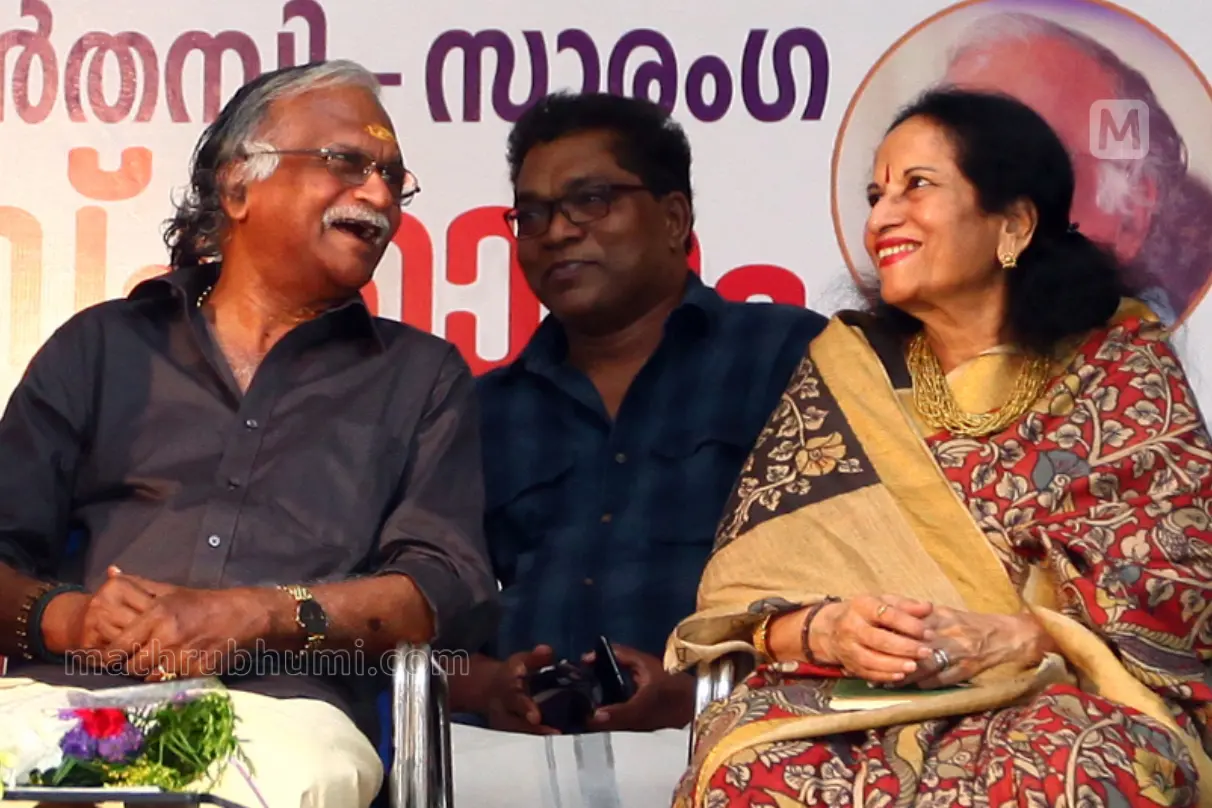
Saranga, an organisation in my hometown, Haripad, Alappuzha, instituted an award (Puraskaram) in my name. The first Saranga–Sreekumaran Thampi Puraskaram was given to Vani Jairam. When she arrived to receive it, she was emotional. “If Jairam were here, how happy I would have been today,” she said, breaking down.
Most of my songs sung by Vani Jairam became hits, and although I do not intend to list them, how can one forget “Ilam Manjin” (Paathira Sooryan movie ), “Manjappattu Njorinju” (Ambalavilakku movie), “Ethu Panthal Kandaalum” (Venalil Oru Mazha movie), and “Nilavilakkin Thiri” (Santha Oru Devatha movie), these and “Pakal Swapnathin Pavanurukkum” (Ambalavilakku movie) sung with Yesudas remain unforgettable.
“Malligai En Mannan” from the Tamil film 'Dheerga Sumangali' was among Vani Jairam’s early hits (Kannadasan–MS Viswanathan composition). When the film was remade in Malayalam as 'Aayiram Janmangal', MS Viswanathan chose Vani again. The song “Mullamaala Choodivanna” (lyrics by P Bhaskaran) remains a favourite. Vani did not sing many songs written by Vayalar or composed by Devarajan Master, but the two songs she recorded for the movie 'Sammanam', written by Vayalar, are exquisite. The song “Ente kayyil poothiri ” and "Kaattu Chennu Kalebaram" (Music: V Dakshinamoorthy) still resonates with beauty.
Vani received state awards for her singing in Tamil, Telugu and Kannada. But she never received that recognition from Kerala.
Vani Jairam’s death was sudden, shocking and deeply heartbreaking. Only a day before she passed, we spoke on the phone, at a moment when she had just been honoured with the Padma Bhushan.
Had she lived, Vani Jairam would have turned 80 on November 30.
A doorway to the heart is memory, a sorrow that lingers, whether that door remains open or closed.