EXCLUSIVEThe saree meant to outlive the wedding; Ahaana Krishna's bridal story, told by the man behind it
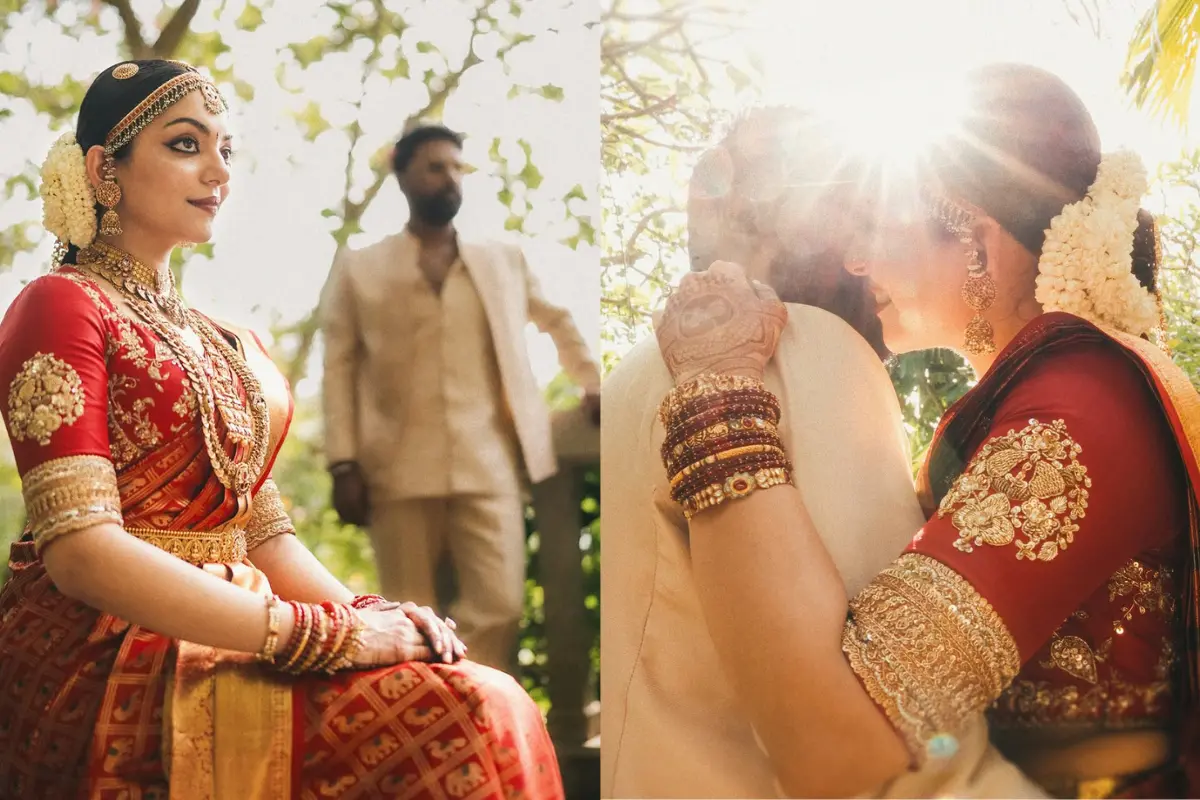
When Ahaana Krishna's wedding pictures began circulating online, one detail dominated conversation, the deep, unusual red of her bridal Kanchivaram. Behind that saree is Joel, whose association with the family dates back to Diya Krishna's wedding, when a saree he designed for Ahaana as a bridesmaid became one of the most referenced bridal looks over the following two years.
Joel calls Diya's wedding a turning point in his own career, and interestingly, it wasn't the bride's saree that went viral that day, it was Ahaana's. "That was very unexpected for us," he says. "Diya's saree was beautiful, but somehow it didn't translate as dramatically in pictures. Ahaana's saree, on the other hand, went viral almost instantly." He recalls suggesting a pastel shade to her, one she was initially hesitant about but came around to, a look that ended up as a reference picture for brides for nearly two years.
Also Read: ‘She's my best friend’: Inside Nimish Ravi and Ahaana Krishna's creative partnership
It was during that process, he says, that he first sensed what he describes as Ahaana's ‘Lakshmi’ energy, alongside a protective, decisive ‘Durga streak.’ Ahaana is someone who reacts correctly, exactly when it's needed. Most girls in that position might get emotional or lean on a brother or father to speak up. But I've seen her step in and handle things herself, to the point where there's nothing left to add."
So when it came to designing for her own wedding, Joel didn't get an elaborate mood board or a stack of reference images. "She didn't bring in a Rashmika Mandanna picture or anything like that," he says. "She just told me, Joel, I don't want what Diya had, and I don't want the trendy meenakari or tissue Kanchipuram work everyone's doing right now."
Her brief was simple but exacting, an evergreen color that could last generations, and it had to be red, though not just any red. "She wanted a shade with a magenta tinge, with a small element of rani pink in it. Not maroon, not a flat red. A special red."
Ahaana had one non-negotiable through it all, this had to be a saree she could pass down like gold, to a daughter and eventually a granddaughter. When Joel asked if she wanted anything personal woven in, initials, a nod to her love story, the kind of detail that's become something of a trend at celebrity weddings, she turned it down outright. "She wanted a proper traditional Hindu bridal look, and it had to be evergreen. Nothing that would date it."
That specificity turned into a months-long hunt. The first saris were shown to Ahaana on February 23, and Joel personally traveled to Kanchipuram for the project, eventually bringing back close to twenty shades of red for her to try on in person before they settled on the final tone.
Most sarees from his atelier take two to three weeks to weave, Ahaana's took 45 days to weave alone, though the process behind it stretched across roughly 6 months from the first colour discussions to final delivery, which happened just 7 days before the wedding. Part of what made it so time-intensive, Joel explains, is a technical quirk of saree-weaving most people don't know about, unlike a dyed lehenga fabric, where the colour is straightforward, a saree's exact shade only becomes clear once it's actually woven, because the colour given to the warp differs from the colour given to the weft.
"You genuinely can't predict the final shade until it comes off the loom." Every time Ahaana didn't love a result, the weaver started over, a cycle repeated several times before the final red was locked in.
Also Read: From clicking DPs for friends to shooting Mammootty, the self-taught rise of Nimish Ravi
Once the colour was settled, the real design challenge began because a traditional Kanchivaram doesn't leave much room for contrast or new elements in the border; most of the variation a designer can bring has to live within the buttas. Since Ahaana wanted a saree that stayed close to the traditional silhouette while still carrying real bridal richness, Joel's team introduced a check motif across the fabric, a detail that keeps the base color visible while still delivering the "blingy" effect a bride expects on her wedding day.
A bird motif runs through the saree too, the same element Joel had used in Diya's wedding saree, reworked here with a subtle green touch on the feather for added elegance, alongside a specially designed parrot, peacock and an elephant motif carried through both the mehendi look and the saree itself. "It's a very traditional element in Kanchivaram sarees," Joel says, "but it signifies prosperity and richness. We tried several figure motifs, but the elephant was the one Ahaana connected with instantly."
On the border, arrow motifs, a near-default choice on traditional borders, were deliberately left out because Ahaana dislikes them, and replaced instead with rudraksha motifs, a swap that closed off any room to bring in a more modern element there. The border ended up being the single most time-consuming part of the entire saree, Joel's team went through roughly 30 design iterations before finalizing it, weaving it in a banarasi-style pattern using 4-gram gold zari.
The blouse, by contrast, came from a different hand entirely, designed by Santinni, primarily in zardozi work mixed with cut-bead detailing. Joel's only real input there was a request to keep the embellishment restrained, so the base color itself would stay visible rather than getting buried the way it had in the more heavily embroidered pastel look from Diya's wedding.
Also Read: Did Suriya and Jyotika live the love ‘Sillunu Oru Kadhal’ once described?
Joel's involvement went well beyond Ahaana's own outfit. He describes his role with her as something like an elder sibling's protective, closely involved, but working within a framework Ahaana herself set rather than handed complete freedom. His team ended up dressing nearly the entire bride's side of the wedding, sarees for Ahaana's mother, her mother-in-law, actress Hansika, Sindhu Krishna, cousins, and her best friend, amounting to what Joel estimates as ninety-five percent of the bride's side.
"She isn't someone who just hands over full freedom and disappears," he clarifies. "She sets timelines, we need to finalize motifs by this date, and she won't check in obsessively before that deadline. But everything was run past her. When you're working with 4-gram gold zari, you can't keep changing things after the fact."
For the immediate family, Ahaana set an unusually specific colour code limited to ivory, white, yellow, green, and gold, rather than a typical coordinated palette and even within that, getting Sindhu Krishna's saree right took eight or nine attempts before they landed on a gold-and-yellow combination.
Joel adds, Ahaana's own jewellery was entirely her doing, sourced independently over several years.
As for sequencing the couple's outfits, Joel says it's standard practice for the bride's look to be finalized first, since grooms work with far tighter colour constraints while brides have far more room to experiment. In this case, Nimish Ravi wasn't around for much of the process and, Joel notes, isn't particularly invested in these details, every call on her look was Ahaana's alone.
Also Read: ‘Janani’, The house Nimisha Sajayan has painted into being
Online reaction since the wedding has been mostly positive, Joel estimates around seventy percent, with the rest questioning why this particular red mattered so much, or drawing unfavourable comparisons to the pastel pink look from Diya's wedding. He takes both in stride. "Both are my children," he says of the two looks.
"But I only wanted one thing this time, for the wedding look to be entirely different from the pink one. If we'd reused any element of that pastel look, people would've said it's the same thing all over again. So the colour, the work, the whole approach had to be completely distinct, while still giving that bridal richness."
Asked to sum up the final look in three words, he doesn't hesitate: traditional, classy. "It's not an over-the-top, richly loaded look, not a lot of zari, not a lot of noise. It's a clean, traditional bridal look. A standard bridal look, done right." As for the red itself, he's unbothered by the debate around it. "Every bride's preference is personal. Red might be a common color, but this red was special to Ahaana specifically."
Also Read: The wildest wedding accessory? The handbag; for every bride and bridesmaid
Because for Joel, the internet's verdict was never really the point. "The moment the saree was revealed, seeing the happiness on Ahaana's mother's face and on Ahaana's own face, that was a bigger reward than anything else could have been."
Strip away the interviews and the Instagram commentary, and what remains is something far less glamorous, thirty borders rejected before one felt right, a weaver starting over each time a red came out wrong, a feather touched up in green because it felt truer to the bird. None of it announces itself in a photograph. Ahaana never wanted a saree for a single day, she wanted one that would outlast the wedding, the headlines, even her own memory of the morning she wore it, something that could sit folded away for years and still mean something when it's finally unwrapped again, for a daughter, and one day, perhaps, for a daughter of hers. In that sense, the six months were never really about getting a colour right. They were about getting a legacy right.
(All photos in this article are sourced from Joel Jacob Mathew, captured during the making of Ahaana Krishna's wedding saree.)