'Dark humour is not for everyone, but this film...' Chandini Sreedharan on ‘Pravinkoodu Shappu’
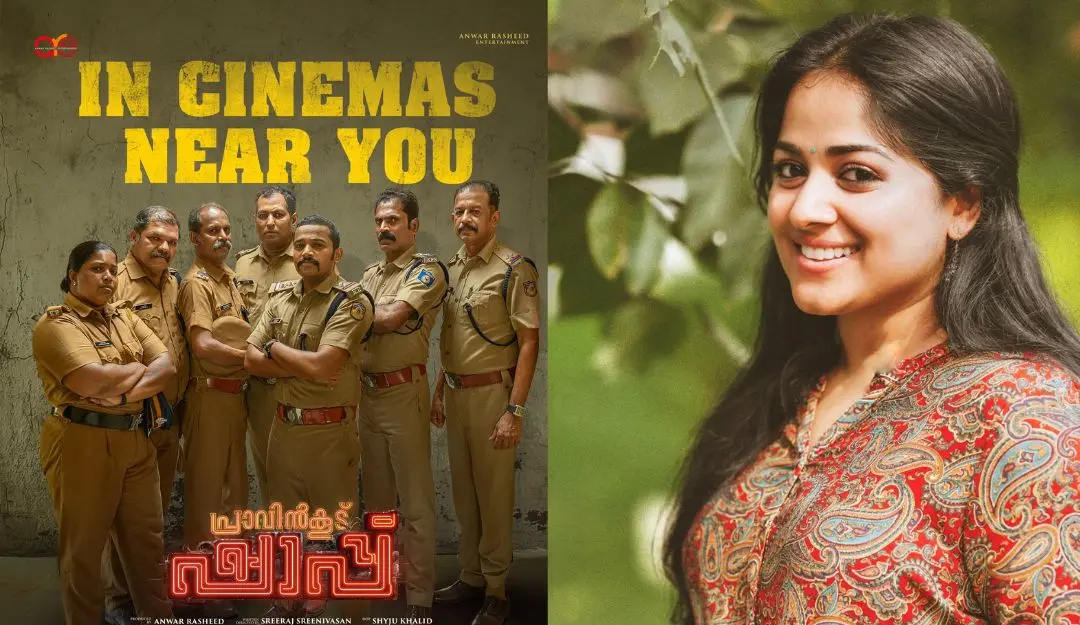
In a candid chat, actor Chandini Sreedharan opens up about her latest film ‘Pravinkoodu Shappu’, a darkly humorous thriller that’s won over audiences and critics alike. With the movie now set for an OTT release on Sony LIV on April 11, Chandini reflects on the unique experience of playing the eccentric Merinda — a role she calls a once-in-a-lifetime opportunity.
From diving into the world of regional dialects to working alongside Malayalam cinema’s finest, she speaks about the challenges and joys of her journey so far and why she believes Malayalam films continue to set the bar with their rooted storytelling and compelling characters. Read excerpts:
What was the audience response to your film’s theatrical release? Were you happy with how it was received?
The movie ‘Pravinkoodu Shappu’ is a dark humour thriller. And it's a very difficult movie to just explain in one sentence. But the movie revolves around the characters Kannan (Soubin Shahir), Merinda (Chandini), Sub-Inspector Santosh (Basil Joseph) and Komban Babu (Shaji Chen). It revolves around the murder of Babu at a toddy shop, as the police investigate the case.
We were all very excited about the theatre release. I think dark humour is received very differently by different audiences, and ‘Pravinkoodu Shappu’ is dark humour. People really loved the technical aspects of it. I personally received really great feedback regarding my character Merinda. I was told that it's a very quirky character and a very different one too. I really enjoyed how the film was received at the theatres.
Your portrayal of Merinda has been praised. How did you approach this character? Was there any special preparation involved?
Mirinda is a once-in-a-lifetime character, and I'm so happy and thankful that I got to play this exciting role. When I first got to know about the character, I found it to be one that is extremely quirky and layered. As a performer, I was able to kind of showcase a lot of different shades for one character, which I found very exciting, and I don't think I have ever seen another character like Merinda on screen. The credit for this definitely goes to the film’s director (Sreeraj Sreenivasan), who is also the scriptwriter.
As for the preparation, Merinda’s look is very different from my personal look in terms of the hair, the skin tone, or the costumes. It's definitely the director's vision, and I think he, along with the makeup and costume teams, executed it really well.
During the shoot, every day I think I went in and sat down for like an hour and a half to get into the look of the character, and it took double the amount to kind of get everything off as well, but it was so exciting. Once I was in the makeup and costume of the character, my body language changed completely. I think it really helped with it because I couldn't relate to it as myself; I just felt like the character. I could execute it well because of the vision that my director had for the character.
With ‘Pravinkoodu Shappu’ now set for an OTT release, how do you feel about the shift towards digital platforms for film releases?
I think it's extremely important, and also I think it helps us as makers and creators to have our product reach a wider audience. A platform like Sony Liv is seen as a platform that has good quality movies and shows. When I found out that the film is releasing on Sony Liv, I was pretty excited because all the movies that came up on Sony Liv in the last year are some of the biggest hits and movies.
OTT releases also help in a way that films are released in multiple languages on platforms, catering to a wider audience across regions and languages. Even without the dubbing, a lot of people are now watching Malayalam movies with subtitles because they're looking forward to the good content that we're making. So I'm happy that our product is going to reach a wider audience, meaning more people are going to watch it, bringing more exposure to us.
When it comes to Malayalam cinema, many believe it offers superior content compared to films in other languages. In your opinion, what gives Malayalam films that distinct edge?
I was brought up in the United States of America, and I’m very much exposed to Hollywood movies. I love superhero movies, and those movies have a lot of special effects. The thing with Malayalam movies is that they don't rely on or focus on the extra effects; it's very technically driven. Mainly I think it's the content, the stories that our makers make here. I'm sure people can relate to it, but even more than that, I think people are entertained and interested by it. I definitely think the main source of a good film is the storytelling. In Malayalam cinema, we largely rely on using our natural, authentic stories of what's happening in Kerala and surrounding Kerala’s culture.
Your Malayalam accent is spot on. Having lived in the US for quite a long time, how did you manage to perfect the slang, and what was the dubbing process like for your character?
I don't know if people in Kerala or my colleagues would agree with you on that. Maybe they might now. Having said that, I have to thank my parents because I was brought up in the States. I went there soon after being born, but my parents made sure to speak to my brother and me in Malayalam. That’s how we both know how to speak Malayalam. In fact, I can read and write in Malayalam. I also know a few other Indian languages. And the reason is that they (parents) kept exposing us to that. They're from Calicut, so the slang I had is what I picked up from them.
But after I started working here, I met people from across the region, and everyone has a different slang, which is why I no longer know what slang or accent I have. Even with this film, Merinda has a different slang; the accent is from the rural parts of Thrissur. It's like a specific type that the director wanted us to have, all of us.
For the dubbing part, the director definitely guided me. He definitely put his hard work in, and I kind of studied his accent that he was trying to make me portray. I get very happy when people say that (about my accent) because I am trying to work hard on it. Because I think it works and helps a lot for the character, and also because I love to dub for myself.
You speak not just Malayalam but also Telugu and Tamil. How challenging is it to get the accent right in those languages?
I've been told that I pick up languages quickly, which is a great perk to have in this profession, because it helps when you're acting in different languages. Also, I like learning languages. It's interesting to understand the tiny nuances and the differences. I enjoy learning different languages, but I'm sure my accent in Telugu or Tamil, as people have told me, is a bit better. I sound a bit more authentic, or probably not completely authentic, but it's just that practice makes you perfect. I like to read my scripts and dialogues; that is how I learn them.
You’re already working in Malayalam, Tamil, and Telugu cinema. Do you have plans to explore the Hindi film industry as well?
Right now, most of the movies I’m doing or the stories I’m coming across are in Malayalam. As far as Hindi cinema is concerned, all of us in the Indian film industry want to do movies in Hindi because it's a great industry and it gives us a bigger reach.
I would love to do movies in any language. I just, I love doing interesting stories where my character has a lot of substance and something which I find interesting as an audience member. The language is not the problem; I just want to do interesting and good movies.
For your Tamil debut, you were credited as Mrithika, and in Telugu, as Rehana. However, in Malayalam films, you use your real name. What’s the reason behind having different names in different industries?
Yes, Chandini is my real name, Chandini Sreedharan. I don't know. I mean, the makers of the respective movies, they just, for whatever their beliefs were, wanted to try out a different name, but ultimately my name worked for me. It wasn't my choice to have different names. As a newcomer, you just kind of, you know, go with it. You're also not aware of what's going on. But yeah, in the Malayalam industry, they were happy to let me use my name, and I'm happy.
To be very honest, the people involved in those projects, even now, they've never called me by the name that they put in the credits. It was kind of last minute. It was just like, Okay, this is what's going to be. It was decided towards the release, not beforehand. It was a very last-minute thing. The people involved in those movies still call me by my real name. So it was just the purpose of, I guess, the official credits.
As an excellent singer, will we hear you singing in a film soon, given that many actors are now taking up singing in their movies?
I would love to. Before getting into acting, in my initial years, what I learnt was dancing and singing. And I'm trained in that the most. Ironically, none of my movies have dancing in them. In Malayalam cinema especially, there's no dancing. I'm just still waiting for a movie where I can take out my dancing shoes and we're singing. I would love to. I feel like not many people know about it. I'm just waiting for the right opportunity. But yes, I would love to.
You’ve had the opportunity to work with some of the finest talents in the Malayalam film industry, including Prithviraj and Unni Mukundan. What was the experience like collaborating with them, and what were some key takeaways from those projects?
I think I've been very blessed to be able to work with all these stars and superstars and to learn from them. And I think each person has a different way of doing their own, the type of acting or however they portray it. When it comes to Unni, I think even now it's a very buddy-buddy-like friendship, and it's more chill. In the movie we were together, we had scenes of us fighting all the time. The rapport that we share personally helped us to get through it all, and it was fun.
With Prithviraj, as you can see, he's a director now. When we were acting together, I kind of was like, Wow, he would be a good director one day. He'd be a great director someday because of the way he would explain things. He wouldn't overpower it, but he has suggestions that are very helpful. To act with him was very easy because there was a lot of give and take in terms of romance and stuff like that. Once during the shoot, when the editor showed me a suggested shot, Prithvi’s shots were mirrored perfectly. There's a lot to learn from someone who's as experienced as him.
When I worked with Dulquer Salman on ‘Comrade in America’, directed by Amal Neerad, there was a lot to learn from him. Dulquer was also very chill, and it's a very fun experience to work with him. It's just like a friend on set, and it was very chill. We shot in America, so that was very relaxed, and it was a lot of fun. He's what you see; like, he's just as fun in general, and he's very genuine.
Kunchako Boban is another such experienced actor, and I loved working with him. Even now, I think he's one of the sweetest co-stars of mine. He's very genuinely concerned about you, and he only has, like, good things to say, like, in general, a very positive person. So it's very nice to be around him, and I would love to work with him again.
In our movie (‘Pravinkoodu Shappu’), it was mainly Soubin Shahir and Basil Joseph, and Chemban Vinod Jose was also in there. I've actually previously associated with them in other projects where we didn't have, like, any scenes together, but we've known each other. It was fun to work with them because, if you've seen any of their interviews, they are fun and jovial. That's exactly how they were on set, and so it made the set even more fun because everybody was just so passionate about what they were doing in ‘Pravinkoodu Shappu’. It made everyone want to work harder.
I think with everybody I worked with, there's just something that I've been able to take away, like in the sense that, okay, this is something you can take away from each person in general in life where each person is unique. So it's nice to see the different takes of people's perspectives and stuff like that, and I think that's what I like to observe and learn from people, like their perspectives in life.
But among all these stars that you've worked with, who's your favourite co-star, if you could pick one, and why?
I mean, I don't do favourites, but I feel like, like I said, with each person I have a different dynamic and different relationship with, like the equation's different. But out of everybody I've worked with, even now, I feel like the equation that's just super fun and very familiar and very comfortable is Kunchako. It's just that because of who he is. He is such an experienced and like a legend in the industry, and just the way he is.
During corona, I remember he would just kind of check on you, like, ‘Oh, are you good? Okay.’ It’s more about how he is as a person; you can feel the positivity in him. It just kind of touches you a bit more, and I think that's what's more important to me, like how people are to you personally. So probably Kunchako.