Patriarchy not same in all places
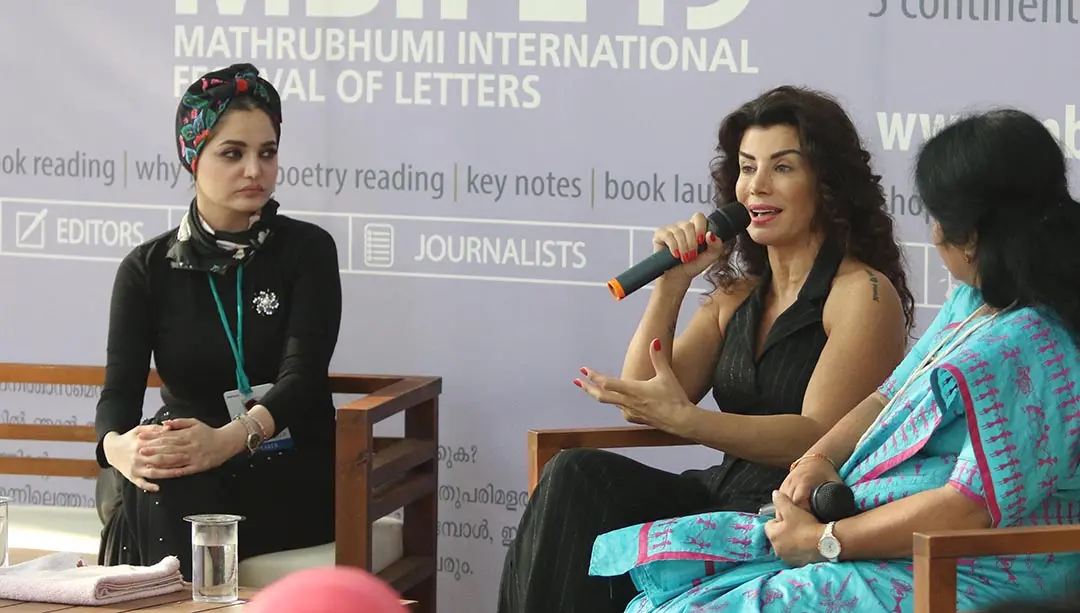
India ranks far behind when it comes to gender inequality and the session on Women and War: The life and times of Arab women caught up in regional conflicts opened up to a wide audience with Joumana Haddad from Lebanon and Shahad Al Rawi discussing on the travails of Arab women during war times. The session was moderated by Dr Meena T Pillai.
Speaking on the occasion, writer, translator, journalist, university professor and a human right activist Joumana said there is a cliché to stereo type Arab women because of the patriarchy. Women still don't have control over themselves.
Joumana started off with two kinds of wars that is waged in her country Lebanon. The war that is happening outside her home and the war that happens inside the domestic circle, within the intimate range of her own life.
She said that civil war started in her country when she was 5 years old. "When there was civil war in Beirut, everyone fought with everyone. There were 10 different wars that was happening." During times of war, the writer said that the only thing that saved her life was reading which she did as a child. She took refuge and salvation in reading.
While there was a different kind of war that was happening outside there was a war happening inside and that was discrimination towards girls by of conservative families. She has to become stronger to deal with the external as well as the internal war. Jumana says she has to confront the people to convey that she has to be strong to deal with it. Women are the biggest losers, she says.
Iraqi writer and the author of Baghdad Clock, Shahad Al Rawi, reacting to Jumana's act of reading as a form of resistance, said that living in two kinds of wars in the city of Baghdad has affected the women of the region, losing communication with the world.
Dr Meena T Pillai compared the situation of the women of the two countries to that in Kerala saying women here have a relatively safe and secure life.
Patriarchy is not the same in all places. The nature of patriarchy differs from one country to another. How does patriarchy change the time of war. Joumana said that men become harsh during war times even though it is immaterial they are in the winning or losing side. However in a war, everyone loses. The warriors resort to drugs to hide the hardship and when they come back to relieve the frustration from wars.
Education plays a large role during these critical times. Women have been trained and educated to have patience and women use their brains and imagination. Joumanna only wished there would be a world where women are equal in all respects.
Joumana also mentioned that when she was about to fly to India, her mother's piece of advice was "they rape women there, so please be beware." People choose the worst thing about a country and the country becomes that, she said.
Women are paying the price for the weakness and it happens everywhere. Joumana also stated an example in her country Lebanon, where rapist are allowed to marry the victim, thereby punishing the victim twice.
Shahad Al Rawi talked about the Yezdi women in her country and the difficulties they had to undergo. She appreciated Kerala's women's wall organised for gender equality. She vouched for financial freedom lest people will be blackmailed. Being a women itself is being different.