What is the FIFA 'Japan Curse' everyone is talking about? Viral theory explained
Every FIFA World Cup brings its own set of football superstitions. Some fans refuse to wash their lucky jerseys until their team is knocked out. Others become convinced that a particular mascot, shirt colour or even a stadium has mysterious powers.
But during the 2026 FIFA World Cup, one unusual theory captured the internet's imagination more than most.
It revolved around a curious chain of results involving Japan, and for a while, many supporters became convinced it could predict the next world champion.
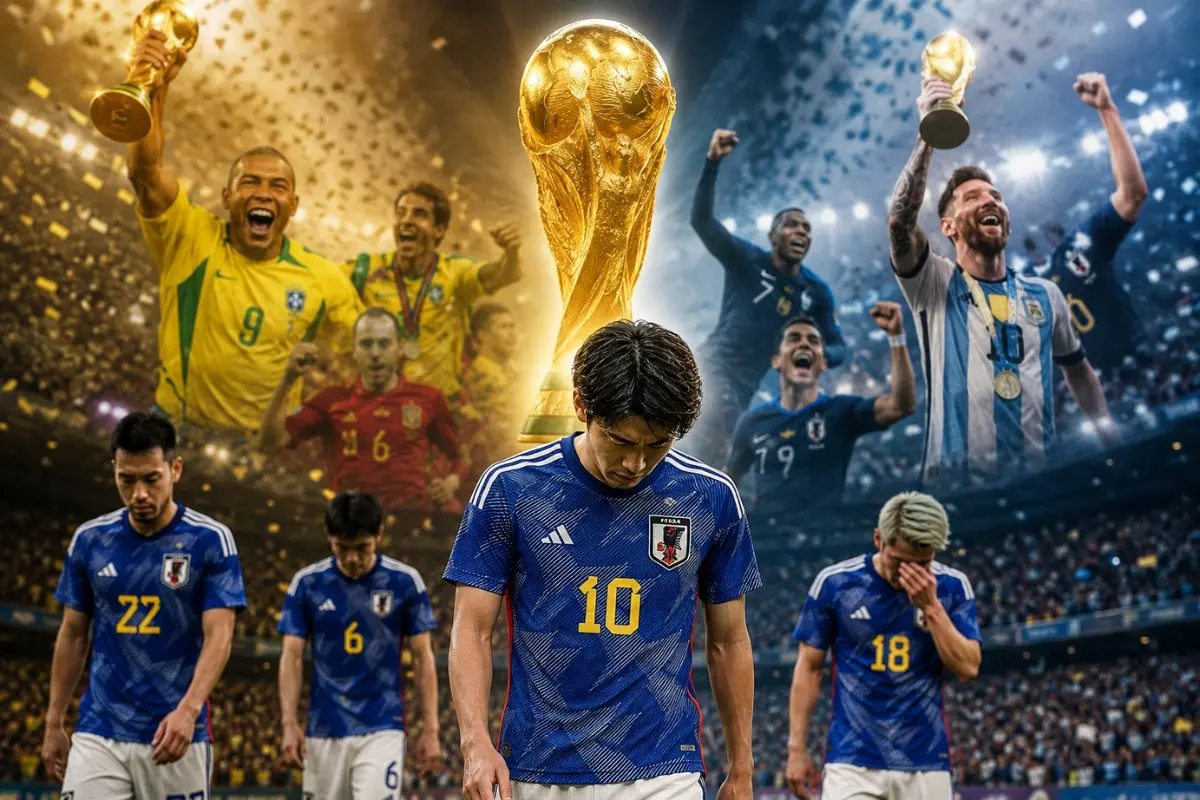
Dubbed the "Japan curse" or the "Japan pattern" by football fans online, the theory suggested that Japan's journey through the knockout stages could reveal who would eventually become world champions. It sounded bizarre, yet every World Cup since 2002 appeared to support it. It wasn't backed by science, statistics or football analysis. But it was entertaining enough that thousands of fans couldn't stop talking about it.
It started with someone spotting a strange coincidence
Unlike famous football superstitions that have existed for decades, the Japan theory wasn't invented by pundits or analysts.
It grew naturally online after supporters noticed an unusual pattern stretching across several FIFA World Cups.
Whenever Japan reached the knockout stage, the team that knocked them out never lifted the trophy themselves. Instead, that team would eventually lose to the nation that went on to become world champions.
At first, it looked like nothing more than an odd coincidence. Then it happened again. And again.
Eventually, fans began wondering whether Japan's exit had quietly become one of the tournament's strangest unofficial predictors.
The pattern that refused to go away
The story begins at the 2002 FIFA World Cup. Japan were beaten by Turkey in the Round of 16. Turkey then lost to Brazil, who went on to win the tournament.
Eight years later, Japan lost to Paraguay on penalties. Paraguay's journey ended against Spain, who eventually became world champions.
In 2018, Belgium famously came from behind to beat Japan in one of the tournament's most memorable matches. Belgium later lost to France, who lifted the trophy.
Then came Qatar in 2022. Japan pushed Croatia all the way before losing on penalties. Croatia reached the semi-finals but eventually lost to Argentina, who became world champions.
Four tournaments. The same sequence. Enough for football fans to decide that maybe this wasn't just coincidence anymore.
But what about 2006 and 2014?
If you've seen the theory online, you may have noticed two missing World Cups. That's because Japan did not reach the knockout rounds in either 2006 or 2014. Since the original pattern depends on Japan being eliminated in a knockout match, those tournaments are generally left out.Some fans have tried to make the sequence fit anyway. They point to Australia ending Japan's hopes in 2006 before Italy later defeated Australia and won the World Cup. Similar attempts have been made for 2014 by tracing Japan's group-stage exit through later knockout results.
Most supporters who discuss the "Japan curse" simply ignore those editions because the knockout chain never began.
Then Norway entered the story
The 2026 tournament gave the internet another opportunity to test the theory. Japan once again reached the Round of 32 before losing to Brazil.
A few days later, Norway stunned Brazil with a 2-1 victory in the Round of 16. That was all social media needed.
According to the pattern, Norway had now inherited Japan's strange football destiny. Suddenly, posts predicting Norway as the next world champions began appearing across Reddit, X and football forums.
For a few days, supporters joked that Erling Haaland's side had become football's chosen team, simply because history seemed to point in their direction.
England ended more than Norway's World Cup
Every superstition survives until reality gets in the way.
Norway reached the quarter-finals carrying the weight of one of football's most talked-about fan theories. Then England won.
Their 2-1 victory on 11 July did more than book a place in the semi-finals. For many supporters online, it also ended a sequence that had somehow survived more than two decades of World Cups. Within minutes, memes began circulating declaring the "Japan curse" officially broken. Others jokingly wondered if England had now inherited the pattern instead.
That's the thing about football folklore. Even when one theory dies, another usually appears before the final whistle.
Why fans love these stories
Football supporters know the difference between statistics and superstition. Nobody seriously believes Japan's knockout exit controls the fate of the World Cup.
But tournaments are long. Between matches, fans look for stories, coincidences and little pieces of trivia that make the competition even more enjoyable. That's why conversations about the World Cup often drift beyond football itself.
People debate lucky shirts. They analyse penalty shoot-out records. They remember famous curses, impossible coincidences and bizarre historical patterns that somehow refuse to disappear.
The Japan theory belongs in that category. It isn't really about Japan. It's about the fun of believing that football still has room for a little mystery.