Pakistan's nightmare! INS Vikrant's Carrier Battle Group ready for killer blow
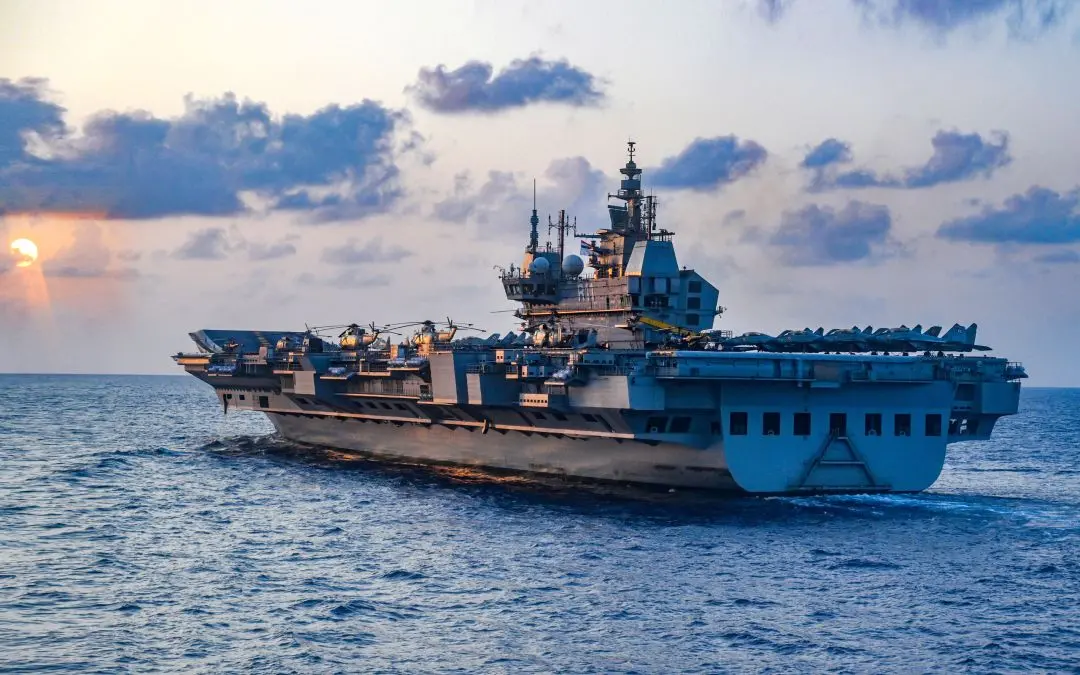
India's maritime might has suddenly become the centre of global attention -- and Pakistan's nightmare. Following the horrific Pahalgam terror attack on April 22, 2025, which killed 26 civilians, India's aircraft carrier INS Vikrant moved into the Arabian Sea, just 600–700 km from Karachi. This was not just a routine naval deployment -- it was a clear signal of strength. With Pakistan already under pressure due to domestic unrest and economic strain, this movement by India has raised serious alarms in Islamabad.
Message delivered loud and clear
India responded to the Pahalgam attack with speed and purpose. The Indus Waters Treaty was suspended. Visas were revoked. The Attari-Wagah border was shut. And most significantly, India deployed its most powerful warship -- INS Vikrant. Positioned strategically in the Arabian Sea, Vikrant could threaten Karachi, Pakistan's main port city that handles nearly 70% of its trade and 80% of oil imports. The symbolism was strong. The threat was real. And Pakistan knew it.
INS Vikrant, weighing over 45,000 tonnes, is not just a warship -- it is a statement. It carries MiG-29K fighter jets capable of striking targets over 800 km away, helicopters like Kamov-31 for airborne surveillance, and HAL Dhruv for anti-submarine missions. The carrier is also protected by Barak-8 surface-to-air missiles and advanced radars like the EL/M-2248 MF-STAR, making it a self-sufficient fortress at sea.
But what makes Vikrant truly fearsome is the Carrier Battle Group that surrounds it -- Kolkata-class destroyers, Talwar-class frigates, and Kalvari-class submarines. Together, they carry missiles that can strike deep, hard, and fast—leaving little chance for Pakistan to respond.
Missile might of Vikrant's strike group
Kalvari-Class Submarines: India's stealthy Kalvari-class submarines, including INS Kalvari and INS Vagir, are designed for silent operations. These submarines are equipped with Exocet SM-39 anti-ship missiles (range: 70 km; warhead: 165 kg). A single hit can sink a 3,000-tonne ship or destroy key port infrastructure. The submarines can also lay up to 30 naval mines, capable of blocking Karachi or Gwadar, causing massive trade disruption.
Why it matters: These submarines are difficult to detect and can stay submerged for over 20 days. If deployed during hostilities, they could choke off Pakistan’s maritime trade routes silently but effectively.
Kolkata-Class Destroyers: These warships, like INS Kolkata and INS Chennai, carry 16 BrahMos supersonic cruise missiles (range: 450 km; warhead: 300 kg) and 32 Barak-8 surface-to-air missiles (range: 90 km). BrahMos is India's most lethal missile -- fast, accurate, and deadly. A salvo can wipe out an enemy frigate or devastate port facilities.
Why it matters: These destroyers can target Pakistan's naval bases, oil depots, and warships from long distances, while the Barak-8 ensures air defence for the entire group.
Talwar-Class Frigates: Frigates like INS Talwar, INS Teg, and INS Trikand are fitted with 8 BrahMos missiles. Some older ships (like INS Trishul) may still carry 3M-54E Klub-N missiles (range: 220 km; warhead: 450 kg), which reach Mach 2.9 in their terminal stage. These ships also carry 24 Shtil-1 air defence missiles (range: 32 km).
Why it matters: These frigates are fast, stealthy, and hard to detect. Their missiles can destroy enemy ships, radar posts, and oil terminals, making them perfect for coastal strikes or support operations.
Why Pakistan is on edge
The moment INS Vikrant moved closer to Karachi, Pakistan increased naval patrols and claimed to deploy 'carrier-killer' missiles. Indian sources confirm that Vikrant returned to Karwar Naval Base by April 26, possibly to avoid escalation. But that temporary retreat doesn't reduce the threat -- it underlines India's readiness and restraint.
Pakistan's real worry is the next move. A return of Vikrant's group, supported by submarine-laid mines and a flurry of cruise missiles, could sink ships, block ports, and paralyse Karachi in hours. Pakistan's naval defences -- limited to a few aging submarines and surface ships -- cannot match this firepower.
The bigger picture
India is not just reacting to a terror attack -- it is signalling a shift. The deployment of INS Vikrant showed that India is prepared to project power beyond its shores. With Vikramaditya and other advanced platforms in reserve, India is sending a strategic message: the Arabian Sea belongs to those who can dominate it.
Pakistan's fear isn’t just about missiles -- it is about being outclassed, outgunned, and outmanoeuvred.
INS Vikrant's presence in the Arabian Sea, even briefly, has had a profound psychological and strategic impact. It reminded Pakistan -- and the world -- of India's rising maritime power. With BrahMos, Exocet, Klub-N, Barak-8, and Shtil-1 missiles at its command, the Indian Navy now holds the tools to deliver precise punishment, if provoked.
This is a moment for reflection, not retaliation. But if pushed again, India's navy has shown that it can roar louder than ever -- and strike harder than anyone expects.