Pakistan reveals it has Chinese HQ‑17AE in its inventory, but it is still no match to India's Akash-NG
In the weeks leading up to Pakistan’s Air Force Day on 7 September, a promotional video released by the Pakistan Air Force (PAF) did more than honour fallen pilots. It offered the clearest public glimpse yet of a rapidly expanding Chinese weapons ecosystem inside Pakistan -- from advanced fighter jets and long‑range air‑defence missiles to short‑range systems that appear to have arrived only in recent months. The footage, coupled with a surge in Chinese military air traffic to Pakistani bases over the summer, points to an intensified transfer of technology and hardware that is deepening Islamabad’s dependence on Beijing and altering the military balance in South Asia.
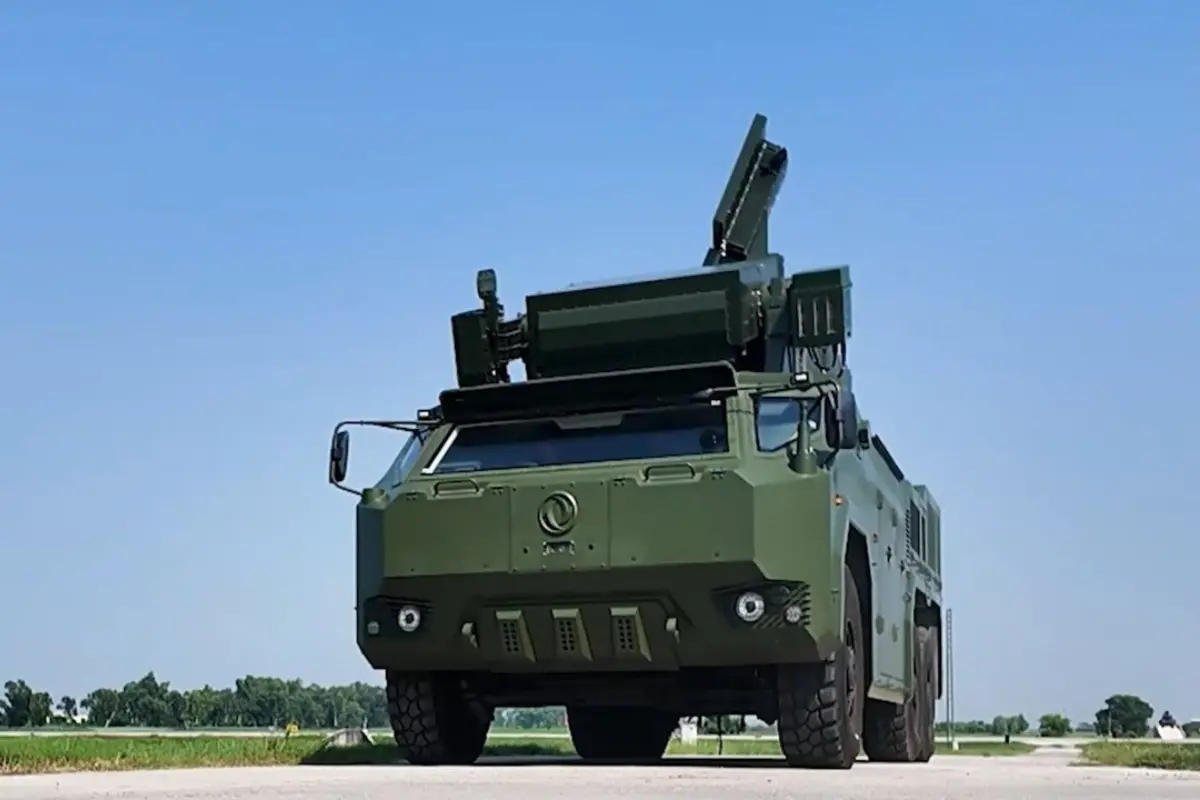
The most talked‑about frame in the PAF’s “Fizaon K Pasbaan” video lasts just 28 seconds. It shows a six‑wheeled vehicle with a large rectangular radar array, moving in formation with other air‑defence assets.
Pakistani officials did not name the system. Chinese state media and independent analysts did: it closely matches the HQ‑17AE, a mobile short‑range air‑defence (SHORAD) missile system developed by China’s CASIC.
If confirmed as in‑service, Pakistan is expected to use the HQ‑17AE to fill a critical gap in its layered air‑defence architecture. Designed to protect frontline units, air bases, command centres and high‑value assets, the system can search, track and engage targets while moving at about 25 km/h, with an engagement envelope of roughly 1.5–15/20 km in range and up to 10 km in altitude.
It is optimised against drones, cruise missiles, precision‑guided munitions, helicopters and fixed‑wing aircraft -- exactly the kinds of threats that have dominated recent India-Pakistan skirmishes.
Neither Islamabad nor Beijing has formally announced an HQ‑17AE deal. But the visual evidence, combined with Pakistan’s existing use of Chinese HQ‑9, HQ‑7 and HQ‑16 families, suggests that the system has either already been delivered or is at an advanced stage of induction.
What is the HQ‑17AE?
The HQ‑17AE is a Chinese‑made, wheeled, short‑range air‑defence (SHORAD) missile system developed by CASIC (China Aerospace Science and Industry Corporation).
It is the export variant of the HQ‑17 / Tor‑M1‑family concept: a self‑contained, all‑weather, mobile point‑defence system designed to protect high‑value assets -- air bases, command posts, armoured formations, critical infrastructure -- from low‑altitude, high‑speed threats.
The HQ‑17AE is not a strategic, long‑range system like India's S‑400 or HQ‑9. Its lethality lies in closing the inner layer of air defence. It is optimised to detect, track and engage low‑flying, fast‑moving, small‑radar‑cross‑section targets that can slip under the coverage of long‑ and medium‑range systems.
By pairing with longer‑range systems (HQ‑9BE, HQ‑16FE) and Turkish systems like KORKUT, the HQ‑17AE helps create a multi‑tiered shield: long‑range for high‑altitude, medium‑range for mid‑layer, and HQ‑17AE for the terminal, close‑in defence around key sites.
Its mobility and “search‑and‑kill on the move” capability make it particularly dangerous in a fluid battlefield, where static air‑defence sites are vulnerable to pre‑emptive strikes.
Key features and technical characteristics
Based on open‑source specifications for the HQ‑17AE and related Tor‑family systems, the main features include:
- 8×8 or 6×6 wheeled chassis carrying an integrated radar, fire‑control system and missile launcher. The entire system is self‑contained and can operate independently.
- 3D search and tracking radar capable of detecting multiple targets simultaneously, with strong performance against low‑altitude, small RCS (radar cross‑section) objects like drones and cruise missiles. Electro‑optical/infrared (EO/IR) trackers provide passive targeting and redundancy in heavy electronic‑warfare environments.
- The system can search, track and engage while moving at road speeds of around 25 km/h, allowing it to keep pace with armoured columns or relocate quickly to avoid counter‑attacks.
- Typically carries 8 ready‑to‑fire missiles in a vertical launch configuration. Missiles use high manoeuvrability and proximity/impact fuzes to destroy or disable incoming threats.
- Designed for very short reaction times -- from target detection to missile launch in a matter of seconds -- crucial for defending against sudden drone or cruise‑missile raids.
- Capable of operating in adverse weather, dust, smoke and at night, with robust resistance to electronic countermeasures.
- Engagement range of approximately 1.5 km to 15–20 km, depending on target type and variant.
- Engagement altitude of up to about 10 km, covering low to medium altitudes where most tactical air threats operate.
- Capable of engaging high‑subsonic and some supersonic targets, including manoeuvring cruise missiles and fast jets at low level.
- A typical battery (multiple launchers, command vehicle, radar, support vehicles and an initial missile load) is likely in the tens of millions of dollars range.
How is it compared to India's Akash‑NG?
India’s Akash‑NG is a newer, networked short‑range system with improved radar and missile performance, designed to counter modern threats, including manoeuvring missiles and drones.
HQ‑17AE is more directly comparable to India’s older Akash‑1S or Russian‑derived point‑defence concepts.
In a conflict scenario, HQ‑17AE would aim to protect Pakistani assets against Indian low‑level strikes, drones and stand‑off munitions. However, on pure kinematic performance (range + altitude), Akash‑NG is superior. It can engage targets farther out and higher up, giving defenders more time and a larger protective bubble.
Akash-NG has a range of roughly 25–35 km (some sources cite up to 40 km in ideal conditions). Its altitude ceiling is around 18 km, allowing it to engage targets well above the low‑level band.
Besides, Akash-NG is positioned as a short‑to‑light‑medium range system, bridging the gap between VSHORAD (like MANPADS) and medium‑range SAMs.
Even in terms of raw networking and integration with a broader IADS, Akash‑NG has the edge, given India’s push for integrated air‑defence. HQ‑17AE is very capable as a standalone or locally networked battery, but its strength is more in autonomous, rapid point defence.
While the HQ-17AE uses a phased‑array surveillance radar and a separate engagement radar capable of guiding up to 4 missiles against 4 targets simultaneously from a single launcher, Akash-NG is built around a 3D Rajendra‑class phased‑array fire‑control radar (in upgraded forms) with multi‑target tracking and engagement capability, integrated into India’s networked air‑defence architecture (linking multiple batteries, long‑range SAMs, fighters, AWACS, etc.).
Overall, in a hypothetical India-Pakistan conflict, these two systems would not really fight each other one‑on‑one; they would sit in different layers of their respective air‑defence pyramids. Akash‑NG would try to thin out incoming raids earlier and at greater range; HQ‑17AE would try to protect specific high‑value or mobile assets that manage to penetrate that outer layer. To sum up, Akash‑NG is the better short‑range area defence system, while the HQ‑17AE is, at best, a last‑ditch point defence system.