Conflicting paradigms: Seeking new direction at MBIFL 2026
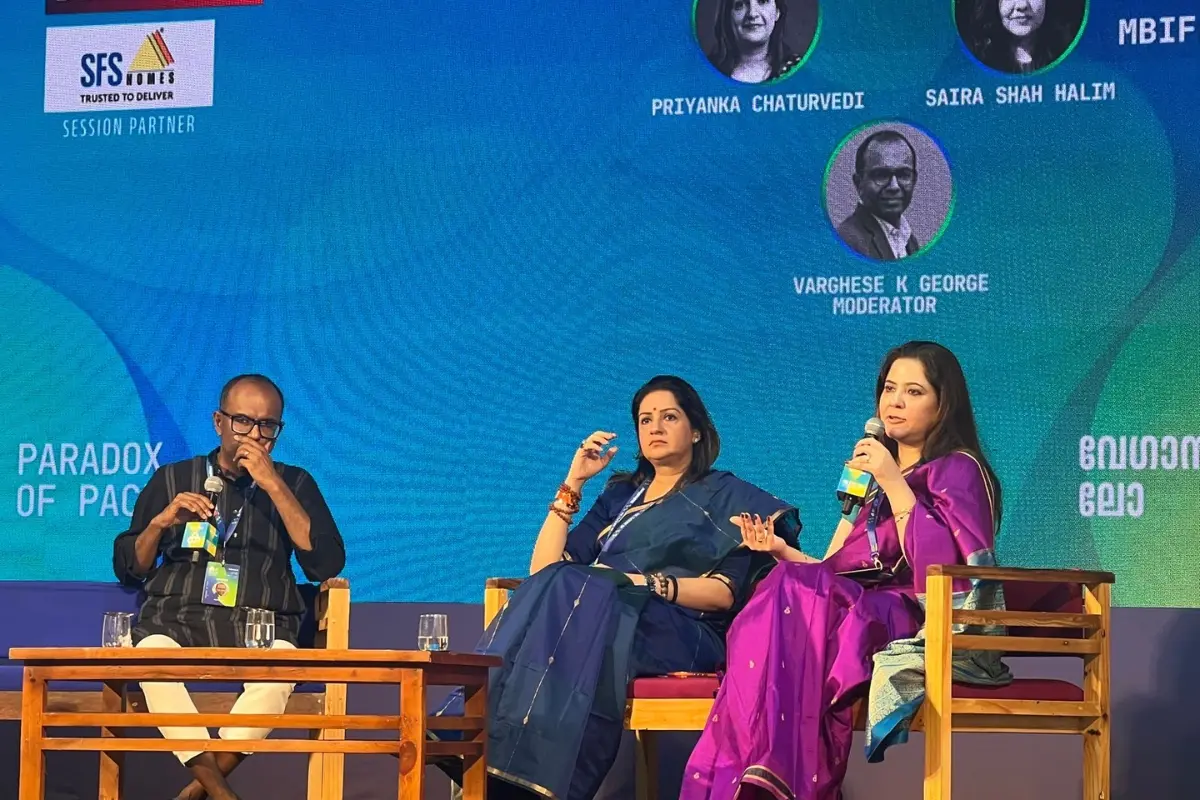
Moderated by K George, resident editor of The Hindu, the session titled Conflicting paradigms: seeking new direction brought together Priyanka Chaturvedi, Member of Parliament, Rajya Sabha, and Saira Shah, social activist, educator and writer. The discussion examined how past legacies, present realities and evolving identities intersect in today’s political landscape.
Opening the session, K George framed the discussion around conflicts of history, identity and nationhood, noting how religious, regional and national identities are being renegotiated across India.
Political evolution and regional responsibility
Responding to questions on negotiating regional and national identities, Priyanka Chaturvedi said political movements must evolve with changing public aspirations. She noted that while many parties emerged from specific historical moments, failing to respond to present-day concerns leads to political decline.
She highlighted that people in Maharashtra are increasingly focused on development, employment, environmental protection and economic stability. According to her, representing regional interests and defending constitutional values are not conflicting roles but interconnected responsibilities.
Gender, identity and courage in public life
Saira Shah addressed the idea of conflicting identities by arguing that individuals naturally inhabit multiple roles. Drawing from her experience as a corporate professional, activist, writer and political candidate, she said purposeful public life requires taking positions that may be uncomfortable.
She observed that questioning authority has increasingly become risky, with dissent often attracting punitive responses. Despite this, she argued that speaking truth to power remains essential and aligns with the festival’s theme of paradox and debate.
National versus regional political frameworks
Chaturvedi reflected on her transition from national to regional politics, noting that regional governance brings sharper accountability and local responsibility. She pointed to Maharashtra’s economic importance but also flagged concerns such as industries relocating, reduced central support and rising social pressures.
She stressed that political contribution and policy outcomes matter more than party labels, particularly when citizens expect tangible governance results.
Dissent, discomfort and constitutional values
On speaking out against prevailing narratives, Chaturvedi said she entered politics without privilege or political lineage. She explained that her interventions on issues such as medical education, UGC guidelines and discrimination were rooted in constitutional principles of equality.
She referred to Articles 14 and 15 of the Constitution to underline that justice must be universal, adding that public abuse and labelling often reveal deeper inequalities in political discourse.
Defining today’s central conflict
Addressing whether India’s key conflict lies between secularism and communalism or democracy and technology, Saira Shah asserted that the Constitution itself is unambiguous. She stated that India was never intended to be a majoritarian state and that criminalising dissent undermines democratic safeguards.
She pointed to the use of stringent laws and the detention of peaceful protesters as indicators of democratic stress, while also noting that public resistance continues to sustain democratic life.
Religion, education and inclusion
MP Priyanka Chaturvedi spoke about her education in missionary institutions, saying exposure to different belief systems fostered inclusion rather than alienation. She identified fear of intermingling across religious and cultural lines as a major contemporary conflict.
According to her, inclusion strengthens society and does not dilute individual belief systems, warning against equating cultural interaction with identity loss.
The discussion also addressed technology’s role in politics. Saira Shah described digital platforms as both empowering and dangerous, particularly due to misinformation, targeted abuse and harassment, especially against women.
She emphasised that electoral outcomes depend on governance and policy delivery rather than online narratives alone.
Audience questions and reflections
Audience members raised questions on balancing tradition with modernity and distinguishing reform from polarisation. The speakers responded by stressing constitutional frameworks, dialogue, curiosity and resistance to fear-based narratives.
Chaturvedi remarked that communities are not the problem, but authoritarian politics is, while Shah highlighted the importance of education and openness in countering division.
The MBIFL 2026 session underscored how India’s political and social conflicts are increasingly shaped by identity, technology and the limits placed on dissent. The discussion highlighted the continuing relevance of constitutional values, inclusive education and public questioning in navigating these tensions.