Kathakali maestro Vijayakumar channels Pahalgam tragedy through dance drama
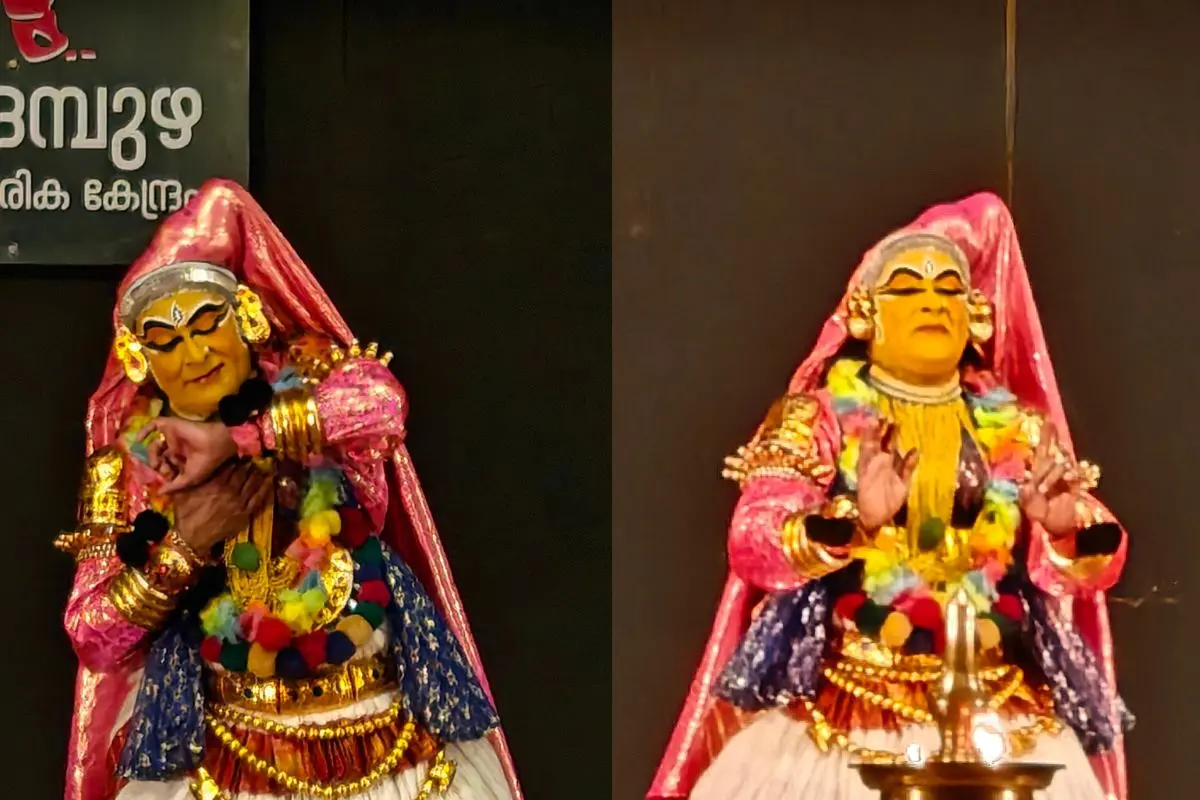
Kathakali artist Kalamandalam Vijayakumar, settled in the UK for four decades, staged a poignant solo performance in Kochi inspired by the April 22, 2025 Pahalgam terror attack. Using immortal Malayalam film songs by G Devarajan, he conveyed grief and outrage, blending tradition with contemporary resonance at Changampuzha Samskarika Kendram, Edapally.
The Changampuzha Samskarika Kendram in Edapally, Kochi, became the stage for a deeply moving artistic response to tragedy when Kalamandalam Vijayakumar performed his latest Kathakali-based work. The 45-minute solo dance drama, choreographed in the wake of the April 22, 2025 terror attack on tourists in Pahalgam, was not merely a performance but a meditation on grief, outrage, and resilience. For Vijayakumar, a Kathakali artist who has lived in the United Kingdom for over four decades, the attack was a wound that demanded expression through the language of his art.
Kathakali, with its elaborate costumes, stylised gestures, and mythological narratives, is rarely associated with contemporary events. Yet Vijayakumar chose to break convention, weaving into his choreography the shock and sorrow of the Pahalgam tragedy. His decision to incorporate four evergreen Malayalam film songs composed by the legendary G Devarajan gave the performance a unique resonance. The songs—‘Ezhu Sundara Rathrikal’ from Ashwamedham (1967), ‘Chandra Kalabham Charthi’ from Kottaram Vilkanundu (1975), ‘Manjalayil Mungi Thorthi’ from Kalithozhan, and ‘Ayiram Padasarangal Kilungi’ from Nadhi (1969)—were not simply musical accompaniments but emotional bridges. While ‘Manjalayil’ was penned by P Bhaskaran, the other three bore the lyrical genius of Vayalar Rama Varma. Together, they carried cultural memory and nostalgia, allowing audiences to connect instantly with the performance.
“Initially, I thought of composing new lyrics,” Vijayakumar explained. “But I realised that these immortal songs already hold a place in the hearts of Malayalis. They carry layers of meaning, and by recontextualising them, I could reach the audience more directly.” His choice reflected a keen understanding of Kathakali’s evolving role in society—an art form capable of absorbing and reinterpreting contemporary realities without losing its classical essence.
The performance unfolded with Vijayakumar’s mastery of abhinaya, the expressive language of Kathakali. His eyes conveyed horror and helplessness, his gestures embodied grief and rage, and his movements reflected the resilience of communities confronting violence. As the familiar strains of Devarajan’s compositions filled the hall, the audience was transported into a space where art became testimony. The juxtaposition of Kathakali’s stylised movements with film songs blurred boundaries between classical and popular, past and present, grief and resistance.
Vijayakumar’s career has long been marked by innovation and dedication. Trained at Kerala Kalamandalam under masters like Kalamandalam Vasu Pisharodi, he specialised in female roles—Damayanti, Lalitha, Devyani, Devaki—that demanded subtlety and emotional depth. In 1987, he co-founded the Kala Chethena Kathakali Company in the UK with his wife, Kalamandalam Barbara Vijayakumar. Barbara, a British-born artist, is widely recognised as the world’s first female Kathakali chutty (make-up) artist, breaking barriers in a field traditionally dominated by men. Together, they have introduced Kathakali to audiences across Europe, North America, and Australia, ensuring that the art form is seen not as an exotic relic but as a living tradition.
Their partnership has been instrumental in Kathakali’s global journey. While Vijayakumar’s performances have showcased the emotional depth of streevesham roles, Barbara’s pioneering work in chutty has expanded the scope of women’s participation in Kathakali. Their shared vision has been to preserve authenticity while making Kathakali accessible to international audiences. This commitment has earned Vijayakumar honours such as the Guru Kunchukurup Endowment Award (1995) and the V.N. Menon Memorial Award (2005).
Yet this latest work was perhaps his most personal. It was not about mythological heroines or divine battles but about ordinary people caught in extraordinary violence. By choosing Kathakali as the medium, Vijayakumar asserted that classical art can respond to contemporary crises with urgency. His performance was not a retelling of the attack but a meditation on its emotional aftermath. The songs became metaphors—the beauty of nights shattered, the moon’s radiance dimmed, the river’s music interrupted. Each line, each gesture, carried echoes of lives lost and futures disrupted.
The audience at Changampuzha Samskarika Kendram responded with silence, applause, and tears. For many, it was a reminder that Kathakali, often confined to temple festivals and cultural showcases, can also be a vehicle of social commentary. Vijayakumar’s work challenged the notion that classical arts must remain detached from contemporary realities. Instead, he demonstrated that they can amplify collective emotions, offering catharsis and solidarity.
His journey from Kerala to the UK and back to Kochi for this performance symbolised the global resonance of local tragedies. Terror attacks, though geographically specific, reverberate across borders. By staging the performance in Kerala, Vijayakumar brought the grief home, reminding audiences that violence anywhere is violence everywhere. His art became a bridge between continents, cultures, and communities, reinforcing Kathakali’s relevance in a fractured world.
Beyond the performance, Vijayakumar’s career reflects a lifelong dedication to teaching and preserving Kathakali. He has trained students at institutions like the Sandarsan Kathakali Vidyalayam in Alappuzha, nurturing the next generation of artists. His emphasis on streevesham roles has enriched Kathakali’s repertoire, highlighting the emotional depth and resilience of female characters. In his hands, Kathakali is not static but dynamic, capable of embracing new themes while honouring tradition.
The Pahalgam-inspired performance will likely be remembered as a milestone in Kathakali’s contemporary journey. It showed that classical art can be both timeless and timely, rooted in tradition yet responsive to the present. For Vijayakumar, it was a way of processing grief, of transforming outrage into art, and of reminding audiences that silence is not the only response to violence. Dance, music, and gesture can speak when words fail.
As the final strains of ‘Ayiram Padasarangal Kilungi’ faded into the night, the audience rose in ovation. The applause was not just for the artist but for the act of remembrance, for the courage to confront tragedy through art, and for the resilience of a tradition that continues to evolve. Kalamandalam Vijayakumar, with his decades of experience and his unwavering commitment to Kathakali, had once again shown that art is not a luxury but a necessity—a way of bearing witness, of healing, and of resisting despair.
The performance at Edapally was more than a cultural event. It was a statement: that Kathakali, with its centuries-old vocabulary, can still articulate the pain of today. That an artist, even after forty years abroad, can return to his roots to remind his people of their shared humanity. And that in the face of terror, art remains one of the most powerful forms of defiance.