If you’re a ‘Cockroach’, these 9 books belong on your shelf
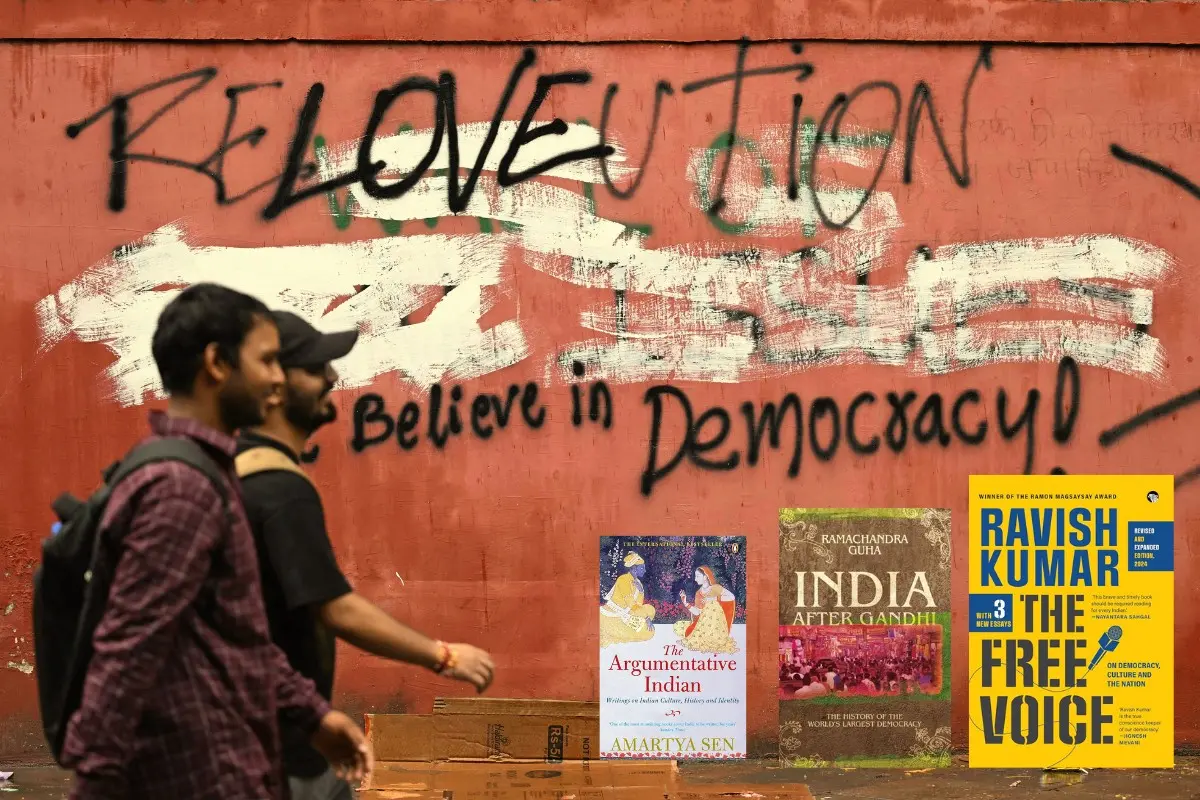
Whether you have been following the recent CJP protests closely or have only just begun reading about them, one thing quickly becomes clear; the conversations are much bigger than a single protest.
They touch on questions about democracy, the Constitution, free speech, equality, the media and the many identities that make up India.
Books cannot provide all the answers, but they can offer context. They help us understand how India has evolved, why certain debates keep returning, and how different writers have interpreted the country's journey.
The books below come from historians, economists, journalists and public intellectuals. While their viewpoints differ, each has contributed to discussions on Indian democracy, society and public life.
The Doctor and the Saint (Arundhati Roy)
Originally published as a long introduction to a new edition of BR Ambedkar's Annihilation of Caste, this book examines the contrasting ideas of Mahatma Gandhi and Dr BR Ambedkar on caste, social reform and equality. Roy revisits historical debates that continue to influence discussions on caste and justice in India today.
The book is useful for readers who want to understand why Ambedkar's writings remain central to conversations about constitutional rights and social equality. Rather than presenting a simple historical account, it encourages readers to think about how the past shapes present day debates.
India After Gandhi (Ramachandra Guha)
Often described as one of the most comprehensive histories of independent India, this book follows the country's journey from 1947 onwards. It covers elections, linguistic movements, wars, economic changes, regional politics and the challenges of holding together a nation as diverse as India.
Instead of focusing on a single political event, Guha places decades of history into one narrative, making it easier to understand how today's issues have developed over time. It is an excellent starting point for anyone interested in modern Indian history.
Listening to Grasshoppers: Field Notes on Democracy (Arundhati Roy)
This collection of essays explores themes such as democracy, nationalism, conflict and public dissent. Roy reflects on political developments in India through reportage, commentary and personal observation.
The essays were written at different points in time, which allows readers to see how public debates evolved over the years. Whether or not one agrees with her conclusions, the book offers insight into how one of India's best-known public writers interprets the relationship between citizens and the state.
The Argumentative Indian (Amartya Sen)
Nobel laureate Amartya Sen argues that debate and disagreement have long been part of India's intellectual tradition. Drawing from history, philosophy and politics, he examines how ideas of pluralism and public discussion have shaped the country.
The essays move between ancient history and contemporary society, showing that disagreement has often played an important role in Indian public life.
Readers looking to understand India's diversity beyond headlines will find plenty to think about here.
Why I Am Not a Hindu (Kancha Ilaiah Shepherd)
Published in the 1990s, this book presents Kancha Ilaiah Shepherd's critique of caste structures and social hierarchy from a Bahujan perspective. He combines autobiography with social analysis to explain how caste influences everyday life, education and opportunities.
The book has been widely discussed in academic and political circles because it introduces readers to perspectives that are often missing from mainstream narratives. It remains an important text in conversations about caste and social justice.
Everybody Loves a Good Drought (P Sainath)
Based on years of reporting from rural India, this book documents poverty, inequality and the gap between government policies and people's lived realities. Sainath travelled extensively across villages, speaking directly to communities affected by drought, unemployment and limited public services.
Rather than relying on statistics alone, he uses real stories to show how economic policies affect ordinary people. Decades after its publication, it continues to be recommended for readers interested in rural India and development.
The Free Voice: On Democracy, Culture and the Nation (Ravish Kumar)
Written by journalist and Ramon Magsaysay Award winner Ravish Kumar, this collection of essays reflects on journalism, public discourse, democratic institutions and the importance of independent media. The book discusses how fear, public conversation and the role of the press influence democratic life. A revised edition was later published with additional essays covering developments after the 2019 general election.
Readers interested in media literacy and the relationship between journalism and democracy may find this an accessible introduction to those discussions.
An Era of Darkness (Shashi Tharoor)
Also published internationally as Inglorious Empire, this book examines the economic, political and social impact of British colonial rule in India. Tharoor draws on historical records to argue that colonial policies had lasting consequences for India's economy and institutions.
The book revisits familiar chapters of Indian history while asking readers to reconsider how colonialism shaped modern India. It is particularly useful for those interested in understanding the historical background behind discussions on nationhood and identity.
India Is Broken (Ashoka Mody)
Former International Monetary Fund economist Ashoka Mody examines India's political and economic development from Independence to the present. He argues that long-standing institutional and policy challenges have affected the country's growth and democratic functioning.
The book combines economic analysis with political history, making it relevant for readers who want to understand contemporary debates through a policy lens.
These books do not all make the same arguments, nor do they represent a single viewpoint. Together, however, they explore many of the themes that appear in discussions around the CJP protests, including constitutional values, caste, democracy, free speech, journalism, history and social justice.
Reading across different disciplines and perspectives can help build a deeper understanding of the issues that continue to shape public life in India.