Dissecting the politics of caste | Book review
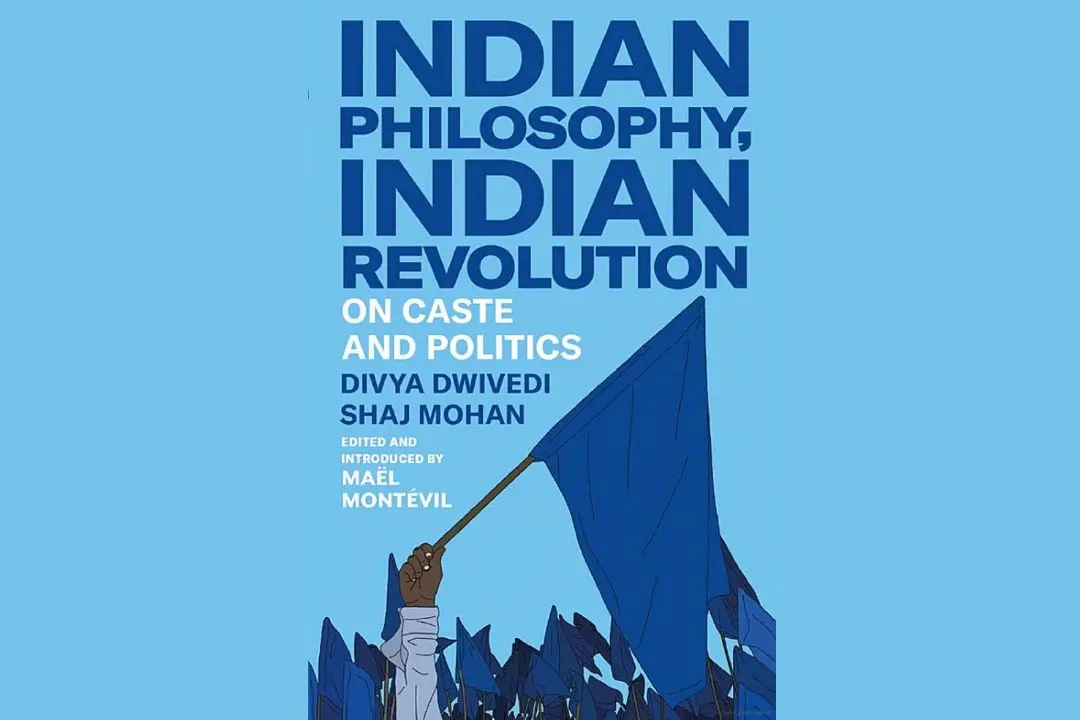
June 4 th ,2024 pronounced the public verdict of the opposition to the ongoing project of Hindu-Hindi centralisation by the upper caste supremacist regime in India. The BJP-led by Modi did not get a majority but through the alliance NDA they will form a government. The book Indian Philosophy, Indian Revolution on Caste and Politics written by Divya Dwivedi and Shaj Mohan outrightly opposes the contemporary Hindu Nationalist BJP politics. Dwivedi and Mohan call for an unambiguous rise to power in all areas of political and social life from the Dalit-Bahujan majority through an understanding of a revolutionary theory (as opposed to revisionist theories such as postcolonial or decolonial theories) of Indian politics.
The collection of essays illustrates the various nuances of the Aryan doctrine, the fault lines of postcolonial theories and its upper caste theorists (majority of whom hail from West Bengal) as well as the doctrine of upper caste supremacy in all realms of life. They expose the dominant Indian paradigms of academic research coterminous with the politics of Hindutva. They observe the hoax of the Hindu majority created recently for the purpose of majoritarian politics by the upper caste supremacists for political hegemony. The essays reveal the historical injustice meted out to Dalit-Bahujans in the country from Gandhi's times and the persisting effects of the same in contemporary Indian politics, 'The 1921 Census of India Report noted that 'No Indian is familiar with the
term 'Hindu' as applied to his religion'. In 1911, the census commissioner E. A. Gaits issued a circular with certain questions to help the census officers to determine the viability of 'Hindu' as the religion common to all those disparate groups.'(p 36). The ritualistic, endogamous caste system pervades the society through different layers. This creates a remarkable bridge between the upper Caste minority and lower caste majority in modern India; a bridge that can be opened and closed as per the convenience of the upper caste minority, as in separate lift for 'servants' in apartments.
The essays historically illustrate the emergence of these caste-based graded inequalities through a critical lens and dig out the revolutionary theory against them. It showcases the existence of the ancient oppressive caste order in new modes--university curricula which teach only upper caste myths and theories of society that suppress lower caste position in politics-achieved through the subversions and perversions of constitutional norms giving legitimacy to autocratic rule. Dwivedi and Mohan are theoretical and poetical at the same time, and through that method, they urge writers to revolt against the limits on language, including the imposition of language suited for upper caste supremacism. 'Without the aggression of language that breaks free of every holy land, we risk being embargoed into a ceremonial colony, even geographically, in the subcontinent. The writer is someone who breaks through the ceremonial idolatry and the desiccated surfaces of a tired language in order to bring new matter, be she the practitioner of fiction, history, or philosophy.'(p 30). The above-quoted text talks about the significance of a writer in producing something new to contest in a world of inequality and injustice. Dwivedi and Mohan assert that the task is not the recovery of the lost or fictive pride of upper caste supremacism, but the courageous invention of a new future through poetic-theoretic acts.
There are three aspects to the revolutionary theory announced by the very title of this book. First is that the theoretical basis for understanding Indian social and political history and its concepts are upper caste-centric, even north India-centric. Instead, the book gives a new theory of history and demonstrates this theory through the chapters. The second is that of a theory of transformation. It is given explanations and even a dictionary by the editor Maël Montévil. It shows that when societies cannot progress it is because the different parts of that society cannot work together anymore. As an example, caste discrimination means that lower caste people do not rise to top positions and prestigious jobs such as chiefs of companies and editors of publishing houses. This limits the workforce available in society. They use the word 'stasis' for this situation. There is 'criticalisation' when parts or components of society are 'worn out' and can't work together with the other parts without damaging them also. Poverty and lack of investment in education-mainly due to caste discrimination created extremely backward regions and people in India.
Third, is the theory which can recognise, analyse, and objectively find a new way for India to progress. The principle for this progress is called various names through the book by Dwivedi and Mohan-egalitarianism, people without exception, annihilation of caste, anastasis. Of these terms, anastasis is the most theoretical term. According to it, the components of Indian society are organised under the law of upper-caste supremacism. So, Dwivedi and Mohan demand that a new law- equality for all without an exception-should guide and raise all the components of society to a new mode of organisation. The tools for this process are given through the chapters, the introductions and philosophical glossary and at the end of the book by the editor Montévil. These theoretical introductions and glossaries by the editor are very valuable because the philosophical works of Dwivedi and Mohan are suppressed in India, while their importance is clear in Europe. The editorial work shows the connection between the deep philosophical and metaphysical works of the authors and their political interventions.
The narrative criticises the silencing of progressive writers in society like Perumal Murugan, Narendra Dabholkar, Gauri Lankesh, etc to the extent of terminating them literally through coercive means. The daring attempt of Dwivedi and Mohan to open up the truthful narration is applaudable in a country where all sorts of dissents are getting oppressed by means of physical assault and penal intimidation. The state machinery is being used to curtail the voices and the continuing constitutional amendments shaking the laws of caste-based reservation in a country where almost all higher posts are occupied by upper caste minorities are illustrated through the essays and the effect of which is quite reflective in the election results as well.
This book by Dwivedi and Mohan is unprecedented in the Indian academic and theoretical field and anti-caste thought. Every thoughtful and progressive Indian should read this book of revolutionary theory for a better world that we can hand over to the next generation.
( The author is a research scholar in English)