Job security of college professors in Kerala under threat with falling student enrollment
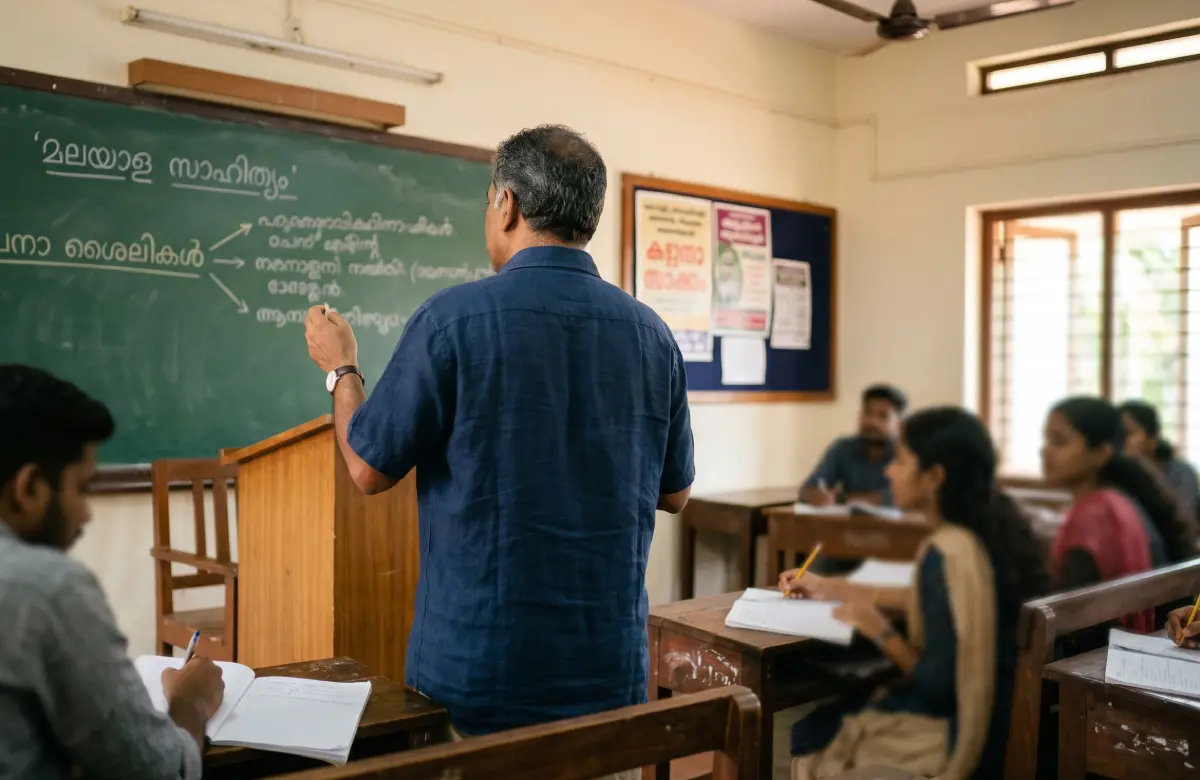
The reduction of student enrollment in the arts and science colleges of Kerala is significantly impacting the job security of more than 1,100 permanent teachers. In fact, the present conundrum in the state’s higher education sector represents a pattern that is palpable in the schools as well.
Following a UGC mandate, the government of Kerala had put forth an order in 2020 that secures permanent employment to teachers who can complete at least 16 hours of teaching in a week. Others will be provided with guest lecturer positions.
Consequently, when the government made a report in 2022, the stark reality, that 1,062 teachers were not able to complete their minimum teaching hours of 16, came into the forefront. 81 teachers from 20 subjects in government colleges and 981 teachers from 60 subjects in aided colleges showed this pattern.
The state contains a total of 218 arts and science colleges with a collection of 9,742 permanent teachers and 2,393 guest lecturers. The concerning fact is that even though the rank list of PSC college professors is available, guest lecturers are getting hired in their positions due to the non-compliance of the 16-hour teaching target.
The 2022 report pointed out that student enrolment, in the arts and science colleges, is getting reduced in subjects including Mathematics, Physics, English, Commerce and Malayalam. Mathematics teachers recorded the highest number of 16-hour teaching non-compliance cases, with a tally of 81. Similarly, the number of teachers in the list of Physics, English, Commerce and Malayalam were 81, 78, 70 and 69 respectively.
As the government is taking a favourable stance, the reduction of student enrollment might not impact the job security of teachers very negatively. However, the leaders of teachers’ organisations have noted that the colleges are facing a crisis in which numerous courses will have to be dropped in the near future.
Key Reasons for Student Enrollment Reduction
According to experts, the key reasons for the dilemma include a declining birth rate, migration, lack of job-oriented courses, limited job opportunities and a waning interest in traditional courses.