Delhi University allows four-year UG students direct entry to PhD without Master's degree
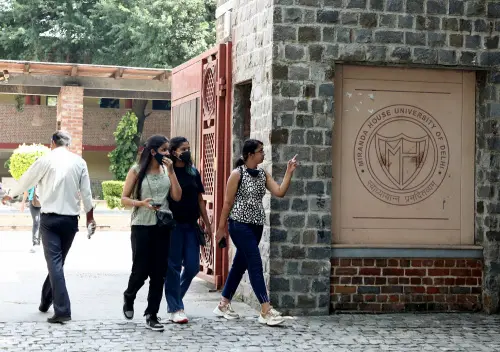
New Delhi: The University of Delhi (DU) has introduced a direct PhD admission pathway for students completing its four-year undergraduate programme (FYUP), enabling eligible graduates to enrol in doctoral programmes without completing a master’s degree.
As a special measure for the inaugural FYUP batch graduating in 2026, the university has approved direct PhD admissions for the 2026–27 academic session.
Under this provision, general category students achieving a minimum Cumulative Grade Point Average (CGPA) of 7.5, and SC/ST candidates securing at least 7.0 CGPA, are eligible to apply directly for doctoral studies.
FYUP progression and enrollment trends
DU introduced the FYUP under the Undergraduate Curriculum Framework 2022 (UGCF), aligned with the National Education Policy (NEP) 2020, starting in the 2022–23 academic session.
Out of the 75,948 students admitted that year (including those enrolled through the School of Open Learning), 40,005 opted to exit after three years in 2025. The remaining 35,943 students opted to enter the fourth year, which was structured to focus on research, entrepreneurship and alignment with global academic standards.
Alignment with NEP 2020 and research frameworks
The university reiterated that the NEP 2020 curriculum framework is designed to integrate real-world application into undergraduate studies. Skill-based modules, internships, community outreach and entrepreneurship tracks, promoted via the Udhmodya Foundation, have been incorporated across faculties, with 25 colleges establishing dedicated Skill Development Centres funded by DU.
In addition, fourth-year students selecting academic projects are required to address real-time operational or social problems as part of their mandatory research outcomes.
To formalise the direct PhD track for FYUP graduates, DU amended Ordinance VI of the University Ordinances following approvals from its Academic Council and Executive Council.
The university noted that this structural provision aligns with recommendations from senior academia, confirming that a master's degree is no longer mandatory for four-year undergraduate graduates seeking advanced research tracks.
ANI