Mathrubhumi Media School hosts "Body Lab" workshop
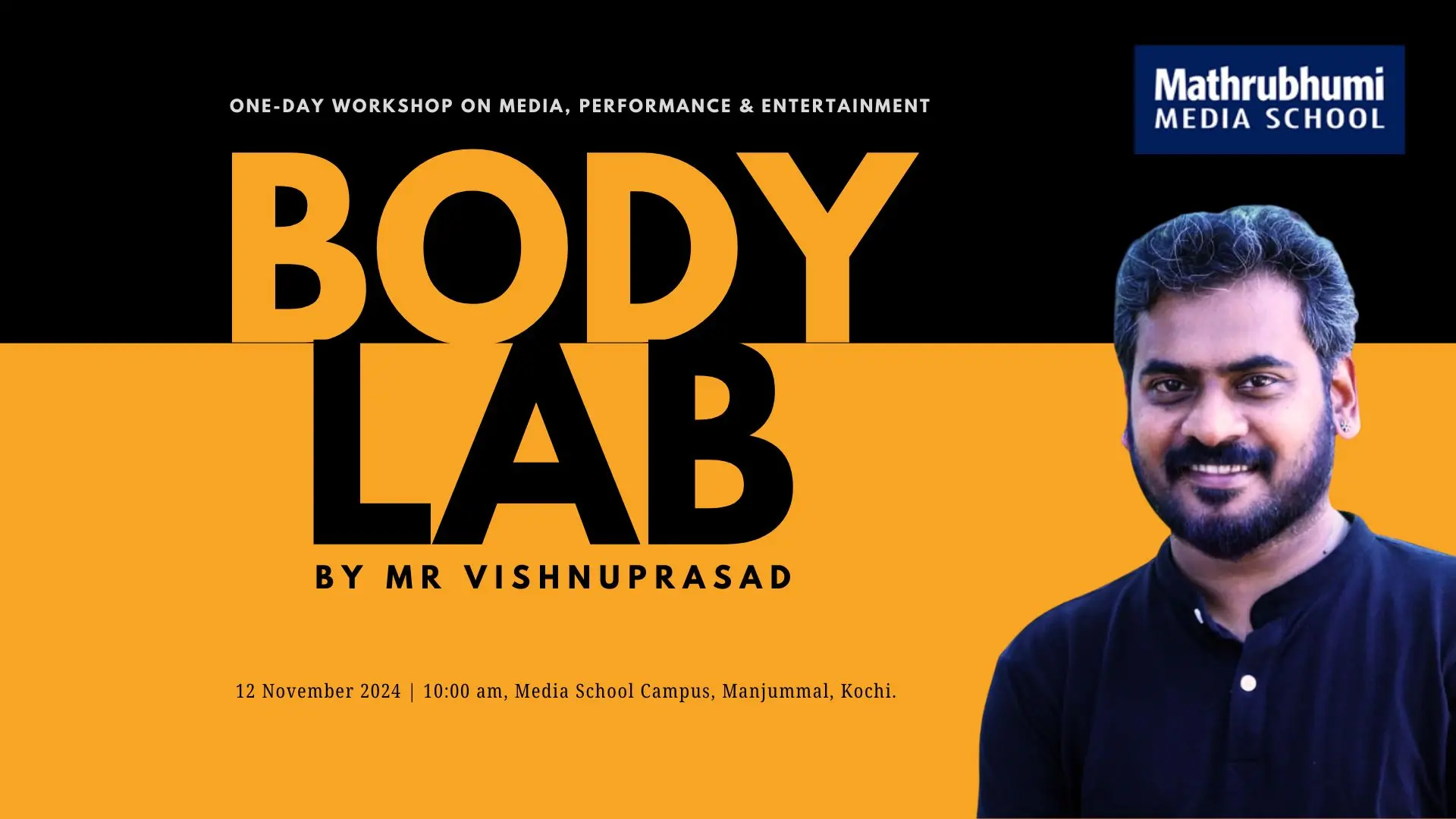
In an age dominated by screens and digital interactions, the body—our primal mode of expression—often goes unnoticed, rarely recognized for its essential role in communication. This perspective took center stage today at Mathrubhumi Media School, where poet and performance artist Dr. M R Vishnuprasad led an immersive one-day workshop titled Body Lab, drawing media and communication students into a deeper understanding of “Body, Performance, and Communication.” Held within the buzzing walls of the media school, the session provided a platform for students to tap into their inherent expressive potential, using their bodies as dynamic, communicative instruments in today’s digitized world.
The Body as a “Hyper-Absent” Medium
“Our body is a hyper-absent subject,” Dr. Vishnuprasad stated as he opened the workshop, his words capturing the underlying theme of the session. “It is an unconscious subject. Let us explore it.” With this simple yet profound statement, he invited participants to rethink the role of the body in their lives, particularly in the context of media. Vishnuprasad, known for his innovative blending of poetry and performance, believes that the human body remains an undervalued and largely invisible component of communication—one that has the potential to revolutionize how we interact and connect with others.
Drawing on his background in Theatre and Performance Studies, Dr. Vishnuprasad structured Body Lab as both a lecture and a participatory workshop, creating a balanced experience that aimed to be as educational as it was experiential. "When we communicate," he explained, "we tend to focus on words, visuals, and sounds, but the body is a powerful, overlooked communicator." The session’s design reflected this belief, offering a space for students to engage in exercises that utilized their bodies as communicative tools, beyond the traditional confines of media.
Exploring Embodied Expression Through Hands-On Exercises
Body Lab was far from a conventional workshop. It was a carefully curated blend of interactive discussions, improvisational activities, and live performances that challenged participants to use their bodies in ways they hadn’t considered before. Dr. Vishnuprasad guided them through a series of exercises that ranged from video performances to audio improvisations, encouraging students to think of their bodies as living, breathing instruments capable of conveying nuanced messages.
The participatory nature of the workshop sparked creativity and allowed students to experiment in a collaborative environment. The exercises emphasized non-verbal communication, using gestures, movement, and posture to communicate ideas and emotions. One student remarked, “This workshop made me realize that my body is not just a tool for presenting ideas but a medium through which I can express emotions and narratives in ways words can’t capture.”
According to Dr. Vishnuprasad, this immersive approach is crucial for media students, who are often trained to focus on spoken or visual media without considering the role of physical presence. “A good communicator isn’t just someone who knows how to use words effectively but someone who understands how to engage their entire being—body included—in the act of conveying a message,” he explained. By the end of the session, students were encouraged to integrate embodied expression into their media practices, gaining insight into how performance and physicality can complement and enhance traditional media forms.
Breaking Free from Traditional Media Conventions
One of the central aims of Body Lab was to challenge conventional media norms and inspire students to step outside their comfort zones. In an era where media consumption is dominated by scrolling and clicking, Dr. Vishnuprasad’s emphasis on physical presence and body-centered communication was refreshing. "Today’s media landscape has made us distant from our own bodies," he observed. "We often consume media passively, without engaging in any active physical response. I want students to break free from that pattern and understand the power of their own bodies."
To achieve this, he introduced exercises that required improvisation, collaboration, and play. Students were invited to pair up, create quick performances, and even attempt spontaneous storytelling using only physical gestures. These activities fostered a sense of freedom, allowing participants to shed the limitations of conventional media techniques and embrace a more liberated form of expression. They were encouraged to look beyond scripted communication, letting go of the need for polished words and relying instead on the spontaneous expressiveness of their bodies.
One of the highlights was an improvisational segment where students were asked to convey complex emotions solely through movement. This exercise was a revelation for many, who found that their bodies could articulate emotions as clearly as words could. "It was incredible to see how much I could convey without speaking," one participant reflected. "This session showed me that there are endless possibilities for expression beyond verbal communication."
Discovering the Power of Embodied Communication
The core of Body Lab lay in Dr. Vishnuprasad’s belief in the power of “embodied communication”—a concept that views the body as a vital medium for conveying emotions, ideas, and narratives. In this approach, the physical self becomes a central element in the act of communication, capable of delivering messages with a depth and immediacy that words alone often cannot achieve. For Vishnuprasad, who has made a name for himself with his unique poetry and performance art, embodied communication represents an essential shift in how we understand and practice media.
During the workshop, he shared insights from his own artistic journey, which has taken him to prestigious platforms like the Kochi-Muziris Biennale and the Goethe-Institut. His background in poetry and performance art provided students with a real-world example of how embodied communication can be both powerful and transformative. “My goal is to make the audience feel something real, to connect with them on a visceral level,” he shared. “I hope these students will carry that sense of connection into their own media work.”
A New Perspective on Media and Communication
For many students, Body Lab was a game-changer. Dr. Vishnuprasad’s approach to media practice was unlike anything they had encountered in their formal studies, offering a fresh perspective on what it means to communicate effectively. "The workshop made me realize that my body is more than just a vessel; it's a storyteller," one student commented. "I never considered how much my posture, gestures, and expressions could contribute to my work in the media."
This revelation was perhaps the most significant takeaway from Body Lab. Dr. Vishnuprasad encouraged students to move beyond passive communication and develop an awareness of their physical presence. "In a digital world, it’s easy to forget the importance of physicality," he noted. "But our bodies are powerful instruments, capable of expressing things that words and images cannot. In media, the body can be a tool, a subject, and a voice all at once."
The workshop’s impact was evident, with many students eager to integrate the lessons from Body Lab into their future work. The experience not only challenged their understanding of media but also provided practical strategies for using their bodies in innovative ways. Dr. Vishnuprasad’s parting words encapsulated the essence of the workshop: "Your body is more than just a passive presence—it’s a living, breathing part of your story. Use it wisely."
The workshop’s success highlights the potential of embodied communication as a valuable skill for media professionals. In a world where digital media continues to evolve, the ability to connect with audiences on a deeper, physical level may well be the next frontier in media practice. For Dr. Vishnuprasad, this workshop is just one step in a broader movement to reclaim the body’s role in communication, reminding us that, even in the age of technology, the body remains one of our most powerful tools.